
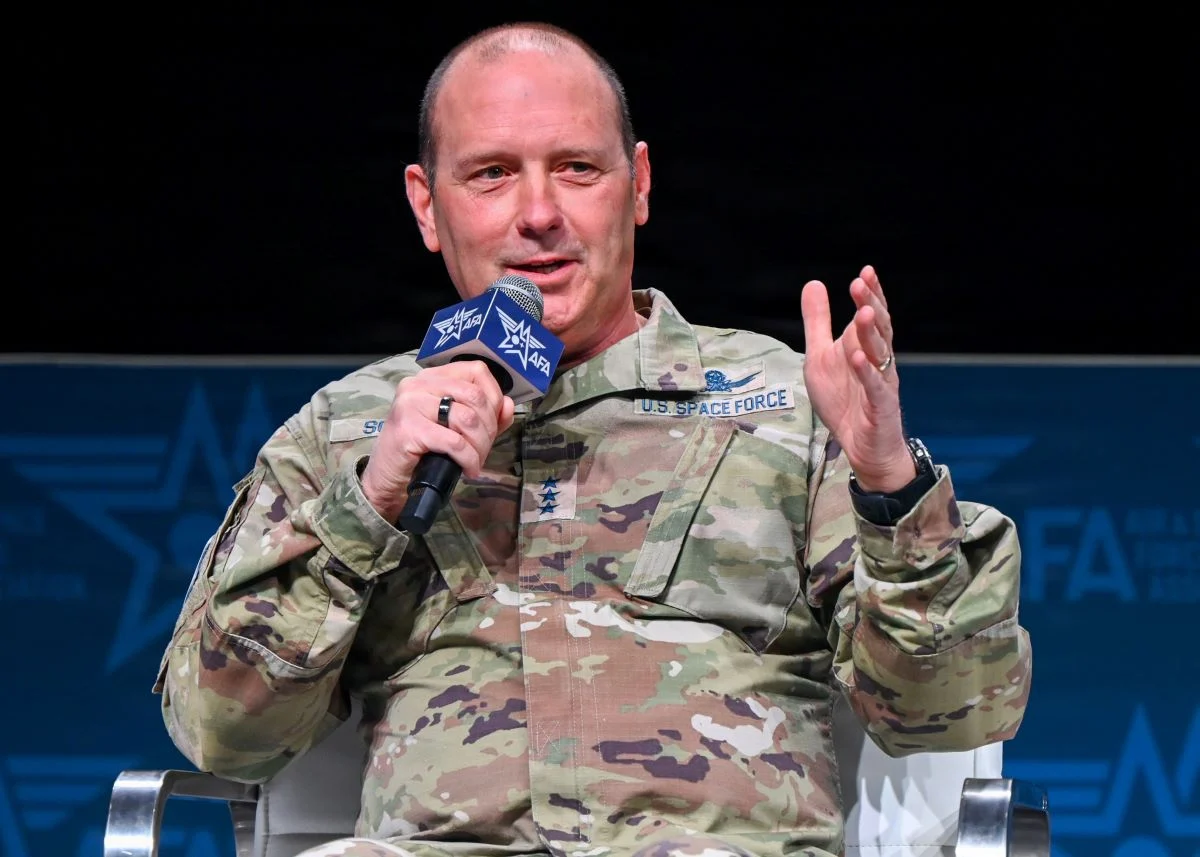

The Trump administration has officially announced the nomination of Lt. Gen. Douglas Schiess to serve as the next Chief of Space Operations (CSO), the highest-ranking uniformed officer in the United States Space Force. Pending confirmation by the U.S. Senate, Schiess will receive his fourth star and succeed Gen. B. Chance Saltzman, who has led the service through a critical period of foundational growth and the establishment of the "Competitive Endurance" doctrine. The transition comes at a pivotal moment for the Space Force as it shifts its primary focus from being a provider of satellite services to a combat-ready branch capable of conducting and winning conflicts in the orbital domain.
Lt. Gen. Schiess currently serves as the Deputy Chief of Space Operations for Operations, Cyber, and Nuclear, a role he has held since November 2023. His nomination is seen by defense analysts as a signal of continuity in the service’s aggressive modernization efforts, particularly regarding offensive and defensive capabilities designed to protect American interests in a contested space environment. Schiess brings 34 years of multi-faceted military experience to the role, having commanded at every level of space operations, from launch wings to service components of combatant commands.
A Career Defined by Operational Evolution
The trajectory of Lt. Gen. Schiess’s career reflects the evolution of the U.S. military’s approach to space. Commissioned in 1990, Schiess began his service in the Air Force, where he held foundational roles including Intercontinental Ballistic Missile (ICBM) crew commander and Global Positioning System (GPS) crew commander. These early roles provided him with a technical understanding of the two most critical pillars of U.S. strategic space power: nuclear deterrence and precision navigation.
Over the following decades, Schiess transitioned into high-level leadership positions. He served as the head of space forces for U.S. Air Forces Central Command (AFCENT) during the height of the conflict in Afghanistan, where he oversaw the integration of space-based assets into tactical ground operations. His command experience also includes a tenure as the commander of the 45th Space Wing—now restructured as Space Launch Delta 45—which is responsible for all rocket launches from the Eastern Range, including Cape Canaveral Space Force Station and Kennedy Space Center.
Prior to his current assignment at the Pentagon, Schiess served for nearly two years as the inaugural commander of U.S. Space Forces-Space (SFS-S), the service component assigned to U.S. Space Command. In this capacity, he was responsible for the day-to-day operation of space assets and the protection of the joint force from space-enabled threats. This operational depth is expected to be a cornerstone of his leadership as CSO, as the Space Force seeks to integrate more deeply with other branches of the military.
Strategic Priorities: Orbital Warfare and "More Fires"
In public statements leading up to his nomination, Lt. Gen. Schiess has been vocal about the urgent need for the Space Force to develop what he calls "orbital warfare systems." During an address in late 2025, Schiess emphasized that the era of viewing space as a sanctuary is over. He argued that the United States must be prepared to engage in active combat in orbit to protect its economy and national security.
"When it comes to orbital warfare, I need more fires," Schiess stated during a recent industry symposium. "I need the ability to deny, degrade, and disrupt our potential adversaries so that they cannot attack our forces and they cannot attack our homeland."
The term "fires" in a space context refers to a range of capabilities, from electronic warfare and jamming to directed energy and kinetic interceptors. Under Schiess’s leadership, the Space Force is expected to accelerate the development of "effectors"—systems capable of actively neutralizing enemy satellites or ground-based anti-satellite (ASAT) weapons. This represents a significant shift from the service’s historical focus on passive resilience and toward an active deterrent posture.
Enhancing Space Domain Awareness
A primary requirement for effective orbital warfare is Space Domain Awareness (SDA)—the ability to track every object in orbit and understand its intent. Schiess has identified SDA as a top priority for his potential tenure as CSO. To achieve this, he has championed several high-profile programs that are currently in development or early deployment.
Chief among these is the SILENTBARKER program, a joint venture between the Space Force and the National Reconnaissance Office (NRO). SILENTBARKER consists of a constellation of satellites designed to provide "neighborhood watch" capabilities from geosynchronous orbit (GEO). Unlike ground-based radars, these satellites can track objects in deep space with unprecedented clarity, providing early warning of suspicious maneuvers by adversary spacecraft.
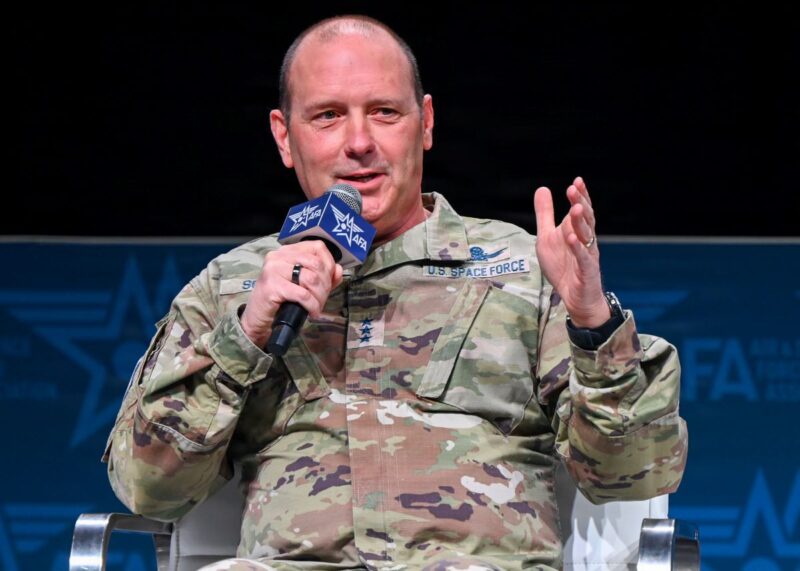
Additionally, Schiess has emphasized the importance of the Deep-Space Advanced Radar Capability (DARC), built by Northrop Grumman. DARC is a ground-based radar system that will provide 24/7, all-weather tracking of objects in deep space. By integrating data from SILENTBARKER and DARC, Schiess aims to create a comprehensive "common operating picture" that allows commanders to make real-time decisions during a conflict.
Strengthening the Commercial and Allied Ecosystem
Recognizing that the Space Force cannot maintain its technological edge through government investment alone, Lt. Gen. Schiess has been a staunch advocate for deeper integration with the private sector. He has pushed for an expansion of the Commercial Integration Cell (CIC), a platform that allows commercial satellite operators to share data and coordinate with the military.
Schiess has also called for increased data sharing between the CIC and the NRO’s commercial contractors. By leveraging the rapid innovation cycles of companies like SpaceX, Maxar, and BlackSky, the Space Force aims to build a "proliferated" architecture—one that relies on hundreds of small, inexpensive satellites rather than a few large, vulnerable ones.
On the international stage, Schiess has prioritized "burden-sharing" with U.S. allies. During the most recent Space Symposium in Colorado, he spoke extensively about the need for resilient, redundant architectures built in collaboration with partners such as the United Kingdom, Australia, Canada, Japan, and NATO allies.
"We want to make sure that, whatever we are doing together, we are building resilient architectures that can withstand some of our potential adversaries and things that they may do," Schiess told international delegates. "We want to have redundant capabilities so that we can go from one to the other, and we can work together with that."
Geopolitical Context and Potential Challenges
The nomination of Schiess comes amid rising tensions in the space domain. Both China and Russia have demonstrated advanced ASAT capabilities, including ground-launched missiles, co-orbital "stalker" satellites, and high-powered lasers. China, in particular, has rapidly expanded its space presence, launching its own space station and developing a robust architecture for Long-Range Precision Fires that depends on space-based targeting.
Analysts suggest that Schiess’s primary challenge will be balancing the need for rapid technological acquisition with the constraints of the federal budget. While the Space Force’s budget has grown steadily since its inception, it remains the smallest of the military services. Schiess will need to convince Congress that investments in orbital warfare and SDA are essential to preventing a "Space Pearl Harbor" that could cripple the American economy and military communications.
Furthermore, Schiess will need to navigate the complex organizational culture of a young service. The Space Force is currently undergoing a "re-optimization" for Great Power Competition, which involves streamlining command structures and creating new units dedicated specifically to space combat. Schiess’s experience as the inaugural commander of U.S. Space Forces-Space makes him uniquely qualified to lead this internal transformation.
Implications for the Future of the Space Force
If confirmed, Lt. Gen. Douglas Schiess will inherit a service that has successfully established its identity but now faces the daunting task of preparing for a war it hopes never to fight. His focus on "fires," SDA, and commercial integration suggests a more assertive and operationally focused Space Force.
The transition from Gen. Saltzman to Lt. Gen. Schiess is expected to be smooth, given their shared history in the service’s upper echelons. However, the "Schiess era" is likely to be defined by a shift from theory to hardware. While Saltzman spent much of his tenure defining the "why" and "how" of space power, Schiess will be tasked with delivering the "what"—the specific systems and weapons that will ensure American dominance in the final frontier.
The Senate Armed Services Committee is expected to hold confirmation hearings for Schiess in the coming weeks. Given his extensive operational background and clear strategic vision, he is expected to receive broad bipartisan support. As the global race for space supremacy intensifies, the leadership of Lt. Gen. Schiess will be instrumental in determining whether the United States can maintain its lead in the ultimate high ground.
