

The integration of autonomous AI agents into enterprise workflows has fundamentally changed how organizations interact with search engines and large-scale data retrieval, yet this shift has introduced a hidden, significant cost: the rapid exhaustion of token budgets. Modern AI agents frequently operate in recursive loops, pulling full-length logs, massive file repositories, and dense comment blocks into their context windows. In many instances, the raw volume of data retrieved far exceeds the model’s actual reasoning requirements, leading to high latency and unnecessary expenditures. As token consumption directly correlates with API costs and performance bottlenecks, developers are increasingly moving away from verbose data formats like JavaScript Object Notation (JSON) toward leaner alternatives, most notably Markdown.
The Token Problem in Agentic Workflows
To understand the scale of the challenge, one must consider the anatomy of a standard search query. A simple request—such as "find local coffee shops"—might seem trivial, but the programmatic response returned by search APIs often includes extensive metadata, tracking parameters, nested objects, and redundant schema information. When an LLM processes this data, it must tokenize every character, including the structural syntax of JSON that provides no semantic value to the reasoning process.
For an agent tasked with summarizing these results, this bloat is counterproductive. The model effectively "pays" for every curly brace, quotation mark, and metadata field. When an agent runs a multi-step search or engages in recursive query refinement, these token counts compound, potentially leading to thousands of dollars in excess costs per month for high-traffic applications. The industry has reached a tipping point where the efficiency of the data input is becoming as critical as the capability of the model itself.
Comparative Analysis: JSON vs. Markdown
The primary argument for transitioning to Markdown lies in its signal-to-noise ratio. While JSON remains the gold standard for software-to-software communication—where strict typing and machine-readability are paramount—it is often suboptimal for human-like reasoning models.
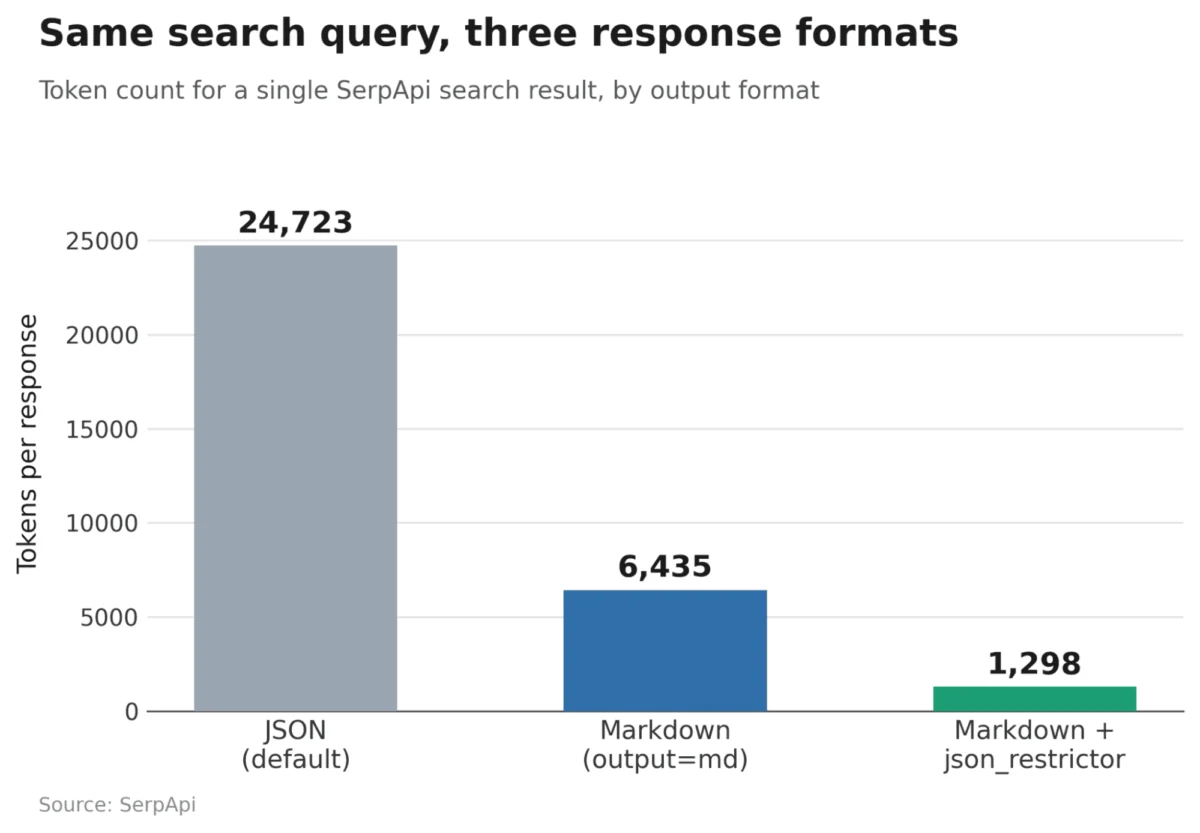
Data from recent benchmarks highlights the stark difference in efficiency. A standard search for "coffee" in a traditional JSON format may result in a payload requiring approximately 24,723 tokens. When the same search is performed using Markdown, the payload is condensed to roughly 6,435 tokens. This represents a 74 percent reduction in data volume without sacrificing the core information required by the LLM. With further filtering—such as restricting the returned fields to only the most relevant keys—that number can drop to 1,298 tokens.
This optimization is not merely about cost; it is about context window management. LLMs have finite context windows; by reducing the size of retrieved data, developers can fit more search results or longer documents into a single prompt, allowing for more comprehensive analysis and reducing the need for expensive "chunking" or multi-step summarization strategies.
The Mechanics of Data Trimming
The transition to Markdown is facilitated by the intentional removal of non-essential structural elements. In the context of search API responses, these elements typically include:
- Internal Tracking Metadata: Much of the data in search results is intended for ad-tracking or analytics, which is useless for an AI agent’s decision-making process.
- Redundant Field Definitions: JSON often repeats keys and schema definitions across nested arrays. Markdown tables and lists condense this structure.
- UI-Specific Rendering Logic: Elements designed for visual interfaces, such as specific CSS class names or icon-mapping indices, provide no value to a language model.
- Non-Semantic Formatting: While JSON requires rigid structural characters to maintain validity, Markdown uses whitespace and plain text delimiters that are significantly more token-efficient for transformer models.
Industry Implications and Strategic Shifts
The rise of Markdown as a preferred data interchange format for LLMs marks a broader trend in AI engineering: the shift toward "model-centric" data preparation. Just as developers previously optimized databases for human-readable web applications, they are now re-architecting data pipelines to suit the idiosyncratic "reading" patterns of transformer models.
Industry observers note that this shift is particularly beneficial for companies building autonomous agents for market research, real-time news monitoring, and competitive intelligence. By implementing server-side filtering, such as the json_restrictor pattern now being deployed by providers like SerpApi, developers can ensure that the AI receives only the data points it needs to execute its primary objective.
When to Maintain JSON Structures
Despite the benefits of Markdown, technical leaders emphasize that a wholesale abandonment of JSON is not a universal solution. The decision to switch must be contingent on the specific requirements of the downstream pipeline.
If a system requires high-precision mathematical operations—such as calculating average price points across thousands of products, performing currency conversions, or mapping geographic coordinates—JSON remains the superior format. Its strict schema allows for native parsing into floats, integers, and boolean arrays, which are essential for robust programmatic logic. Markdown, while human-readable and token-efficient, introduces the risk of parsing errors if the LLM is expected to extract structured data from a table into a database. The best-practice architecture, therefore, involves a bifurcated approach: using Markdown for summarization and analytical tasks, and retaining JSON for data-heavy, programmatic workflows.
Implementing Efficient Data Strategies
To mitigate token bloat, developers are increasingly adopting a "request-time" configuration strategy. By utilizing query parameters or header switches, developers can request that APIs return data in the format most appropriate for the specific task.
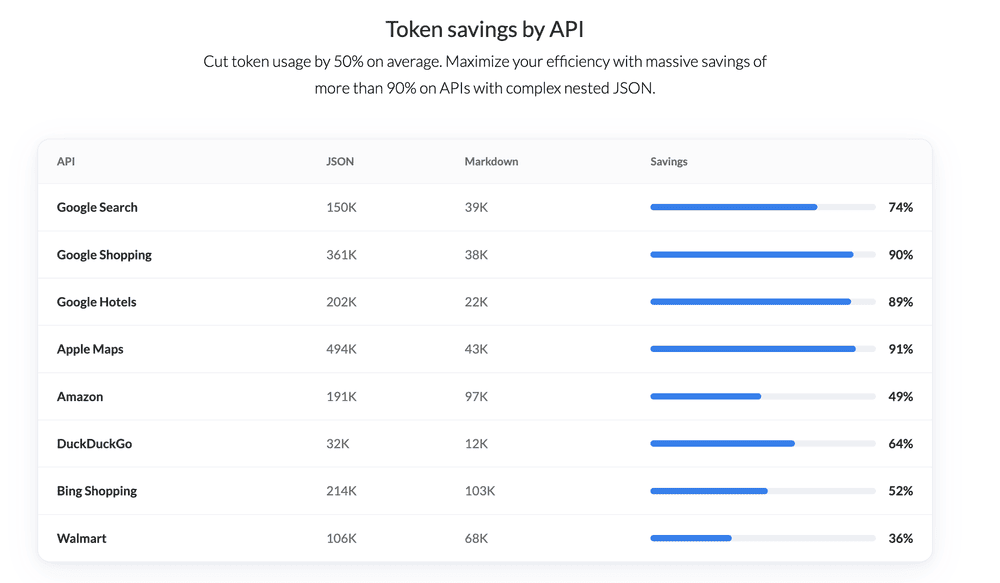
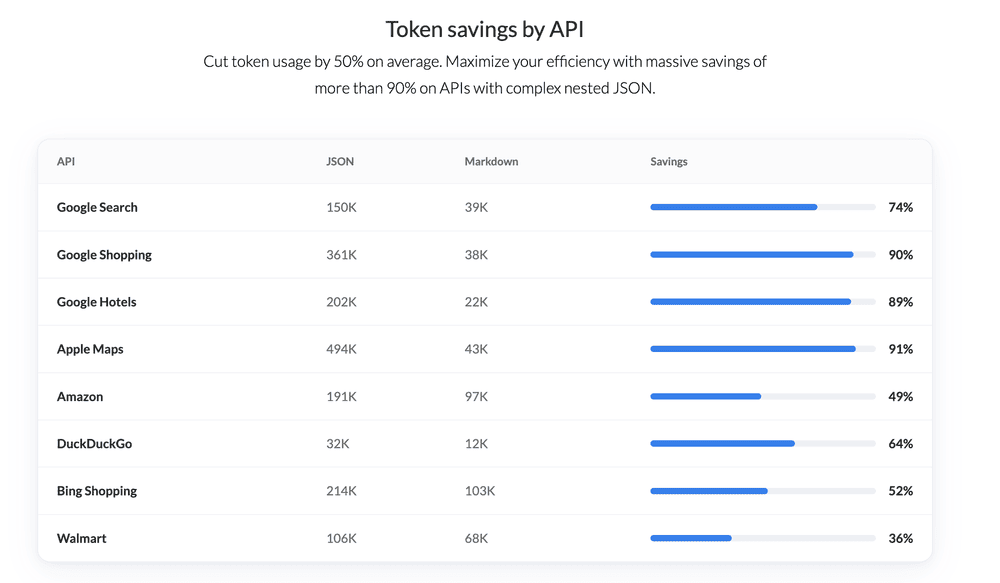
For instance, if a developer is utilizing the SerpApi ecosystem, they can now toggle between formats across more than 100 different search APIs. This allows for a modular system where an agent can request JSON for its "data gathering" phase and Markdown for its "synthesis and reporting" phase. By combining this with field-level restriction—selecting only the keys that are necessary for the model’s reasoning—developers can achieve a high level of granularity in their budget control.
Future Outlook: Token-Aware Development
As the cost of AI computation continues to be a barrier for widespread enterprise adoption, token-aware development is moving from a "nice-to-have" optimization to a core engineering requirement. The move toward Markdown is a reflection of a maturing industry that is learning to treat tokens as a finite and valuable resource.
This evolution will likely extend beyond search APIs. We are seeing a growing interest in token-efficient documentation, lightweight prompt templates, and synthetic data reduction techniques. The objective is to achieve the highest possible output quality with the lowest possible token expenditure.
Organizations that fail to optimize their data payloads face not only higher operating costs but also slower response times, which can degrade the user experience in real-time applications. Conversely, those that adopt efficient data formats like Markdown will find themselves better positioned to scale their AI operations, as they can extract more utility from every token spent.
Conclusion
The transition from JSON to Markdown for LLM input is a pragmatic response to the economic and technical constraints of current AI systems. While the change may seem like a minor adjustment in formatting, the compounding effects of a 70-plus percent reduction in token usage are substantial. As the ecosystem continues to evolve, the focus will remain on refining the interface between the vast, chaotic data of the internet and the structured, reasoning-heavy requirements of AI models. For businesses and developers looking to sustain long-term AI deployments, scrutinizing the "shape" of their data is no longer optional—it is a critical component of building scalable, cost-effective, and efficient agentic workflows. By measuring the delta between standard payloads and optimized formats, engineers can reclaim significant portions of their operational budget, ultimately freeing up resources for more advanced, value-driven AI development.
