
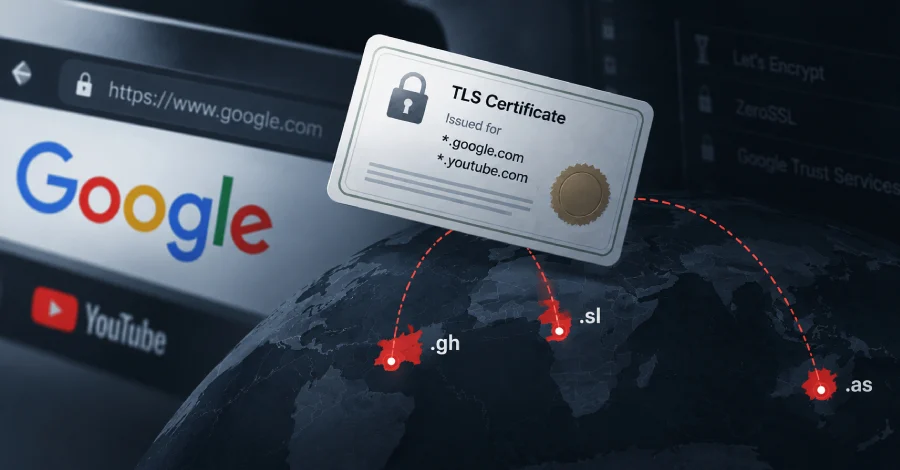

In a significant security disclosure released on October 6, Google confirmed that malicious actors successfully compromised three country-code top-level domain (ccTLD) registries, enabling the unauthorized issuance of HTTPS certificates for several Google domains. The breach, which specifically targeted the .gh (Ghana), .sl (Sierra Leone), and .as (American Samoa) domains, highlights the persistent vulnerabilities inherent in the global Domain Name System (DNS) infrastructure. While Google’s internal corporate systems remained uncompromised, the incident underscores the danger of external registry-level attacks, where attackers gain the ability to manipulate DNS records to trick certificate authorities (CAs) into issuing fraudulent encryption credentials.
The incident underscores a critical vulnerability in the trust model of the internet. By hijacking the authoritative DNS servers for these specific ccTLDs, attackers were able to redirect traffic or present themselves as the legitimate owners of these domains to automated validation services. Once they had control of the DNS records, they successfully requested domain-validated (DV) certificates from reputable Certificate Authorities, specifically Let’s Encrypt and ZeroSSL. These certificates are designed to provide encrypted, authenticated connections; however, in the hands of an attacker, they can be weaponized to perform man-in-the-middle (MITM) attacks, potentially allowing for the interception and decryption of private user data.
Chronology of the Registry Hijacks
The timeline of the attacks, as reconstructed through Certificate Transparency (CT) logs, suggests a highly coordinated effort spanning the final week of September. The attackers targeted one ccTLD registry at a time, likely to maintain operational stealth and avoid triggering bulk security alerts across multiple registries simultaneously.
The initial compromise began on September 22, when certificates were generated for various subdomains of the .gh (Ghana) namespace. This was followed on September 25 by a wider wave of activity targeting the .sl (Sierra Leone) registry, and culminated on September 27 with the compromise of the .as (American Samoa) registry. During this six-day window, at least 12 distinct certificates were issued for various Google and YouTube properties.
The speed at which these certificates were revoked provides a secondary timeline of the discovery and response phase. The two certificates issued for the .gh domain were revoked by September 26. The ZeroSSL certificate associated with the .sl registry was also revoked on September 26, while the remaining nine certificates, covering the .sl and .as namespaces, were revoked on October 1. The delay in revocation for the latter group suggests a multi-stage discovery process by Google’s security team, which reportedly identified the hijacks the week prior to their formal disclosure.
Technical Analysis of the Compromise
To understand the scope of the incident, it is necessary to examine the mechanics of the Domain Validation process. CAs like Let’s Encrypt rely on automated verification methods to ensure that an applicant possesses control over a domain. This is typically achieved by requiring the applicant to update a DNS record—a process known as a DNS-01 challenge. Because the attackers had achieved unauthorized control over the registries for .gh, .sl, and .as, they were able to inject the necessary DNS records to satisfy the CA’s validation requirements.

Once the CA verified these records, it issued certificates that were technically legitimate from a cryptographic standpoint, as the validation requirements had been met from the perspective of the issuing authority. Google has stated that there is no evidence that the CAs acted with negligence; rather, the CAs functioned exactly as designed, operating under the assumption that the DNS records provided by the registry were accurate and authorized.
The logs reveal that 11 of the 12 fraudulent certificates were issued by Let’s Encrypt, with the remaining certificate issued by ZeroSSL. This distribution is largely reflective of the widespread use of Let’s Encrypt’s automated, high-volume infrastructure. While the certificates were revoked promptly upon discovery, the existence of these records in public CT logs provides a rare window into the scale of modern DNS-based identity theft.
Implications for Global Web Security
The broader impact of this incident extends beyond Google. Google’s internal investigation indicated that several other organizations and global brands were also caught in the crossfire of these registry-level hijacks. By manipulating the authoritative DNS, the attackers were not limited to Google; they could theoretically issue certificates for any website hosted under the compromised ccTLDs.
The security implications of such an event are profound. If a malicious actor successfully intercepts traffic through an unauthorized HTTPS certificate, they can bypass the very protections that make the web secure. Users visiting a site under these conditions would see a "secure" padlock icon in their browser, unaware that the underlying encrypted connection is being terminated by an adversary.
Google’s response was multifaceted. First, they utilized "CRLSets," a mechanism within the Chrome browser that allows for the rapid distribution of certificate revocation information, bypassing the slower, standard Certificate Revocation List (CRL) or Online Certificate Status Protocol (OCSP) methods. By pushing this update to Chrome users globally, Google effectively neutralized the threat for anyone browsing through their platform. However, as Google’s own security team noted, this does not protect users on other browsers or legacy systems that may not have received or implemented similar emergency updates.
Official Responses and Best Practices
The incident has prompted renewed discussions regarding the security of registry operators. While many registrars have implemented DNSSEC (Domain Name System Security Extensions) to prevent unauthorized DNS record modification, the adoption rate among various ccTLDs remains uneven. The vulnerability of these registries is a systemic issue that the cybersecurity community has long warned about.
Let’s Encrypt, in its response to the incident, reaffirmed its commitment to security and transparency. Matthew McPherrin of Let’s Encrypt confirmed the revocation of the certificates and highlighted the importance of CT logs in identifying these unauthorized issuances. The transparency afforded by these public logs was essential in allowing Google to identify the scope of the threat and act with the necessary urgency.

For domain owners, the incident serves as a stark reminder that DNS management is a critical security layer. Google recommended that domain owners implement Certification Authority Authorization (CAA) records. A CAA record allows a domain owner to specify which CAs are permitted to issue certificates for their domain. While a CAA record cannot entirely prevent an attacker from bypassing the check if they have total control over the DNS, it adds a layer of friction and serves as a vital signal to CAs.
Furthermore, the industry is moving toward shorter lifespans for domain validation checks. The CA/Browser Forum, which governs the rules for certificate issuance, has been steadily reducing the window during which a CA can reuse a previous validation check. Currently, these checks can be valid for up to 200 days, but future standards aim to reduce this to as little as 10 days by 2029. Let’s Encrypt has already taken a proactive stance, currently capping their own validation reuse at 30 days, with plans to reduce this to seven hours by 2028.
The Challenge of Registry Security
The core of the problem remains the security posture of the registries themselves. Unlike traditional web hosting, where a business might have total control over their DNS settings, a registry is a global infrastructure provider. If a registry is compromised, the domain owners it serves are effectively powerless to prevent the resulting security failures.
The incident involving the .gh, .sl, and .as domains is not an isolated event. Over the past decade, several high-profile registry hijacks have occurred, often linked to state-sponsored actors or sophisticated cyber-criminal syndicates. These attacks serve as a reminder that the "trust chain" of the internet is only as strong as its weakest link. In this case, the weak link was not the security of the browsers or the encryption algorithms themselves, but the administrative control over the top-level domains that provide the foundation for the internet’s naming system.
As the industry moves forward, the focus will likely remain on enhancing the security of the registry-registrar-registrant chain. Increased adoption of multi-factor authentication (MFA) for domain management, more rigorous security audits for registry operators, and the universal implementation of DNSSEC are widely considered the most effective long-term solutions.
Conclusion
The successful interception of certificates for Google and YouTube serves as a high-profile wake-up call for the cybersecurity industry. While Google’s rapid response—utilizing browser-level blocks and coordinating with CAs for rapid revocation—minimized the immediate risk to the public, the incident remains a cautionary tale. It emphasizes that in an era of automated, large-scale certificate issuance, the integrity of the underlying DNS infrastructure is paramount.
As of early October, the affected domains have been secured, and strict CAA records have been implemented to ensure that only Google’s authorized certificate infrastructure can issue credentials for these specific subdomains. However, the mystery surrounding the perpetrators and the exact method of the registry compromises remains, leaving security researchers to monitor the situation closely. For the average internet user, the event reinforces the necessity of using modern, updated browsers that can handle emergency security patches in real-time, as the threat landscape continues to evolve beyond the reach of traditional defenses. The incident is a sobering reminder that while the web has become significantly more secure through the universal adoption of HTTPS, the human and administrative elements of the internet’s architecture remain the most persistent vulnerabilities.
