
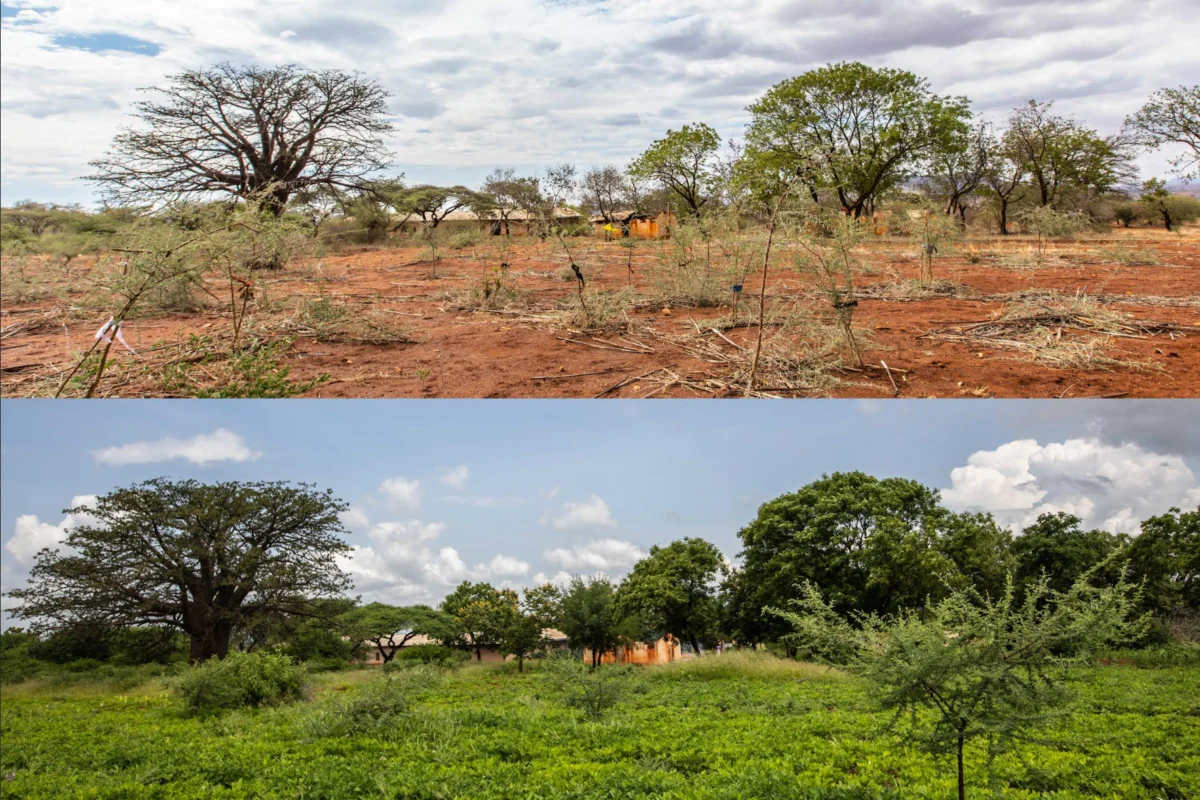

The fight against global desertification and rising temperatures has found an unlikely but powerful synergy in the drylands of East Africa, where the non-profit organization Justdiggit is blending centuries-old agricultural wisdom with cutting-edge digital infrastructure. By deploying a combination of semi-circular "bunds"—earth-moving techniques used to capture rainwater—and sophisticated artificial intelligence (AI) models, the organization has already restored approximately 500,000 hectares of degraded land across Tanzania and Kenya. This area, equivalent to roughly half of all the football pitches in the world, represents the frontline of a mission to cool the planet through nature-based solutions. As the organization sets its sights on a massive 100-million-hectare target by 2040, the integration of high-resolution satellite imagery, mobile applications, and generative AI is proving essential to scaling impact without a corresponding increase in organizational overhead.
The Convergence of Ancient Wisdom and Modern Engineering
At the heart of Justdiggit’s physical operations is a surprisingly simple intervention: the semi-circular bund. These are crescent-shaped pits dug into the parched earth, designed to capture rainwater that would otherwise wash over the hardened surface, leading to erosion and flash flooding. By slowing down the runoff, these bunds allow water to infiltrate the soil, recharging groundwater levels and providing the necessary moisture for dormant seeds to germinate.
While Justdiggit has become a primary proponent of this method in East Africa, Carl Lens, the organization’s Head of Digital Regreening, emphasizes that the technique is a legacy of traditional knowledge. The method has been utilized in West Africa for generations to combat the encroaching Sahara. By introducing these "smiles on the earth" to new geographies like Kenya and Tanzania, the organization has seen a rapid transformation of barren landscapes into lush, carbon-sequestering grasslands.
Beyond water harvesting, the organization utilizes a method known as "Treecovery," or Farmer Managed Natural Regeneration (FMNR). This technique focuses on identifying and protecting the living stumps of trees that have been previously cut down. By pruning and managing these "underground forests," smallholder farmers can bring back mature trees much faster than through traditional planting. In Tanzania alone, this program has facilitated the return of more than 23 million trees over the past six years, making it the organization’s most impactful intervention by land area.
A Chronology of Expansion: From Pilot Projects to Continental Ambition
The journey of Justdiggit reflects a broader trend in the environmental sector: the shift from localized pilot projects to data-driven, scalable ecosystems.
- Phase I: The East African Proof of Concept (2014–2018): Justdiggit began by establishing deep roots in Kenya and Tanzania, focusing on community-led bund digging. This period was defined by establishing trust with Maasai pastoralists and local farming collectives.
- Phase II: Technological Integration (2019–2022): Recognizing that physical presence alone would not meet the urgency of the climate crisis, the organization began integrating satellite data to monitor vegetation growth. This era saw the birth of "Digital Regreening," utilizing mobile technology to reach farmers beyond the reach of physical training teams.
- Phase III: AI-Driven Scaling (2023–Present): Currently, the organization is implementing AI avatars and conversational models to democratize regreening knowledge. The launch of the Kijani app ("green" in Swahili) marks a transition toward a self-service model for land restoration.
- Phase IV: The 100-Million-Hectare Goal (Target 2040): The organization’s long-term strategy involves expanding across Sub-Saharan Africa, targeting areas with the highest potential for regeneration to create a cooling effect on a continental scale.
The Role of AI and Satellite Analytics in Site Selection
One of the most significant challenges in land restoration is technical suitability. Not every landscape is conducive to bunds or Treecovery; factors such as soil composition, slope gradient, and rainfall patterns determine the success of an intervention. To solve this, Justdiggit utilizes suitability maps powered by complex algorithms. These models ingest vast datasets—including historical weather patterns, topography, and land-use data—to identify exactly where specific techniques will yield the highest return on investment.
Once a project is underway, the focus shifts to monitoring and verification. For a non-profit reliant on donor funding, proving impact is critical. Historically, manual monitoring of 500,000 hectares would have been prohibitively expensive. Today, Justdiggit employs high-resolution satellite imagery paired with custom-built AI to automate the process. These AI models can count individual bunds from space, estimate the volume of water captured, and calculate the amount of carbon sequestered by the returning vegetation. By automating these metrics, the organization provides donors with transparent, data-backed evidence of their environmental impact.
Community Adoption: The Socio-Economic Imperative
The success of nature-based solutions is inextricably linked to the people who live on the land. Justdiggit’s leadership acknowledges that without community "buy-in," restored land can quickly revert to a degraded state. If livestock are allowed to overgraze a newly regreened area before the vegetation has stabilized, the ecological gains are lost.
To prevent this, Justdiggit focuses on "intrinsic motivation." While the organization’s high-level goal is cooling the planet, the messaging delivered to local communities is focused on livelihoods. For pastoralists, regreening means more resilient grazing land for their cattle. For smallholder farmers, "Treecovery" means improved soil health, better water retention, and higher crop yields.
"It’s not something that’s externalized or far away; it’s directly impacting the livelihoods of people," Carl Lens noted. By aligning environmental restoration with economic stability, the organization ensures the long-term sustainability of its projects. This approach has led to the establishment of grazing management committees within Maasai communities, where local leaders take ownership of the restoration process, ensuring that the land is protected for future generations.
Scaling Through Digital Regreening and the Kijani App
The most ambitious component of Justdiggit’s strategy is its "Digital Regreening" initiative. The organization realized that to achieve a 100-fold increase in impact, it could not simply become a 100-times larger organization. The solution lies in the Kijani mobile app.
Kijani serves as a digital tutor, providing farmers and pastoralists with step-by-step video instructions on regreening techniques. To make this content more accessible and scalable, Justdiggit utilizes AI-generated avatars through platforms like Synthesia. These avatars can "speak" multiple languages, allowing the organization to localize educational content rapidly for different regions without the need for expensive, on-location film shoots.
Furthermore, the organization is experimenting with conversational AI. By integrating large language models (LLMs) like OpenAI’s ChatGPT through automation tools like n8n, Justdiggit aims to create an interactive experience where users can ask specific questions about their land and receive tailored advice. This "AI tutor" could potentially follow up with users, asking for updates on their progress or troubleshooting issues they encounter during the digging or pruning process.
Strategic Challenges and the Linguistic Barrier
Despite the promise of AI, significant hurdles remain. Sub-Saharan Africa is home to incredible linguistic diversity, with over 900 active languages in the regions where Justdiggit operates. While major languages like Swahili are well-supported by current AI models, many localized dialects are not.
Justdiggit is currently looking to the broader tech industry to bridge this gap. The organization does not intend to build its own language models; instead, it advocates for tech giants to expand the linguistic capabilities of existing AI. Access to localized AI would allow the Kijani app to reach the most remote and underserved populations, ensuring that the tools for climate resilience are available to those most affected by its consequences.
Analysis of Broader Environmental and Economic Implications
The Justdiggit model represents a shift in the global conservation paradigm. By moving away from "top-down" aid and toward "bottom-up" tech-enabled empowerment, the organization is addressing the root causes of land degradation.
The implications of regreening 100 million hectares are profound. Beyond the immediate sequestration of carbon, large-scale regreening can alter local microclimates. Increased vegetation leads to higher evapotranspiration, which can influence rainfall patterns and lower ambient temperatures. Economically, the restoration of degraded land is a powerful tool for poverty alleviation. According to UN data, land degradation costs the global economy trillions of dollars annually in lost ecosystem services. By reversing this trend in Africa, Justdiggit is not only cooling the planet but also fostering a "green economy" where nature-based assets provide a foundation for agricultural stability.
As Justdiggit continues to refine its AI tools and expand its digital reach, its work serves as a blueprint for how technology can be used to amplify nature’s inherent ability to heal. The organization’s journey from digging holes in the ground to deploying AI avatars in the cloud demonstrates that the solution to the climate crisis may lie in a perfect balance of the physical and the digital, the ancient and the modern.
