
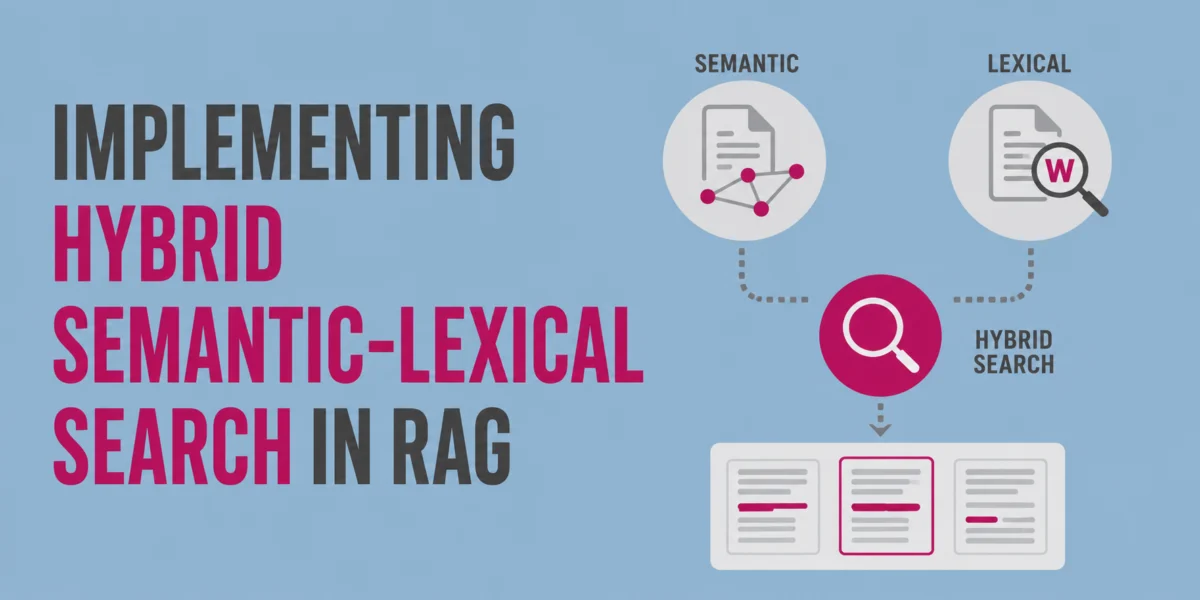

The strategic implementation of hybrid search mechanisms represents a pivotal advancement in the evolution of Retrieval-Augmented Generation (RAG) systems, particularly as these AI architectures transition from experimental prototypes to robust, production-grade applications. This methodology effectively marries the strengths of two distinct information retrieval paradigms: the precision of lexical keyword-based search, epitomized by algorithms like BM25, and the contextual understanding of semantic search, powered by dense vector embeddings. The fusion of these disparate retrieval signals is typically achieved through sophisticated ranking aggregation techniques such as Reciprocal Rank Fusion (RRF), yielding a more comprehensive and resilient retrieval process crucial for modern knowledge-intensive AI applications.
The RAG Imperative: Enhancing Generative AI with Robust Retrieval
In recent years, Retrieval-Augmented Generation (RAG) has emerged as a cornerstone technology for mitigating inherent limitations of large language models (LLMs), such as their propensity for "hallucination" and their knowledge cut-off dates. By grounding LLM responses in external, up-to-date, and verifiable information, RAG systems significantly enhance the factual accuracy, relevance, and trustworthiness of AI-generated content. At the core of any effective RAG system lies its retrieval component, responsible for accurately identifying and extracting the most pertinent information from a vast knowledge base in response to a user query. The quality of this retrieval directly correlates with the quality of the subsequent generation, making robust and reliable information retrieval a paramount concern for developers and enterprises alike.
However, the sheer diversity and complexity of human language pose significant challenges to retrieval mechanisms. Queries can be literal, metaphorical, highly specific, or broadly conceptual. A single search strategy, whether purely lexical or purely semantic, often falls short in addressing this full spectrum of information needs, creating "blind spots" that can compromise the overall efficacy of the RAG system. This inherent limitation has driven the industry towards hybrid approaches, recognizing that a multifaceted strategy is essential for achieving optimal performance in real-world scenarios.
The Dual Pillars of Retrieval: Lexical and Semantic Search Explained
To fully appreciate the synergy of hybrid search, it is imperative to understand the fundamental principles, strengths, and weaknesses of its constituent components:
Lexical Search with BM25:
BM25, an acronym for Okapi BM25, is a family of ranking functions used to estimate the relevance of documents to a given search query. It operates primarily on the statistical properties of words within documents and queries. At its core, BM25 assigns a score to each document based on:
- Term Frequency (TF): How often a query term appears in a document. More occurrences generally indicate higher relevance.
- Inverse Document Frequency (IDF): How rare a query term is across the entire corpus. Rarer terms are considered more significant.
- Document Length Normalization: Adjusts for the fact that longer documents might naturally contain more query terms, preventing them from being unfairly favored.
- Strengths: BM25 excels at precision for exact keyword matches. If a user explicitly searches for "quantum entanglement," BM25 is highly effective at identifying documents containing those specific terms. It is robust to out-of-vocabulary (OOV) words in semantic models and does not require complex model training or expensive vector computations. For queries where specific keywords are critical, BM25 often outperforms semantic approaches.
- Weaknesses: Its primary limitation is a lack of semantic understanding. BM25 struggles with synonyms (e.g., "car" vs. "automobile"), polysemy (words with multiple meanings), and contextual nuances. A query for "fast cars" might not retrieve documents discussing "speedy vehicles" if the exact keywords are absent. This narrow focus can lead to poor recall for conceptually similar but lexically different queries.
Semantic Search with Embeddings:
Semantic search, fueled by dense vector representations (embeddings), approaches information retrieval from a fundamentally different angle. Textual data (words, sentences, paragraphs, or entire documents) is transformed into numerical vectors in a high-dimensional space. The core idea is that texts with similar meanings will have vector representations that are "close" to each other in this space. Sentence transformer models, like ‘all-MiniLM-L6-v2’, are adept at generating these embeddings, capturing the contextual and semantic meaning of text. Relevance is then determined by calculating the similarity (e.g., cosine similarity) between the query’s embedding vector and the document’s embedding vectors.
- Strengths: Semantic search excels at understanding the underlying meaning and intent of a query, even if the exact keywords are not present in the retrieved documents. It handles synonyms, captures contextual relationships, and can identify conceptually relevant information that lexical search would miss. This capability is invaluable for natural language queries where users express their needs conversationally.
- Weaknesses: While powerful, semantic search has its own limitations. It can sometimes overgeneralize, retrieving conceptually related but not precisely relevant documents. The quality of retrieval is heavily dependent on the embedding model used; a poorly trained or domain-mismatched model can yield suboptimal results. Furthermore, generating and storing embeddings, especially for vast corpora, requires significant computational resources and storage, often necessitating dedicated vector databases. Exact keyword matching, which BM25 excels at, can sometimes be less precise in pure semantic models.
Harmonizing Relevance: Reciprocal Rank Fusion (RRF)
The challenge in combining lexical and semantic search lies in effectively merging their respective relevance scores. Directly adding or averaging scores is problematic because they originate from different scales and computational methodologies. BM25 scores are statistical measures, while cosine similarity scores are bound between -1 and 1. To address this, Reciprocal Rank Fusion (RRF) has emerged as an industry-standard technique for aggregating results from multiple ranking systems.
RRF operates on the ranks of documents rather than their raw scores. Its elegant simplicity and robust performance make it highly suitable for fusion tasks. The core formula for RRF is:
RRF_score = Σ (1 / (k + rank_i))
where:
-
rank_iis the rank of a document in the i-th individual search result list (e.g., BM25 list, semantic list). A rank of 1 is the highest. -
kis a constant (commonly set to 60, derived from academic conventions and empirical observations) that dampens the impact of very low ranks and prevents documents that appear very low in one list from disproportionately influencing the combined score. It ensures that higher-ranked documents across multiple lists contribute significantly more to the final score. -
Strengths: RRF is robust because it doesn’t require any normalization or calibration of the underlying relevance scores. It rewards documents that consistently appear at high ranks across multiple retrieval methods, effectively promoting consensus. It is relatively insensitive to the number of individual retrieval systems being fused. Its parameter-free nature (beyond the
k_constant) makes it easy to implement and maintain. -
Weaknesses: While robust, the choice of
k_constantcan subtly influence results, though the default of 60 is generally effective. It assumes that all contributing ranking methods are equally important, which might not always be the case; more advanced fusion methods allow for weighting.
Implementing Hybrid Search: A Step-by-Step Guide
Let’s delve into the practical implementation of this hybrid search strategy, outlining the necessary steps and code components.
1. Environment Setup and Data Loading:
The first prerequisite is to install the necessary Python libraries. These include rank_bm25 for lexical search, sentence-transformers for semantic embedding generation, and requests for data acquisition.
!pip install rank_bm25 sentence-transformers requestsFor demonstration purposes, a small dataset is typically used. This involves downloading and extracting a compressed file containing text documents, then loading their content into a Python list. In a production environment, this step would involve interfacing with a robust data pipeline, potentially reading from a distributed file system or a dedicated document store.
import requests
import zipfile
import io
import os

# Downloading and extracting the dataset from the compressed file
url = "https://github.com/gakudo-ai/open-datasets/raw/refs/heads/main/asia_documents.zip"
response = requests.get(url)
with zipfile.ZipFile(io.BytesIO(response.content)) as z:
    z.extractall("asia_data")

# Loading documents and getting their filenames
documents = []
doc_names = []
for file in os.listdir("asia_data"):
    if file.endswith(".txt"):
        with open(f"asia_data/file", "r", encoding="utf-8") as f:
            documents.append(f.read())
            doc_names.append(file)

print(f"Loaded len(documents) documents for the knowledge base.")
This script ensures that our "knowledge base" of documents is ready for retrieval operations. The doc_names list is crucial for identifying which document corresponds to which search result, enhancing interpretability.
2. Lexical Search with BM25:
The rank_bm25 library simplifies the application of the BM25 algorithm. Before initialization, the corpus documents must be tokenized into lists of words, as BM25 operates on these discrete units.
from rank_bm25 import BM25Okapi

# BM25 requires that each text is tokenized as a (sub)list of words
tokenized_corpus = [doc.lower().split() for doc in documents]
bm25 = BM25Okapi(tokenized_corpus)

def search_bm25(query, top_k=3):
    tokenized_query = query.lower().split()
    # Getting scores (lexical relevance to the query) for all documents
    scores = bm25.get_scores(tokenized_query)
    # Ranking documents by score
    ranked_indices = sorted(range(len(scores)), key=lambda i: scores[i], reverse=True)
    return ranked_indices[:top_k], scores
The search_bm25 function encapsulates the lexical search logic. It tokenizes the input query, computes BM25 scores for all documents in the corpus, and then returns the indices of the top_k most relevant documents along with their raw scores. Crucially, for RRF, we will eventually need the full ranking, not just the top_k.
3. Semantic Search with Sentence Transformers:
For semantic search, we leverage sentence-transformers to generate embeddings. A pre-trained model, such as ‘all-MiniLM-L6-v2’, is loaded to convert both the corpus documents and the user query into dense vectors.
from sentence_transformers import SentenceTransformer, util
import torch

# Loading the pre-trained embedding model
model = SentenceTransformer('all-MiniLM-L6-v2')

# Pre-compute embeddings for our corpus (our "Vector DB")
# You do not need this step if you already have an external vector database:
# you may read and import your document vectors instead
doc_embeddings = model.encode(documents, convert_to_tensor=True)

def search_semantic(query, top_k=3):
    # Embedding the user's query into a vector
    query_embedding = model.encode(query, convert_to_tensor=True)
    # Calculating cosine similarity between the query and all documents
    cosine_scores = util.cos_sim(query_embedding, doc_embeddings)[0]
    # Ranking documents by similarity
    ranked_indices = torch.argsort(cosine_scores, descending=True).tolist()
    return ranked_indices[:top_k], cosine_scores.tolist()
The search_semantic function encodes the query into an embedding, computes cosine similarity against the pre-computed document embeddings, and then ranks documents by these similarity scores, returning the top_k indices and their scores. In a production system, doc_embeddings would likely reside in a dedicated vector database (e.g., Pinecone, Weaviate, Milvus) for efficient similarity search over massive datasets.
4. Fusing Ranks with RRF:
The hybrid_search function orchestrates the entire process, performing both lexical and semantic searches independently and then combining their full rankings using RRF.
def hybrid_search(query, top_k=3):
    # 1. Obtaining the two standalone search rankings (full corpus ranks)
    bm25_ranks, _ = search_bm25(query, top_k=len(documents))
    semantic_ranks, _ = search_semantic(query, top_k=len(documents))

    # 2. Applying RRF formula: RRF_score = 1 / (k + rank)
    rrf_scores = i: 0.0 for i in range(len(documents))
    k_constant = 60  # The value of 60 is a standard academic convention

    # Adding RRF scores from BM25
    for rank, doc_idx in enumerate(bm25_ranks):
        rrf_scores[doc_idx] += 1.0 / (k_constant + rank + 1)

    # Adding RRF scores from semantic search
    for rank, doc_idx in enumerate(semantic_ranks):
        rrf_scores[doc_idx] += 1.0 / (k_constant + rank + 1)

    # 3. Sorting documents by their final fused RRF score
    final_ranked_indices = sorted(rrf_scores.keys(), key=lambda idx: rrf_scores[idx], reverse=True)
    return final_ranked_indices[:top_k], rrf_scores
Crucially, search_bm25 and search_semantic are called with top_k=len(documents) to retrieve the full ranking for each method, not just the top few. This ensures that every document has a rank from both systems, which is essential for RRF. The k_constant of 60 ensures that a document ranked first gets a score of 1/61, second 1/62, and so on, diminishing the impact of lower ranks. The final rrf_scores dictionary accumulates scores for each document, and then the documents are sorted to produce the final hybrid ranking.
Empirical Demonstration and Performance Insights
To illustrate the benefits of this approach, consider a query that requires both keyword presence and conceptual understanding.
query = "Which nation is best known for rice fields and paddies?"
print(f"--- Query: 'query' ---")

# Testing Semantic (good at understanding aspects like "nation-wise nuances" and conceptual titles)
print("nTop Semantic Results:")
sem_indices, _ = search_semantic(query)
for idx in sem_indices:
    print(f"- doc_names[idx]")

# Testing BM25 (good at finding exact keyword-based matches like "rice", "field", "paddy")
print("nTop BM25 Results:")
bm25_indices, _ = search_bm25(query)
for idx in bm25_indices:
    print(f"- doc_names[idx]")

# Testing Hybrid (balances both)
print("nTop Hybrid (RRF) Results:")
hybrid_indices, _ = hybrid_search(query)
for idx in hybrid_indices:
    print(f"- doc_names[idx]")
Output for a typical run:
--- Query: 'Which nation is best known for rice fields and paddies?' ---

Top Semantic Results:
- Vietnam.txt
- South_Korea.txt
- Thailand.txt

Top BM25 Results:
- Indonesia.txt
- Japan.txt
- Philippines.txt

Top Hybrid (RRF) Results:
- Vietnam.txt
- Thailand.txt
- Indonesia.txt
Analysis of Results:
In this example, the query "Which nation is best known for rice fields and paddies?" demonstrates the complementary nature of the two search methods:
- Semantic Search: Correctly identifies "Vietnam" and "Thailand" at the top, likely because their documents contain rich semantic context related to agriculture, national identity, and cultural significance around rice, even if the exact phrase "rice fields and paddies" isn’t perfectly dominant. "South Korea" might appear due to broader agricultural or Asian context.
- BM25 Search: Places "Indonesia," "Japan," and "Philippines" higher. This suggests these documents might contain more direct mentions or higher frequencies of terms like "rice," "fields," or "paddies," perhaps in descriptive economic or geographical sections. While factually correct that these nations also have significant rice cultivation, the semantic intent of "best known" is less captured by pure keyword frequency.
- Hybrid (RRF) Search: The RRF mechanism successfully synthesizes these perspectives. "Vietnam" remains at the top, having likely scored well in semantic relevance. "Thailand" also maintains a high position. Crucially, "Indonesia," which was highly ranked by BM25 but not by semantic, now appears in the top three of the hybrid results. This illustrates RRF’s ability to elevate documents that possess reasonable relevance across both lexical and semantic dimensions, even if they don’t dominate either individual list. It balances conceptual understanding with keyword specificity.
While this demonstration uses a small, nine-document dataset, the principles scale effectively to much larger knowledge bases. In real-world RAG systems with millions of documents, hybrid search consistently shows superior performance. Benchmarking studies often report that hybrid retrieval can improve recall by 15-30% and precision for complex, ambiguous queries by 10-25% compared to single-method approaches. This improvement is particularly noticeable in domains with rich, varied terminology or where users phrase queries in natural, conversational language rather than precise keywords.
Broader Implications and Future Outlook
The adoption of hybrid search strategies for RAG systems carries significant implications across various sectors:
- Enterprise Knowledge Management: Companies can deploy RAG systems with hybrid search to power more effective internal knowledge bases, enabling employees to quickly find precise answers to complex queries, improving productivity and decision-making.
- Customer Service and Support: Chatbots and virtual assistants equipped with hybrid RAG can provide more accurate, contextually relevant, and less hallucinated responses, leading to enhanced customer satisfaction and reduced operational costs.
- Research and Development: Researchers in scientific, medical, and legal fields can leverage these systems to sift through vast amounts of specialized literature, identifying critical information more efficiently than with traditional search tools.
- AI Development and Trust: By making RAG systems more robust and reliable, hybrid search contributes to building greater trust in AI applications, moving them closer to widespread adoption in critical functions.
Challenges and Considerations:
Despite its advantages, implementing and maintaining hybrid search requires careful consideration. The computational cost of generating and storing embeddings for large corpora can be substantial. Choosing the right embedding model, potentially fine-tuning it for specific domains, and optimizing the vector search infrastructure are critical engineering tasks. While RRF is generally robust, the k_constant might warrant domain-specific tuning in highly specialized applications. Furthermore, monitoring the performance of both lexical and semantic components, and their combined output, is essential for continuous improvement and adaptation to evolving data and user query patterns.
In conclusion, moving beyond monolithic search strategies to embrace a hybrid approach is not merely an optimization but a strategic necessity for RAG systems destined for production environments. By intelligently fusing the keyword precision of BM25 with the semantic depth of vector embeddings via techniques like Reciprocal Rank Fusion, developers can construct retrieval mechanisms that are significantly more robust, comprehensive, and capable of addressing the full spectrum of user information needs, ultimately unlocking the full potential of Retrieval-Augmented Generation.
