

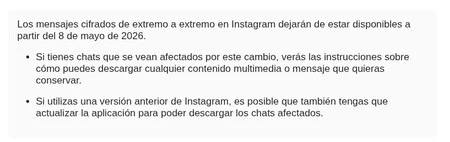
Meta Platforms, Inc. has announced a significant policy shift for its Instagram platform, revealing that it will discontinue end-to-end encryption (E2EE) for direct messages (DMs) beginning May 8, 2026. This move, communicated through an update on Instagram’s support page, signals a notable step back in user privacy protections for millions who utilize the app’s messaging features for personal communications, meme sharing, or responding to stories. The decision has already ignited substantial debate within cybersecurity and privacy communities, prompting users to reconsider the security of their digital conversations on the popular social media platform.
The core of this policy change revolves around end-to-end encryption, a robust security protocol designed to ensure that only the sender and intended recipient can read messages. When E2EE is active, messages are encrypted on the sender’s device and remain encrypted until they reach the recipient’s device, where they are then decrypted. This process uses unique cryptographic keys, making it virtually impossible for third parties, including the platform provider itself, to access the content of private conversations. For Instagram users, this optional layer of security has been available in direct messages since 2023, offering a degree of confidence in the confidentiality of their chats. However, Meta’s recent announcement confirms the impending removal of this feature, urging users to download any content or messages they wish to retain before the specified deadline.
Understanding the Policy Shift: What Changes and Why
The official communication from Meta’s support center, while confirming the cessation of E2EE, initially provided no explicit rationale for this controversial decision. However, a spokesperson for Meta later clarified that the removal is primarily due to a "low level of adoption" of the optional E2EE feature among Instagram users. According to Meta, "Very few people were opting for end-to-end encrypted messaging in DMs, so we are going to remove this option." This justification suggests that the cost and complexity of maintaining a feature with limited uptake may have outweighed its perceived benefits for the company.
Despite Meta’s official stance, privacy advocacy groups and cybersecurity experts have voiced strong suspicions regarding the underlying motivations. Organizations such as Proton, a prominent provider of secure email and VPN services, have cautioned that the discontinuation of E2EE effectively re-enables Meta’s capacity to access, read, and analyze the content of Instagram direct messages. This access could open avenues for various data utilization practices, including the refinement of advertising algorithms, the training of artificial intelligence models, and potentially facilitating law enforcement requests for data related to illicit activities. The broader implication is a significant erosion of user privacy, transforming what were once private conversations into potential data points for Meta’s expansive data ecosystem.
A Chronology of Encryption at Meta
Meta’s journey with end-to-end encryption across its various platforms has been marked by a complex and often contradictory strategy.
- 2014: WhatsApp, acquired by Facebook (now Meta) in 2014, began implementing E2EE by default, a process completed in 2016. This move was widely lauded by privacy advocates and positioned WhatsApp as a leader in secure messaging. Its strong encryption protocol, based on the Signal Protocol, ensured that over two billion users had their communications protected by default.
- 2016-2022: While WhatsApp embraced E2EE wholeheartedly, other Meta platforms, notably Facebook Messenger and Instagram DMs, lagged significantly. Messenger introduced "Secret Conversations" as an optional E2EE feature, requiring users to actively opt-in for secure chats. This optionality meant that the vast majority of Messenger conversations remained unencrypted.
- 2021: Meta announced ambitious plans to roll out E2EE by default across all its messaging services – WhatsApp, Instagram DMs, and Messenger – by 2023. This was presented as a unified vision for a secure, interconnected messaging experience.
- 2023: Instagram officially launched optional end-to-end encryption for its direct messages, allowing users to enable it for specific chats. This was a partial fulfillment of Meta’s 2021 promise, as it was still not the default setting.
- 2024: Meta pushed back its timeline for default E2EE across all platforms to 2025, citing technical complexities and the need to ensure user safety features were adequately integrated with encryption. This delay already raised eyebrows among those monitoring Meta’s commitment to privacy.
- March 2026 (Announcement): Meta reveals the plan to remove the optional E2EE from Instagram DMs, effective May 8, 2026. This starkly contrasts with the previously stated goal of expanding E2EE across all its platforms.
This timeline highlights a significant reversal, particularly concerning Instagram. The initial commitment to E2EE across its messaging ecosystem seemed to align Meta with global privacy trends and user expectations for secure communication. The decision to remove an existing, albeit optional, E2EE feature from Instagram DMs raises questions about the company’s long-term strategy and its prioritization of privacy versus other business objectives.
Broader Context: Data Monetization, AI, and Regulatory Pressure

Meta operates one of the world’s largest advertising empires, heavily reliant on user data for targeted advertising. The ability to access and analyze the content of private messages, even if anonymized or aggregated, provides an invaluable source of information for refining user profiles and ad targeting. Without E2EE, Meta regains a powerful tool for data collection, which can be leveraged to enhance its advertising revenue, estimated to be in the tens of billions of dollars annually.
Furthermore, the burgeoning field of artificial intelligence presents another compelling incentive. Large language models (LLMs) and other AI systems require vast datasets for training. User-generated content, including private conversations, can be a rich source of colloquial language, behavioral patterns, and trending topics. While Meta has assured users that personal data is handled responsibly, the removal of E2EE inherently expands the pool of data that could potentially be used to train AI models, a practice that has already drawn scrutiny regarding Meta’s use of public data for this purpose.
The debate between privacy and public safety also plays a critical role. Law enforcement agencies globally have consistently advocated for "backdoors" or mechanisms to access encrypted communications, particularly in cases involving child exploitation, terrorism, or other serious crimes. While Meta has publicly resisted direct backdoors in its strongly encrypted platforms like WhatsApp, removing E2EE from Instagram DMs inherently makes message content accessible to Meta, which can then be compelled by legal warrants to provide this data to authorities. This aligns with a growing governmental push, particularly in Europe and the UK, to curtail the widespread use of E2EE in the name of national security and crime prevention. The European Police Office (Europol), for instance, has openly expressed concerns about the "dark side" of encryption, arguing that it impedes investigations.
Implications for Users and the Digital Landscape
For the millions of Instagram users who rely on DMs for daily communication, the removal of E2EE carries several significant implications:
- Loss of Privacy: The most immediate consequence is the erosion of personal privacy. Conversations that were once shielded from Meta’s direct view will now be accessible to the company. Users will lose the assurance that their private exchanges remain strictly between themselves and their intended recipients.
- Data Exploitation: With access to message content, Meta can potentially derive insights for targeted advertising, content recommendations, and other data-driven services. While Meta’s privacy policy outlines data usage, the removal of E2EE expands the scope of what data is available for processing.
- Security Risks: While Meta maintains robust security infrastructure, any system that holds user data in an unencrypted or decryptable format presents a potential target for hackers. A data breach could expose the content of millions of private conversations.
- Erosion of Trust: This policy reversal could lead to a decline in user trust. Users who valued the option of E2EE may feel that Meta is prioritizing its business interests over their privacy rights, potentially driving them towards more privacy-centric platforms.
- Legal and Regulatory Scrutiny: The decision could attract renewed attention from privacy regulators, especially in regions with stringent data protection laws like the European Union (GDPR). The EU’s Digital Services Act (DSA) also imposes obligations on platforms regarding user safety and data handling, and this move might be scrutinized in that context.
Navigating the Shift: Alternatives for Privacy-Conscious Users
For users concerned about the loss of privacy on Instagram DMs, the market offers several robust alternatives that maintain end-to-end encryption as a default or highly accessible standard. It is crucial for privacy-conscious individuals to understand these options and encourage their contacts to adopt them for sensitive communications.
- Signal: Widely regarded as the gold standard for secure messaging, Signal offers E2EE for all communications by default (messages, calls, video calls). It is an open-source platform, meaning its code can be independently audited for vulnerabilities, and it operates as a non-profit, explicitly prioritizing user privacy over data monetization.
- WhatsApp: Despite being owned by Meta, WhatsApp maintains its strong, default end-to-end encryption based on the Signal Protocol. This means that, unlike Instagram DMs post-May 2026, WhatsApp conversations remain private from Meta itself. However, users must weigh the privacy of message content against Meta’s broader data collection practices related to metadata (who you talk to, when, how often).
- Telegram (Secret Chats): While Telegram offers optional E2EE for its "Secret Chats," its standard cloud chats are not end-to-end encrypted by default. This distinction is crucial. Users must specifically initiate a "Secret Chat" to ensure E2EE, and these chats are device-specific, meaning they are not synced across multiple devices.
- Threema: A Swiss-based messaging app that offers E2EE for all communications by default. Threema is a paid app, which removes the incentive for data monetization, and it does not require a phone number for registration, further enhancing anonymity.
- Proton Mail / Proton Pass / Proton Drive: While primarily known for secure email, Proton also offers an ecosystem of encrypted services, including a VPN and a password manager. Their commitment to E2EE and privacy is central to their business model, making them a strong choice for those seeking a comprehensive privacy-focused digital suite.
Migrating to these platforms requires user initiative and, ideally, the cooperation of one’s contacts. However, for those prioritizing the confidentiality of their digital interactions, these alternatives provide a critical bulwark against increasing data surveillance and the erosion of digital privacy.
Conclusion: A Crossroads for Digital Privacy
The decision by Meta to remove end-to-end encryption from Instagram direct messages marks a pivotal moment in the ongoing debate surrounding digital privacy. While Meta cites low adoption as its primary reason, the broader implications for data monetization, AI training, and law enforcement access are undeniable. This move underscores a growing tension between user expectations for privacy and the business models of large technology platforms.

As the digital landscape continues to evolve, users are increasingly faced with choices that directly impact their personal data security. The shift on Instagram DMs serves as a stark reminder that default settings and optional features often dictate the actual level of privacy afforded by a service. For those who value the sanctity of their private conversations, actively seeking and utilizing platforms that prioritize and implement strong end-to-end encryption by default will become an even more critical practice in the years to come. The digital world is at a crossroads, and the direction taken by platforms like Instagram will significantly shape the future of online privacy for billions worldwide.
