
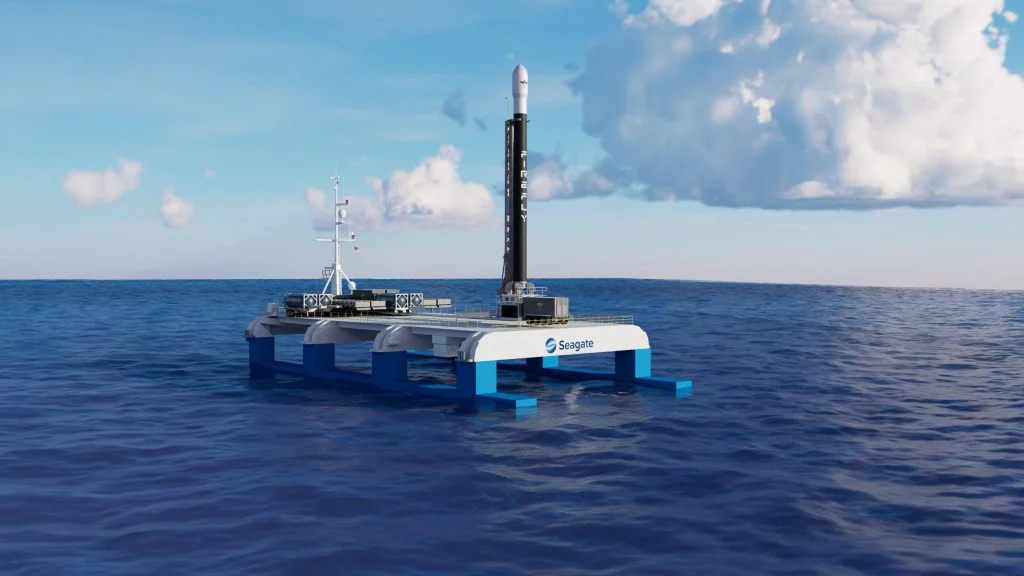

The global aerospace landscape is witnessing a significant shift toward mobile and resilient infrastructure as Lockheed Martin officially joins a strategic partnership with Seagate Space and Firefly Aerospace. This collaboration aims to revolutionize the deployment of small-to-medium lift vehicles by utilizing offshore launch platforms, specifically focusing on the integration of Firefly’s Alpha rocket with Seagate’s proprietary Gateway sea-based launch system. The tripartite agreement marks a major expansion of a Memorandum of Understanding (MoU) initially signed between Seagate and Firefly in April, signaling a concerted effort by major defense and commercial players to address the growing bottlenecks in traditional land-based launch sites.
The inclusion of Lockheed Martin, a titan of the defense industry, brings a wealth of expertise in missile defense, target systems, and complex mission integration to the project. As the demand for rapid, flexible, and tactically responsive space access grows, the partnership is positioned to provide the United States and its allies with a versatile alternative to fixed-site launch ranges like Cape Canaveral Space Force Station and Vandenberg Space Force Base.
The Strategic Shift Toward Sea-Based Launch Infrastructure
The concept of launching rockets from the ocean is not entirely new, but the current geopolitical and commercial climate has renewed interest in the capability. Traditionally, launch sites are constrained by geography, population centers, and strict "launch corridors" to ensure public safety in the event of a flight anomaly. Sea-based platforms, such as the Seagate Gateway, offer the ability to relocate the launch point to optimal latitudes and longitudes, allowing for more efficient orbital insertions and a wider range of inclinations without the need for complex "dog-leg" maneuvers that consume valuable fuel.
Johnathon Caldwell, vice president and general manager of Strategic and Missile Defense Systems for Lockheed Martin Space, emphasized that this collaboration is a natural extension of the company’s long-standing history in defense technology. According to Caldwell, the partnership leverages Lockheed Martin’s legacy in missile defense and countermeasures to develop solutions that meet the "evolving operational requirements" of the modern warfighter. The primary goal is to establish a "responsive launch" capability—a term used to describe the ability to put a payload into orbit on a tactical timeline, often within hours or days of a request, rather than the months or years typically required for traditional missions.
Technical Specifications: The Firefly Alpha and Seagate Gateway
Central to this partnership is the Firefly Alpha launch vehicle. Firefly Aerospace has designed the Alpha to serve the burgeoning small-satellite market, offering a dedicated launch solution for payloads that would otherwise have to wait for "rideshare" opportunities on larger rockets like the SpaceX Falcon 9.
Firefly Alpha Performance Metrics:
- Payload Capacity: Approximately 1,030 kg to Low Earth Orbit (LEO) and up to 630 kg to Sun-Synchronous Orbit (SSO).
- Propulsion: The first stage is powered by four Reaver 1 engines, while the second stage utilizes a single Lightning 1 engine. Both stages use liquid oxygen (LOX) and highly refined kerosene (RP-1) as propellants.
- Structure: The rocket features a lightweight carbon-fiber composite airframe, which maximizes the mass-to-orbit capability by reducing the weight of the vehicle itself.
The Seagate Gateway platform serves as the mobile foundation for these missions. Unlike static pads, the Gateway is designed to be a self-contained, offshore facility capable of supporting the entire launch campaign—from vehicle integration and fueling to final countdown and ignition. Seagate has noted that the platform is specifically engineered for "rapid-deployment," making it an ideal candidate for hypersonic testing and missile defense exercises where varied flight paths are necessary to simulate real-world threats.
Historical Context and the Need for Resiliency
The move toward sea-based platforms is also a response to the increasing congestion at the United States’ primary spaceports. In 2023 and early 2024, launch cadences reached record highs, leading to scheduling conflicts and range availability issues. For the Department of Defense (DoD), this congestion represents a strategic vulnerability. If a fixed launch site were to be neutralized or damaged, the nation’s ability to replenish satellite constellations or conduct urgent testing would be severely compromised.
Historically, the most notable sea-based launch venture was "Sea Launch," a multinational consortium involving Boeing that utilized a modified oil drilling platform in the Pacific Ocean. While Sea Launch successfully conducted dozens of launches between 1999 and 2014, it eventually faced financial and geopolitical hurdles. The new Seagate-Firefly-Lockheed partnership seeks to avoid these pitfalls by utilizing modern, more cost-effective automation and smaller, more agile rockets like the Alpha, which require less infrastructure than the massive Zenit-3SL rockets used by the original Sea Launch venture.
Furthermore, international competitors have already demonstrated the viability of this approach. China, for instance, has successfully conducted several sea-based launches of its Long March 11 and Smart Dragon rockets from the Yellow Sea. This has allowed China to launch closer to the equator and avoid flying spent rocket stages over populated landmasses, a benefit that the Seagate Gateway platform aims to replicate for Western customers.
Implications for Hypersonic Testing and National Security
One of the most critical applications for the Seagate Gateway and Firefly Alpha partnership is the testing of hypersonic technologies. Hypersonic glide vehicles (HGVs) and cruise missiles travel at speeds exceeding Mach 5 and follow unpredictable flight paths. Testing these systems requires vast, clear ranges where sensors can track the vehicle’s performance over long distances.
By launching from an offshore platform, Lockheed Martin and its partners can conduct these tests in remote areas of the ocean, far from commercial flight paths and shipping lanes. This provides a "clean" environment for data collection and reduces the regulatory hurdles associated with land-based testing. Seagate has highlighted that the Gateway platform will be instrumental in supporting "tactical timelines" for the warfighter, ensuring that new defensive and offensive technologies can be flight-proven more rapidly than current schedules allow.
Timeline of the Partnership and Future Milestones
The collaboration has moved swiftly since its inception:
- April 2024: Seagate Space and Firefly Aerospace sign an initial Memorandum of Understanding to explore the feasibility of sea-based launches using the Alpha rocket and Gateway platform.
- Mid-2024: Technical feasibility studies are conducted, focusing on the stability of the Gateway platform during the high-thrust environment of a rocket ignition.
- Current Phase: Lockheed Martin joins the partnership, bringing defense-specific requirements and integration expertise to the table.
- Future Outlook: The companies plan to move toward flight-demonstration projects. These "pathfinder" missions will likely involve suborbital tests or small-satellite deployments to prove the end-to-end functionality of the offshore launch concept.
Economic and Industry Impact
For the broader space industry, the success of this partnership could lead to a "democratization" of launch locations. If the Seagate Gateway proves that offshore launches can be conducted safely and at a competitive price point, it could open the door for other coastal nations to establish their own "sovereign launch" capabilities without the need for massive inland complexes.
From a commercial perspective, sea launch offers "on-demand" orbital access. For telecommunications companies or Earth-observation firms, the ability to choose a launch site that minimizes the time to their desired orbit is a significant advantage. It reduces the amount of onboard propulsion a satellite needs to reach its final station, thereby extending the operational life of the spacecraft or allowing for more scientific instrumentation.
Analytical Perspective: Challenges and Opportunities
While the partnership holds immense promise, it is not without challenges. Operating in a maritime environment presents unique difficulties, including saltwater corrosion, high winds, and the logistics of transporting cryogenic fuels and sensitive rocket components to a floating platform. However, Lockheed Martin’s extensive experience with naval systems and sea-launched ballistic missiles (such as the Trident II D5) provides a critical safety net for these technical hurdles.
The collaboration also aligns with the U.S. Space Force’s "Tactical Responsive Space" (TRS) initiative. The TRS program seeks to develop the capability to replace a damaged satellite or deploy new sensors within 24 hours of a conflict starting. A mobile, sea-based platform like the Seagate Gateway is arguably the ultimate tool for such a mission, as it can be pre-positioned in international waters, ready to launch at a moment’s notice without the bureaucratic delays inherent in multi-user land ranges.
Conclusion
The partnership between Lockheed Martin, Seagate Space, and Firefly Aerospace represents a significant evolution in how the aerospace industry views launch infrastructure. By moving away from the "one-size-fits-all" model of massive, fixed launch complexes, these companies are building a future where space access is as mobile and flexible as the forces it supports. As the project moves into its flight-demonstration phase, the global community will be watching closely to see if the Seagate Gateway can truly unlock the next frontier of responsive, resilient, and versatile space operations. For the warfighter, the commercial satellite operator, and the hypersonic researcher, the horizon of possibility has just moved significantly further out to sea.
