
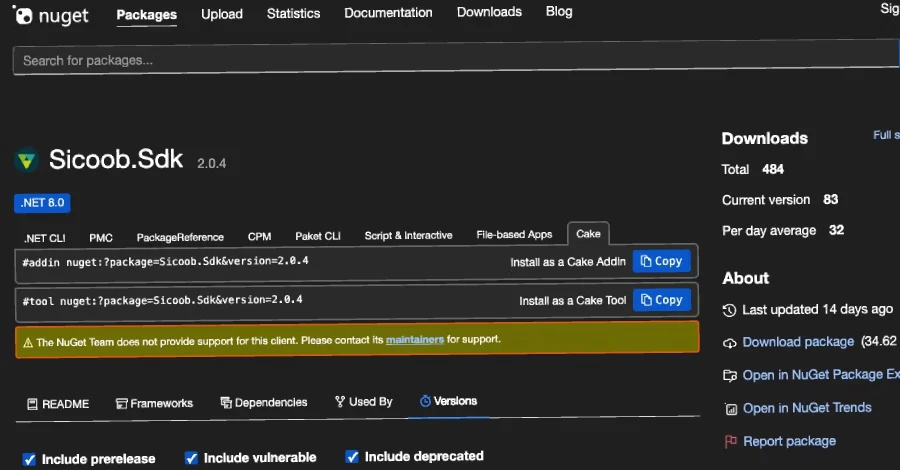

A recent investigation by cybersecurity researchers has brought to light a critical software supply chain vulnerability, detailing a malicious NuGet package that cunningly masqueraded as a legitimate C# software development kit (SDK) for Sicoob, one of Brazil’s largest cooperative financial systems. This deceptive package was engineered to surreptitiously siphon sensitive client IDs and PFX certificates, posing a significant threat to businesses integrated with the financial network. The discovery underscores an escalating trend of sophisticated attacks targeting open-source software ecosystems, where threat actors are employing increasingly elaborate tactics to compromise development pipelines and ultimately breach organizations.
The Malicious Sicoob.Sdk Package: A Deep Dive into Deception
The illicit activity was first brought to light by security researchers at Socket, an application security company, who identified versions 2.0.0 through 2.0.4 of the NuGet package named "Sicoob.Sdk" as containing deeply embedded malicious functionality. This package, designed to mimic an authentic C# library for interacting with Sicoob banking APIs, was found to exfiltrate highly confidential information.
At the core of the attack mechanism, as detailed by security researcher Kirill Boychenko from Socket, was the package’s ability to intercept critical authentication credentials. Specifically, when a developer instantiated the SicoobClient with a client ID, a PFX file path, and its corresponding password, the malicious package would spring into action. It would read the PFX file directly from the disk, Base64-encode its entire contents, and then transmit this encoded data, along with the supplied client ID and PFX password, to a hardcoded third-party Sentry endpoint.
PFX certificates, or Personal Information Exchange certificates, are cryptographic files widely used in secure communications and authentication, particularly within financial systems. In the context of Sicoob, these certificates are indispensable for businesses seeking to authenticate with the banking network, enabling automated banking operations. This includes critical functions such as processing instant payments – a cornerstone of modern digital commerce – and generating dynamic Pix QR codes, a popular instant payment method in Brazil. The theft of these PFX certificates grants threat actors an unparalleled level of access, potentially allowing them to impersonate the victim’s legitimate Sicoob banking API integration, thereby gaining control over financial transactions and sensitive data flows.

Beyond authentication credentials, the malicious package was also crafted to capture raw responses from the Boleto API via a separate Sentry path. Boleto Bancário, commonly known as Boleto, is a ubiquitous cash payment method in Brazil, facilitating both online and offline purchases for millions of consumers and businesses. The compromise of Boleto API responses could expose a trove of sensitive transaction details, including payment statuses, exact amounts, due dates, unique identifiers, and critical payer or payee data. Such information could be leveraged for sophisticated fraud schemes, identity theft, or to disrupt financial operations.
Before its eventual blocking, the "Sicoob.Sdk" package was estimated to have been downloaded nearly 500 times by unsuspecting developers. The user profile responsible for uploading this malicious package, simply named "sicoob," had also listed 11 other NuGet packages, which collectively amassed approximately 6,000 downloads. This suggests a broader campaign of deception, aiming to spread malicious code under the guise of legitimate tools.
Amplification, Deception, and Mitigation
The impact of this malicious package was amplified by its unexpected endorsement from artificial intelligence. The application security company revealed that Google Search AI Mode had, at one point, surfaced the "Sicoob.Sdk" package as a legitimate C# library for interacting with Sicoob banking APIs. This unfortunate recommendation effectively promoted the malicious package to unsuspecting developers actively searching for such integrations, significantly widening its potential reach and impact. This incident highlights a critical vulnerability in how AI-powered search tools assess and recommend software components, potentially becoming an unwitting accomplice in software supply chain attacks.
A key element of the attacker’s deception strategy involved a sophisticated "source-to-package mismatch." While a GitHub repository linked to the "sicoob" profile maintained a seemingly clean and legitimate codebase, the actual artifact distributed via NuGet contained the malicious data-stealing functionality. This tactic creates a veneer of authenticity, allowing the attackers to present a trustworthy public face while embedding harmful code in the compiled package that developers ultimately download and integrate. This sophisticated approach makes detection challenging, as a cursory review of the public source code would not reveal the hidden malicious payload.
Following the responsible disclosure of these findings, NuGet acted swiftly to block the malicious "Sicoob.Sdk" package and suspend the associated "sicoob" profile, mitigating further immediate risk. However, the implications for organizations that had already installed the package are severe. Cybersecurity experts strongly recommend that affected organizations immediately remove the "Sicoob.Sdk" package from all development environments and deployed applications. Furthermore, all PFX material previously used with the package must be considered compromised, necessitating the immediate replacement of exposed PFX certificates and the rotation of associated PFX passwords. Where applicable, affected client IDs should be changed or disabled. Crucially, organizations are advised to conduct thorough audits of their Sicoob authentication and API logs for any signs of unusual or unauthorized activity, which could indicate successful exploitation.

The Broader Landscape: A Surge in Software Supply Chain Attacks
The discovery of the malicious "Sicoob.Sdk" package is not an isolated incident but rather a stark illustration of a rapidly escalating trend in software supply chain attacks. This particular event coincides with a wave of similar discoveries across other popular package ecosystems.
Just prior to this, on May 28, 2026, the Microsoft Defender Security Research Team unveiled the discovery of 14 malicious npm packages. These packages employed sophisticated typosquatting techniques, deliberately mimicking well-known OpenSearch, ElasticSearch, DevOps, and environment-configuration libraries. Published by a single threat actor operating under the alias "vpmdhaj" (associated with the email "[email protected]"), these npm packages were designed to harvest a wide array of sensitive credentials from host environments. This included AWS credentials, HashiCorp Vault tokens, npm tokens, and critical CI/CD pipeline secrets. The exfiltration was orchestrated through a purpose-built credential harvester launched via a preinstall hook – a script that executes automatically before a package is installed, providing attackers with an early and potent point of compromise within the development workflow.
The names of these specific npm packages, while not all listed in detail, were crafted to appear highly plausible and functional, leveraging subtle variations or common misspellings to trick developers. This particular campaign highlights the continuous evolution of attack vectors, moving beyond simple typos to more cunning psychological and technical manipulation.
Beyond Typosquatting: The Rise of "Manufactured Legitimacy"
In a newly published report, supply chain security company Sonatype elaborated on this evolution, asserting that threat actors have significantly outgrown classic typosquatting techniques. Their analysis indicates a strategic shift towards using package names that appear convincingly legitimate within routine developer workflows. This sophisticated form of "brandjacking" transforms what should be a straightforward installation step into a high-risk pathway for reconnaissance, credential theft, and subsequent system compromise.

Sonatype’s research details several advanced brandjacking techniques now prevalent:
- Prefix or Suffix Addition: Adding seemingly innocuous prefixes or suffixes to legitimate package names (e.g.,
react-utils-proinstead ofreact-utils). - Dependency Confusion: Exploiting package managers’ resolution logic to prioritize a malicious private package over a legitimate public one.
- Version Mimicry: Publishing a malicious package with a version number that closely mirrors or precedes a highly anticipated legitimate version.
- Embedded Target Terms: Including keywords relevant to a target company or project within the malicious package name itself.
- Altered Scopes or Namespaces: Using subtly different scopes or namespaces to create packages that appear related to official ones (e.g.,
@myorg/utilsvs.@my-org/utils). - Functional Resemblance: Naming packages based on a function they claim to perform, making them appear useful and relevant to a developer’s immediate needs.
These sophisticated approaches led Sonatype to conclude that "typosquatting" is now "too narrow a label" for what researchers are observing. Instead, they propose the broader term "manufactured legitimacy," defining it as attackers meticulously designing package names to appear plausible, useful, and operationally routine within modern software ecosystems. This calculated approach exploits the inherent trust developers place in package registries and the often-rapid pace of development, where verifying every dependency exhaustively can be impractical.
The Shadow of TeamPCP (Replicating Marauder)
These individual incidents are further contextualized within a larger, more pervasive wave of software supply chain compromises linked to a highly active and sophisticated threat group known by various monikers, including TeamPCP, Replicating Marauder, and UNC6780. This formidable adversary has emerged as a significant force, systematically poisoning popular developer tooling across multiple package ecosystems, including npm, PyPI (Python Package Index), Docker Hub, and Packagist (PHP’s main package repository), in what researchers describe as a "worm-like fashion."
BlueVoyant researcher Michael Warren provided critical insights into Replicating Marauder’s modus operandi, highlighting their innovative approach to supply chain compromise. Warren explained that TeamPCP wasn’t merely inserting malicious code into isolated packages; they were "exploiting automation, inherited trust, and ordinary CI/CD workflows to push compromise further downstream." This strategic shift turned what might otherwise be an isolated instance of software poisoning into a reproducible method for "victim-to-victim expansion." This means that a single poisoned dependency or container image could trigger a cascade of compromises, propagating malicious code into an entirely unrelated organization’s release pipeline, creating a pervasive and interconnected threat across the global software supply chain.
Implications and the Path Forward

The revelations surrounding the "Sicoob.Sdk" package and the broader landscape of sophisticated supply chain attacks present profound implications for software development, cybersecurity, and financial integrity. The erosion of trust in widely used open-source repositories forces developers and organizations to adopt a far more cautious and proactive stance towards dependency management.
The potential for significant financial fraud, data breaches, and operational disruption stemming from compromised API authentication materials and transaction data is immense. For financial systems like Sicoob, the integrity of automated banking operations is paramount, and any compromise could have widespread economic repercussions.
The ongoing battle against "manufactured legitimacy" and similar advanced attack techniques necessitates a multi-faceted response. Package registry operators like NuGet and npm must continuously enhance their security protocols, employing advanced scanning, behavioral analysis, and rapid response mechanisms to detect and block malicious packages. Developers, in turn, must cultivate greater skepticism towards new or unfamiliar packages, prioritize verified sources, implement robust software supply chain security tools, and meticulously audit their dependencies. Furthermore, the incident involving Google Search AI Mode underscores the need for AI systems to be rigorously trained and continually updated to prevent them from inadvertently aiding threat actors.
As the digital economy becomes increasingly reliant on interconnected software components, the security of the software supply chain is no longer an abstract concern but a foundational requirement for global stability and trust. The incidents involving "Sicoob.Sdk" and the broader campaigns by groups like TeamPCP serve as urgent reminders that vigilance, collaboration, and continuous adaptation are essential in safeguarding the digital future.
