
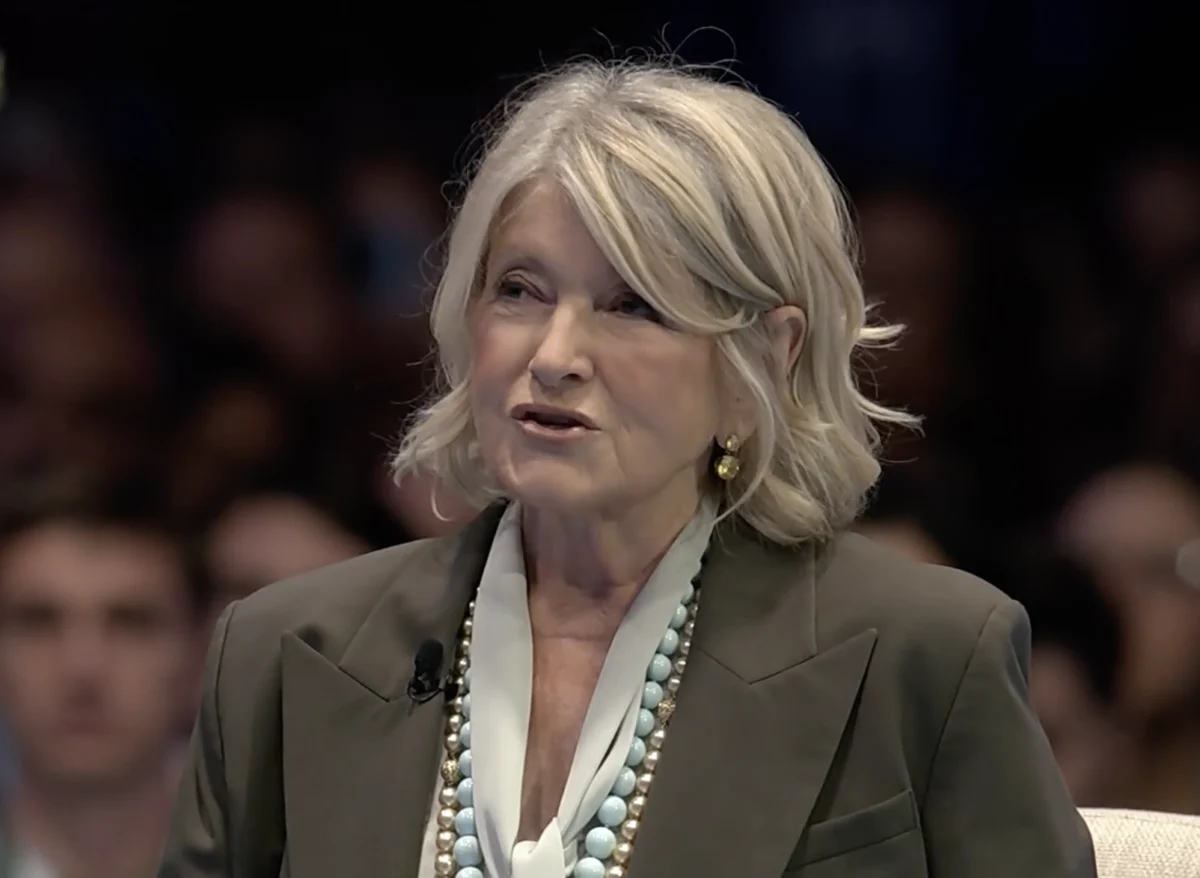

Addressing a capacity crowd of marketing professionals and technology leaders at the Salesforce Connections event in Chicago, Martha Stewart, the founder of Martha Stewart Living Omnimedia and a foundational figure in the American lifestyle industry, detailed her latest venture into artificial intelligence while reflecting on a career defined by early adoption and market intuition. Stewart’s keynote focused on the intersection of human expertise and emerging technologies, specifically highlighting her upcoming company, Hint, an AI-native home management platform scheduled for a late-summer release. The event, which serves as a premier gathering for experts in digital marketing, commerce, and customer service, provided a backdrop for Stewart to explain how her "omni-channel" philosophy has evolved from print and television to sophisticated machine learning.
At 82, Stewart remains a significant force in the commercial landscape, positioning herself not merely as a personality but as a strategist who anticipates consumer needs before they manifest in mainstream data. During her presentation, she emphasized that her business success has always been predicated on a specific internal compass—an intuition for distinguishing between fleeting trends and substantive innovations. This intuition, she argued, is the primary driver behind her pivot to AI, as she seeks to solve the enduring complexities of property ownership through automated, data-driven intelligence.
The Philosophy of Need and Want in Modern Marketing
Central to Stewart’s address was the concept of "need and want," a binary she identifies as the core of any successful marketing endeavor. She posited that effective product development begins with a self-reflective assessment of utility. "I think timing has a lot to do with it," Stewart remarked, describing the moment a creator discovers a solution to a personal problem that mirrors a broader societal demand. By viewing herself as an "ordinary homemaker" or "hausfrau," she maintains a connection to a massive demographic, asserting that if she identifies a gap in her own home management, millions of others likely face the same challenge.
This philosophy challenges the data-heavy, top-down approach often seen in contemporary digital marketing. Stewart suggested that while analytics are vital, they cannot replace the fundamental resonance of a product. If a firm’s offering does not fulfill a genuine need or a compelling want, no amount of marketing expenditure will ensure its longevity. This focus on "substance" has been the through-line of her career, from her early days in catering to her multi-billion-dollar retail partnerships.
A Chronology of Innovation: From Print to Digital Dominance
Stewart’s career trajectory offers a blueprint for the evolution of the modern media and retail landscape. To understand her current foray into AI, one must examine the chronological milestones that established her as a pioneer of the "influencer" model long before the advent of social media.
In the early 1970s, Stewart launched a catering business from her home in Westport, Connecticut. Lacking a significant advertising budget, she leveraged local journalism, securing features in The Westport News. This strategy eventually escalated to national platforms, including The New York Times and People magazine. Her first People cover in 1972, featuring her holding a chicken, tapped into a nascent interest in backyard husbandry—a topic she correctly predicted would appeal to the modern homemaker.
By the 1980s, Stewart transitioned into the retail sector as a consultant and expert for Kmart. This partnership revolutionized the "mass-class" retail concept, bringing high-quality home goods to a broader audience. Within two years, the business exceeded $1 billion in revenue, eventually peaking at nearly $2 billion annually. Stewart noted that this era allowed her to transition from zero advertising dollars to a $20 million budget, utilizing top-tier Hollywood and British directors for television commercials that set new standards for aesthetic quality in retail marketing.
In the 1990s, Stewart’s move into publishing with Martha Stewart Living showcased her early embrace of technology. Her team was among the first in the industry, alongside Wired magazine, to utilize Macintosh computers for desktop publishing. This shift from the "tedious" manual cut-and-paste methods of traditional editing allowed for greater creative control and faster production cycles. However, her early adoption was not without its hurdles. When her magazine launched its first digital edition—complete with time-lapse photography and integrated video—the market was not yet ready. Despite Stewart’s projection that digital readership would reach 33% in the first year, it stalled at 5%, a reminder that being "ahead of one’s time" can carry significant commercial risks.
Social Media Adoption and the Influencer Archetype
As the media landscape shifted toward social platforms, Stewart once again positioned herself at the vanguard. While many of her peers were hesitant to engage with the informal nature of early social media, Stewart "dove right in." She utilized Twitter (now X) not just for brand broadcasting, but as a real-time market research tool. During meetings with major grocery chains, she would conduct instant polls on the platform, presenting the results to executives to demonstrate immediate consumer sentiment.
Today, Stewart maintains a digital footprint that includes 3.1 million followers on X and 5.9 million on Instagram. She noted that while she experimented with TikTok—her first video, demonstrating how to eat a soufflé, garnered millions of views—she remains wary of the high production demands of the platform. Instead, she prioritizes the "personal authenticity" of Instagram and her long-running blog, which she believes provide a more direct and sincere connection to her audience.
Hint: The Convergence of AI and Property Management
The announcement of "Hint" represents the culmination of a four-decade-long ambition. Stewart described the platform as an "always-on, AI-native home management platform" designed to eliminate the guesswork associated with property maintenance. The system integrates property-specific data—including climate zones, soil types, and flood risks—with Stewart’s extensive library of lifestyle content to provide proactive recommendations.
The platform aims to solve practical, time-consuming issues, such as tracking insurance policies, managing deductibles, and scheduling preventative maintenance. Stewart highlighted the inefficiency of modern technology, noting that while the internet and smartphones were promised as time-saving tools, they often lead to increased "time-wasting." Hint is positioned as a utility-first application that saves users money by identifying issues before they become expensive repairs.
Interestingly, Stewart revealed that she had pitched a similar concept to venture capital firm Kleiner Perkins 40 years ago and to Microsoft 30 years ago. At the time, the technology was insufficient to support the vision. Microsoft’s attempt at a user-friendly interface in the mid-1990s, known as "Microsoft Bob," was cited by Stewart as a prime example of a failed tech initiative that lacked genuine utility. With the current maturity of Large Language Models (LLMs) and AI data processing, Stewart believes the infrastructure finally exists to realize her goal of a "healthier and better-run home."
Analysis: Implications for the Marketing and Tech Sectors
Stewart’s move into AI signals a broader trend in the creator economy: the shift from content consumption to utility-based services. For decades, Stewart’s brand was built on "how-to" information. By embedding that information into an AI platform, she is transforming her intellectual property into a functional tool. This transition reflects a sophisticated understanding of the "prosumer"—a consumer who is also a producer of their own environment and seeks high-level efficiency.
Furthermore, Stewart’s emphasis on "human expertise" within an AI framework addresses one of the primary concerns regarding generative technology: the lack of verified, high-quality data. By training her AI on 40 years of her own curated content, Stewart is creating a "walled garden" of expertise that distinguishes her platform from generic AI chatbots.
For marketers, Stewart’s career serves as a case study in brand resilience. Her ability to remain relevant from the era of print newspapers to the age of AI suggests that a core brand identity, when rooted in genuine utility, can navigate multiple technological upheavals. Her work ethic—described as 12 to 20 hours a day of "slogging"—remains the engine behind this longevity.
Looking Ahead: The Future of Martha Stewart Living
As Hint prepares for its summer launch, the industry will be watching closely to see if Stewart can successfully migrate her massive following from social media engagement to a subscription-based or utility-driven AI model. If successful, it could provide a template for other legacy brands looking to monetize their archives through artificial intelligence.
At age 82, Stewart shows no signs of slowing down, concluding her remarks with a reflection on the integration of her personal and professional life. "My life is my work, and my work is my life," she stated, reinforcing the idea that for the modern entrepreneur, the boundaries between lifestyle, brand, and technology are increasingly non-existent. The launch of Hint is not just a new business venture; it is the latest chapter in a decades-long effort to standardize excellence in the American home through whatever technological means are most effective for the era.
