

The economics of artificial intelligence deployment are fundamentally unbalanced, according to AI engineering expert Chip Huyen. While training a frontier model represents a massive, one-off capital expenditure, inference—the process of running the model to generate outputs for users—imposes a recurring, compounding operational cost. Over the practical lifecycle of a commercial large language model (LLM), the ratio of compute spend between training and inference typically lands anywhere from 1:10 to 1:100. For modern reasoning models, which consume vast quantities of hidden computation tokens before returning a final answer, this disparity is magnified even further.
Addressing developers and systems architects at the P99 conference, Huyen emphasized that if inference remains prohibitively expensive, organizations will fail to recover their initial capital outlays. This core financial reality has transformed inference optimization from a routine maintenance task into a critical boardroom imperative. As organizations scale generative AI deployments to millions of end-users, mastering the mechanics of latency, throughput, and compute efficiency has become essential for maintaining corporate profitability.

The Economic Realities of Frontier Models and Reasoning Workloads
The rapid commercialization of generative AI has created an unprecedented demand for enterprise compute infrastructure. Historically, software deployment costs scaled predictably with user acquisition. In the generative AI paradigm, however, every prompt, query, and multi-step agentic loop triggers a fresh computational burden.
Frontier model providers absorb billions of dollars in training expenses, confident that these costs will be amortized across massive inference volumes. For enterprises building applications on top of these models, the financial calculus is far less forgiving. Enterprises routinely face aggressive rate limits, soaring cloud computing bills, and diminishing profit margins on AI-driven features.
The introduction of reasoning models—systems that utilize internal chain-of-thought processing to solve complex logic, coding, and mathematical problems—has dramatically accelerated token consumption. In these advanced architectures, the number of generated tokens far exceeds the number of visible tokens returned to the end user. Consequently, infrastructure teams are forced to rethink traditional application design, transitioning from simple request-response architectures to highly managed, cost-aware AI systems.

Defining Key Performance Metrics for Modern LLM Inference
Optimizing inference pipelines requires a granular understanding of specialized performance metrics that differ significantly from traditional web application telemetry. Software engineers accustomed to tracking simple response times must now monitor a suite of metrics unique to generative AI workloads:
- Time to First Token (TTFT): Measures the duration between a user submitting a prompt and the system generating the very first token of the response. This metric dictates perceived application responsiveness.
- Time to Publish (TTP): In reasoning models, where internal tokens are processed before final output, TTP measures the precise moment the user actually views the first visible output token, accounting for hidden processing delays.
- Time Per Output Token (TPOT): Evaluates the generation speed of subsequent tokens after the initial response has begun, determining the smoothness of streaming text.
- Goodput versus Throughput: While raw throughput measures the total number of requests processed within a given timeframe, goodput specifically counts requests that successfully meet predefined Service Level Objectives (SLOs), such as strict TTFT and TPOT thresholds.
According to Huyen, evaluating inference providers exclusively on raw cost and average latency is a strategic miscalculation. Many commercial inference optimization techniques inadvertently degrade model accuracy, altering model behavior or causing regressions on standard industry benchmarks. Enterprise procurement teams must evaluate inference services through a dual lens of financial efficiency and rigorous quality assurance.
A Strategic Framework for Optimizing LLM Inference
When seeking to reduce latency and infrastructure overhead, system administrators generally operate across three distinct layers: hardware, model architecture, and service orchestration.

While hardware-level optimizations—such as deploying next-generation accelerator chips—offer theoretical performance gains, they remain inaccessible to the vast majority of software engineering teams due to capital constraints and hardware availability. Similarly, horizontal scaling through replica parallelism, or simply provisioning more machines, introduces immense architectural complexity and financial overhead, particularly when managing heterogeneous fleets of hardware accelerators with varying memory capacities.
Consequently, engineering teams must focus their optimization efforts on two primary domains: model-level modifications and service-level orchestration.
Model-Level Optimizations: Quantization and Distillation
Model optimizations alter the underlying weights of an artificial intelligence system to reduce memory footprints and accelerate computational throughput.

Quantization has emerged as an industry-standard practice, with few enterprises running frontier models at full 32-bit precision in production environments. By lowering the numerical precision used to store model weights and activations—for instance, compressing a model from four bytes per parameter down to one byte—engineers drastically reduce memory bandwidth requirements. Because modern hardware can execute lower-precision arithmetic operations significantly faster, quantization simultaneously lowers infrastructure costs and accelerates inference speeds, all with minimal degradation in model accuracy.
Distillation involves transferring the capabilities of a massive, highly resource-intensive frontier model into a smaller, more agile student model. By utilizing a large teacher model to generate extensive training datasets, organizations can train compact models that approximate the performance of larger systems at a fraction of the operational cost. However, engineering teams must carefully review vendor licensing agreements, as many commercial model providers explicitly prohibit using their outputs to train competing proprietary architectures.
Service-Level Optimizations: Batching, Prefill-Decode Decoupling, and Prompt Caching
Service-level optimizations focus on intelligent request scheduling, routing, and cache management without modifying the underlying model weights.

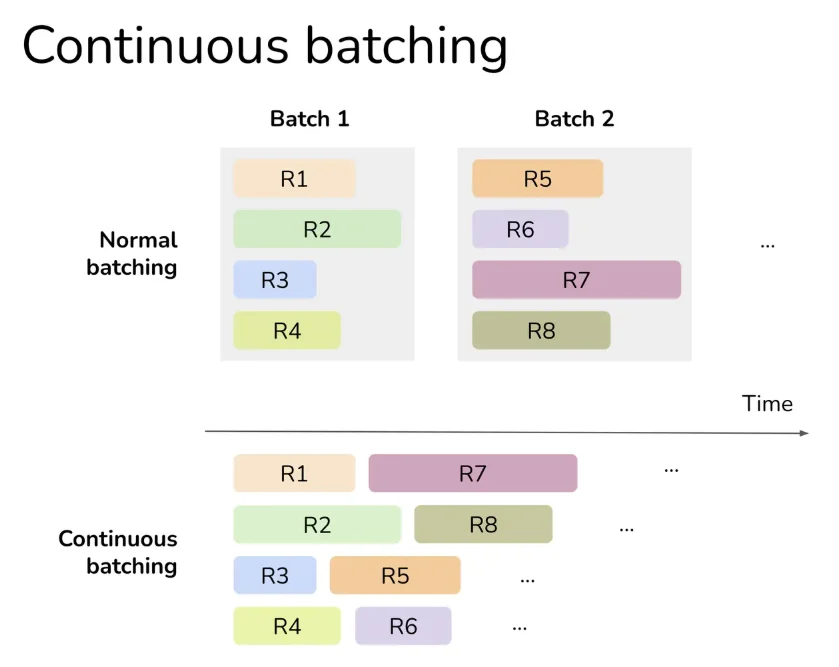
- Advanced Batching: Grouping concurrent user requests into single computational passes maximizes GPU utilization and prevents idle hardware cycles.
- Prefill and Decode Decoupling: Separating the initial prompt processing phase (prefill) from the sequential token generation phase (decode) allows infrastructure teams to allocate specialized machine pools tailored to specific resource constraints. Prefill operations are compute-bound and benefit from parallel processing hardware, whereas decode operations are memory-bound, requiring optimized memory bandwidth.
- Parallelism: Distributing large workloads across multiple machines using tensor parallelism or pipeline parallelism ensures that massive models can be hosted efficiently without overwhelming individual nodes.
- Prompt Caching: Capitalizing on repetitive structural elements within application requests—such as system prompts, standard codebases, and foundational reference documents—prompt caching processes shared text prefixes once and stores them in memory for rapid retrieval.
Prompt caching has evolved from an experimental technique into a foundational pillar of modern LLM infrastructure. Real-world telemetry analysis of complex agentic coding workflows reveals cache hit rates ranging consistently between 90% and 97%. By structuring prompts to place stable, invariant text blocks at the beginning of the input sequence and variable user inputs at the end, developers can achieve massive latency reductions and cost savings.
Industry Implications and Future Outlook
As the artificial intelligence ecosystem matures, the boundary between application development and infrastructure management continues to blur. The metrics established by engineering leaders like Chip Huyen—ranging from granular token generation speeds to sophisticated goodput calculations—have become standardized vocabulary across enterprise engineering organizations.
Looking forward, the proliferation of autonomous AI agents executing multi-step reasoning loops will only intensify the pressure on inference economics. Without proactive investments in model quantization, service orchestration, and prompt caching, organizations risk hitting insurmountable financial and operational bottlenecks. As the industry prepares for upcoming technical forums such as the P99 conference, the focus remains resolutely on bridging the gap between cutting-edge AI capabilities and sustainable, cost-effective production deployment.
