
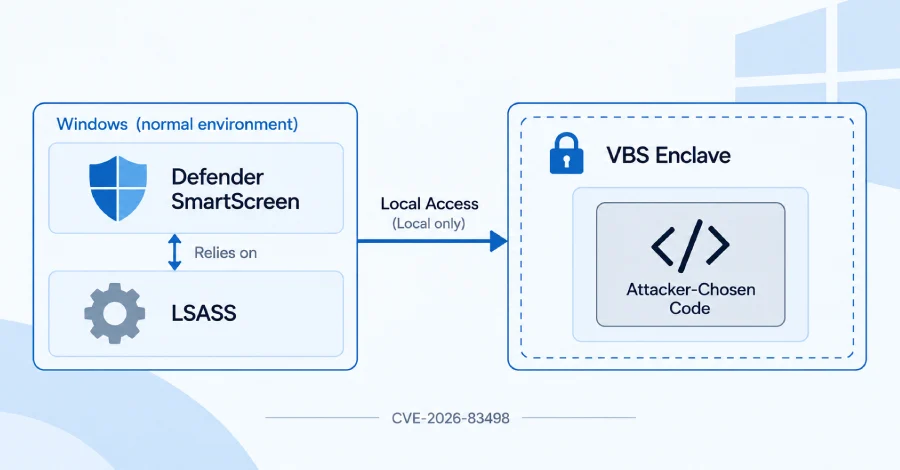

In a significant revelation for the cybersecurity community, researchers from the firm Doyensec have successfully demonstrated a method to execute arbitrary code within a protected Windows component designed to be virtually impenetrable. The research focuses on Virtualization-Based Security (VBS) enclaves, specialized memory environments that reside within a highly privileged, isolated layer of the operating system. By identifying a series of vulnerabilities within the SFAPE.dll—the engine powering Microsoft Defender’s Enhanced Phishing Protection—the researchers proved that even the most secure segments of the Windows architecture are susceptible to sophisticated local exploitation.
The vulnerability, formally tracked as CVE-2026-83498, carries a CVSS score of 7.8, categorizing it as a critical elevation-of-privilege issue. While Microsoft confirmed that the flaw was never observed in wild, real-world attacks, the existence of the research highlights an evolving cat-and-mouse game between hardware-backed security features and advanced exploit development techniques.
Understanding the VBS Architecture
To comprehend the severity of this discovery, one must understand the design philosophy of VBS. Windows employs a dual-layered architectural model: VTL0 (Virtual Trust Level 0) and VTL1 (Virtual Trust Level 1). The standard operating system, including the kernel and user applications, operates within the less-trusted VTL0 environment. Conversely, VTL1, often referred to as Isolated User Mode (IUM), is guarded by the Windows hypervisor, effectively creating a "fortress" within the computer’s memory.
VBS enclaves are signed libraries intended to operate exclusively within this hardened VTL1 environment. Even if an adversary manages to compromise the primary Windows kernel or gains SYSTEM-level privileges—the highest level of standard administrative access—the hypervisor is designed to prevent these entities from reading or modifying the data inside an enclave. These enclaves typically store highly sensitive information, such as cryptographic keys, biometric data, or, in the case of SFAPE.dll, hashed credentials used for anti-phishing safeguards.
The Anatomy of the Doyensec Exploit
The exploit path identified by Doyensec is a masterclass in chaining minor software defects to achieve a catastrophic outcome. The researchers began by examining the initialization function of the SFAPE enclave. They discovered that calling the enclave’s Initialize function a second time resulted in a specific, predictable behavior: the system would write a four-byte error value to a memory address controlled by the calling application. Crucially, the second call bypassed the rigorous address validation checks performed during the initial call.

While a four-byte write is generally insufficient for a full system compromise, Doyensec utilized this small window to corrupt the internal logic that differentiates the enclave’s private memory from that of the host process. Once the safety checks were neutralized, the researchers exploited a secondary timing bug, which triggered a memory-wiping routine. By redirecting the pointers used during this wipe, the team was able to gain read and write access to the enclave’s internal object table. This allowed them to overwrite the function pointers that determine which code the enclave is permitted to execute, ultimately granting them the ability to run arbitrary, attacker-controlled code within the VTL1 environment.
Chronology and Disclosure
The timeline of the disclosure underscores the importance of the patch cycle and the rigorous nature of modern security research:
- September 8, 2026: Microsoft releases a cumulative update (KB5124008) for Windows 11 versions 24H2 and 25H2, which contains a silent fix for the vulnerability.
- Early September 2026: Microsoft internally identifies the same flaw, verifying the potential risk.
- October 13, 2026: Doyensec publishes their comprehensive findings, providing a post-mortem of the exploit chain and detailing the specific mechanisms used to bypass the isolation.
- Post-October 2026: The security community begins a broader assessment of the implications for "Bring Your Own Vulnerable Enclave" (BYOVE) attack vectors.
Microsoft’s intervention was swift and decisive. The cumulative update not only introduced code-level fixes to the initialization process but also implemented a strict policy that prevents the loading of the legacy, vulnerable version of the SFAPE library. On a fully patched system, the older version is effectively blacklisted, rendering the Doyensec exploit impossible to execute.
The Persistence of Legacy Vulnerabilities
While the specific threat posed by CVE-2026-83498 has been mitigated, the research has brought to light a broader, structural issue within Windows: the lack of a centralized, comprehensive blocklist for all legacy, vulnerable enclaves.
Security researchers have long warned about the "BYOVE" (Bring Your Own Vulnerable Enclave) technique. In this scenario, an attacker with administrative privileges loads an older, digitally signed, but known-vulnerable enclave onto a modern system. Because the file is officially signed by a trusted vendor, the operating system may permit it to load. Once active, the attacker can leverage the known flaws within that older version to bypass modern security protections.
Doyensec noted that while the September update successfully blocked the vulnerable SFAPE library, other previously discovered vulnerable enclaves—such as those associated with older versions of Microsoft Edge (CVE-2023-36880)—remain theoretically loadable on many systems. This inconsistency presents a persistent attack surface. If the operating system maintains a "driver blocklist" to prevent the loading of compromised hardware drivers, experts argue that a similar, robust mechanism is required for VBS enclaves to prevent attackers from rolling back the security posture of the enclave environment.

Implications for Enterprise Security
The ability to run code within a VBS enclave represents a significant escalation in the capability of local attackers. In a corporate environment, where adversaries often aim to move laterally through a network after achieving an initial foothold, the capacity to bypass hypervisor-level protection could allow for the exfiltration of credentials that are otherwise immune to standard memory-scraping tools like Mimikatz.
However, it is important to contextualize this finding. The attack is strictly local and requires a high level of pre-existing access. An adversary must already be running code with significant privileges on the target machine before they can even attempt to interface with the enclave. The research serves as a reminder that "Zero Trust" architectures must extend beyond the kernel and into the hardware-backed isolation layers.
Microsoft’s proactive approach—both in discovering the issue internally and patching it before public disclosure—demonstrates an ongoing commitment to hardening the VBS ecosystem. Nevertheless, the reliance on manual patching and the absence of a blanket blocklist for legacy enclaves remain areas where the security community will likely push for further improvements.
Future Outlook and Mitigation
For system administrators and security teams, the primary takeaway is the necessity of maintaining rigorous patch management. The reliance on the September 2026 cumulative update is the only effective defense against this specific exploit. Organizations that delay updates on Windows 11 versions 24H2 and 25H2 remain exposed to the potential for local privilege escalation through this vulnerability.
As virtualization becomes an increasingly central pillar of modern operating system security, the focus will likely shift toward more robust, policy-driven management of enclave lifecycles. The industry is moving toward a model where "signed" is no longer synonymous with "secure," and vendors will need to develop more sophisticated methods to revoke the trust status of individual library versions in real-time.
In conclusion, the Doyensec research is a vital contribution to the field of systems security. It highlights the complexity of protecting memory in an age where hardware and software boundaries are increasingly blurred. While the SFAPE.dll vulnerability has been effectively neutralized, the broader challenge of securing the VBS ecosystem against legacy exploits remains a critical frontier in the ongoing effort to protect enterprise endpoints from advanced, persistent threats.
