
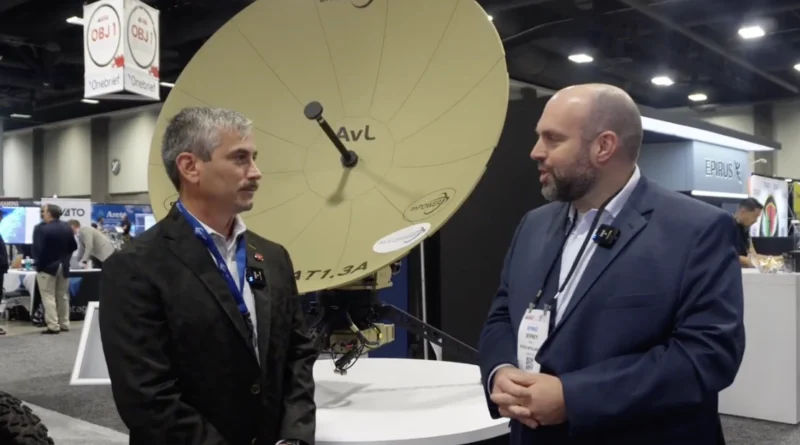

At the annual Modern Day Marine exposition, a premier event for military innovation and amphibious warfare technology, Lite Coms U.S. Government Sales Director George Cerasani detailed the critical necessity for multi-orbit connectivity in the modern battlespace. In a comprehensive discussion with Via Satellite Executive Editor Jeffrey Hill, Cerasani highlighted how Lite Coms is engineering its hardware to meet the rigorous demands of U.S. government customers, specifically the United States Marine Corps (USMC), as they transition toward more agile and dispersed operational models. The central theme of the conversation focused on the CART terminal architecture and the strategic imperative of network resiliency in the face of sophisticated near-peer adversaries.
The shift in tactical communication requirements comes at a time when the Department of Defense (DoD) is prioritizing Joint All-Domain Command and Control (JADC2), an initiative aimed at connecting sensors and shooters across all branches of the military into a unified network. For the Marine Corps, which often operates in contested maritime environments, the ability to maintain a constant data link is not merely a convenience but a fundamental requirement for survival and mission success. Cerasani noted that the current electronic warfare landscape necessitates a "little bit of everything"—a hybrid approach that utilizes Low Earth Orbit (LEO), Geostationary Orbit (GEO), and LTE cellular networks to ensure that if one link is compromised or jammed, the operator can seamlessly transition to another.
The Context of Modern Day Marine and Force Design 2030
Modern Day Marine serves as a critical junction where industry leaders and military procurement officers align on future capabilities. This year’s event took place against the backdrop of the Marine Corps’ "Force Design 2030" initiative, a massive structural overhaul intended to prepare the service for high-end conflict in the Indo-Pacific. This strategy emphasizes Expeditionary Advanced Base Operations (EABO), where small, highly mobile units operate within the reach of enemy long-range precision fires.
In such a scenario, traditional, bulky satellite terminals are a liability. The Marine Corps requires systems that are "man-portable," easy to disguise, and capable of tapping into whatever bandwidth is available in the immediate vicinity. Lite Coms has positioned itself as a key provider in this niche, focusing on the "tactical edge"—the point where the most difficult communication challenges occur. The interview between Hill and Cerasani underscored that the era of relying on a single, vulnerable satellite link is over. Resiliency is now defined by diversity in the electromagnetic spectrum.
Technical Analysis of the CART Terminal Architecture
A centerpiece of the Lite Coms strategy is the CART (Common Aperture Remote Terminal) architecture. In the satellite industry, "aperture" refers to the opening through which electromagnetic waves pass, and in a tactical sense, it refers to the antenna itself. Historically, different satellite constellations required different, proprietary hardware. A terminal designed for a GEO satellite at 36,000 kilometers might not be compatible with a LEO constellation like Starlink or OneWeb, which orbits at roughly 500 to 1,200 kilometers.
The CART architecture addresses this fragmentation by providing a modular, frequency-agnostic platform. According to technical specifications discussed in the broader industry context, such systems allow Marines to swap out "feeds" or radio frequency (RF) components without replacing the entire terminal structure. This modularity provides several key advantages:
- Logistical Efficiency: Instead of carrying three different satellite dishes for X-band, Ku-band, and Ka-band communications, a unit can carry one CART base and the necessary modular components.
- Rapid Deployment: Lite Coms terminals are designed for "auto-acquire" capabilities, meaning they can find and lock onto a satellite signal in minutes with minimal human intervention.
- Multi-Orbit Capability: By supporting both high-latency, high-throughput GEO links and low-latency, high-speed LEO links, the CART system allows for diverse data applications—from simple text-based command and control to high-definition video feeds from Unmanned Aerial Systems (UAS).
The Strategic Necessity of Network Resiliency
The "near-peer threat" mentioned by Cerasani refers primarily to the sophisticated electronic warfare (EW) and anti-satellite (ASAT) capabilities of nations like China and Russia. These adversaries have invested heavily in technologies designed to "deny, degrade, or disrupt" U.S. satellite communications. In a conflict, a GEO satellite—fixed in a predictable spot in the sky—could be easily jammed or even physically targeted.
"You need to have resiliency in your network," Cerasani emphasized during the interview. The strategy he outlined involves a "PACE" plan (Primary, Alternate, Contingency, and Emergency). In a tactical setting:
- Primary: High-speed LEO connectivity (e.g., Starlink or OneWeb) for real-time data sharing.
- Alternate: Military-grade GEO satellites (e.g., WGS) for secure, high-capacity backhaul.
- Contingency: LTE or 5G terrestrial networks if operating near urban or coastal areas.
- Emergency: Narrowband tactical radio or protected satellite waveforms.
By integrating these disparate networks into a single operational workflow, Lite Coms provides the Marine Corps with a "self-healing" network. If a LEO constellation is jammed, the terminal can automatically or manually switch to a GEO satellite or an LTE node. This multi-path approach makes it significantly harder for an enemy to achieve a total communications blackout.
Chronology of Tactical SATCOM Evolution
To understand the significance of Lite Coms’ current offerings, it is necessary to look at the timeline of tactical satellite communications over the last two decades:
- 2001–2010 (The Counter-Insurgency Era): Military SATCOM was dominated by large, stationary VSAT (Very Small Aperture Terminal) dishes. Connectivity was often slow, and because the U.S. held total air and space superiority in Iraq and Afghanistan, resiliency against jamming was a secondary concern.
- 2011–2018 (The Shift to Mobility): The rise of "SATCOM-on-the-move" (SOTM) allowed vehicles to maintain links while driving. However, these systems remained largely tied to GEO satellites, resulting in high latency (delay) that hindered real-time applications.
- 2019–Present (The Multi-Orbit Revolution): The deployment of thousands of LEO satellites by commercial entities transformed the market. The DoD began the "Commercial SATCOM Integration Program," looking for ways to use commercial bandwidth for military purposes.
- 2024 and Beyond: The focus has shifted to "hybrid terminals" like those from Lite Coms, which can bridge the gap between military-specific hardware and the burgeoning commercial space economy.
Official Responses and Market Implications
While the Lite Coms interview was a focused look at their specific products, it mirrors broader statements from the Pentagon’s Space Development Agency (SDA). SDA Director Derek Tournear has frequently stated that "proliferation" is the key to survival. By having hundreds of satellites in LEO and versatile terminals on the ground, the U.S. creates a target set too large for any adversary to effectively neutralize.
Industry analysts suggest that the market for man-portable, multi-orbit terminals is expected to grow at a Compound Annual Growth Rate (CAGR) of over 8% through 2030. This growth is driven by the urgent need for "tactical edge computing," where data is processed locally on the battlefield rather than being sent back to a distant data center. Terminals like those developed by Lite Coms act as the gateway for this data, ensuring that the Marine on the ground has the same situational awareness as a commander in a remote headquarters.
Furthermore, the sponsorship of this conversation by Lite Coms at a venue like Modern Day Marine underscores the growing importance of public-private partnerships. The military is no longer the sole driver of satellite innovation; instead, it is increasingly an "early adopter" of commercial breakthroughs, ruggedizing them for the harsh environments in which the Marine Corps operates.
Broader Impact on Global Defense Operations
The implications of Lite Coms’ work extend beyond the U.S. Marine Corps. Allied nations in NATO and the "Five Eyes" intelligence community are watching the U.S. transition to multi-orbit connectivity with great interest. The ability to switch between LEO, GEO, and LTE is becoming a standardized requirement for interoperability during joint exercises.
If a near-peer conflict were to erupt, the "first shots" would likely be fired in the electromagnetic spectrum. The ability to maintain command and control during the initial hours of electronic interference would determine the outcome of the opening gambit. Lite Coms’ focus on providing "a little bit of everything" ensures that U.S. forces are not putting all their "digital eggs in one basket."
As George Cerasani noted, things happen on certain networks, and the ability to switch over is the difference between a mission’s success and its failure. By designing for the "worst-case scenario" of a contested environment, Lite Coms is helping to define the next generation of tactical communications—one where the network is as mobile, resilient, and adaptable as the Marines who use it.
Conclusion: The Future of Tactical Connectivity
The interview at Modern Day Marine highlights a pivotal moment in military technology. As satellite constellations become more dense and diverse, the hardware on the ground must keep pace. The CART terminal architecture represents a move away from specialized, "one-off" equipment toward a more sustainable, modular future. For the U.S. Government and the Marine Corps, the path forward is clear: connectivity must be ubiquitous, redundant, and invisible to the end-user, allowing the warfighter to focus on the mission rather than the technology behind it. Through the integration of LEO, GEO, and LTE, Lite Coms is ensuring that the tactical edge remains sharp, regardless of the threats that emerge in the orbits above.
