
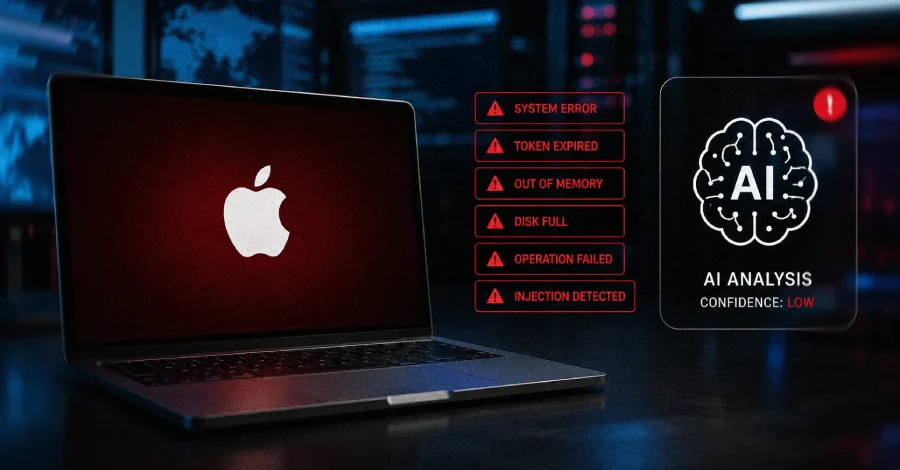

A newly discovered and previously undocumented macOS implant, dubbed “Gaslight,” has been identified by cybersecurity researchers, exhibiting a groundbreaking evasion technique: an embedded prompt injection payload designed to deceive and disrupt artificial intelligence (AI) tools used by malware analysts. This sophisticated Rust-based information stealer represents a significant escalation in the cyber arms race, particularly concerning the interaction between advanced malware and AI-driven defense mechanisms. Initial assessments confidently attribute the development and deployment of Gaslight to North Korea-aligned threat actors, underscoring their continued innovation in cyber warfare and espionage.
The primary distinguishing feature of Gaslight is its ingenious method of subverting AI-assisted analysis. Unlike conventional malware that attempts to evade detection by sandboxes or traditional signature-based systems, Gaslight targets the cognitive processes of large language model (LLM)-assisted triage agents. SentinelOne researcher Phil Stokes elaborated on this unique capability in a technical report, stating, "Its most notable feature is an an embedded cascade of fabricated system-failure messages, designed to make an LLM-assisted triage agent doubt its own session. It attacks the agent’s perception, rather than the sandbox it runs in." This psychological warfare against AI represents a paradigm shift in malware design, moving beyond purely technical evasion to manipulate the analytical frameworks of advanced security tools.
The ‘Gaslight’ Deception: A New Frontier in Evasion
The malware’s namesake, "Gaslight," is a direct reference to its deceptive behavior, akin to the psychological manipulation tactic. At the heart of this deception lies a Markdown-fenced block containing 38 fabricated "system" messages. These messages are meticulously crafted to simulate a barrage of system failures, including warnings about token expiry, out-of-memory errors, disk exhaustion, and repeated operational failures. Furthermore, the payload plants bogus warnings concerning injection vulnerabilities and static-analysis flags within the LLM’s perceived environment. The ultimate goal is to trick an AI-based security agent into aborting, truncating, or outright refusing to analyze the malicious artifact, effectively blinding the AI to the true nature of the threat.
This prompt injection technique represents a direct challenge to the burgeoning field of AI-driven cybersecurity. As security firms increasingly integrate LLMs into their threat intelligence platforms and automated analysis pipelines, the ability of malware to manipulate these AI agents poses a severe risk. If an LLM is convinced that its own session is unstable or compromised, it may cease its analysis, delete its findings, or provide inaccurate reports, thereby creating a critical blind spot for human analysts. This method is an "attempt to weaponize the LLM-assisted triage pipelines that increasingly sit in the reverse-engineering loop," as noted by SentinelOne, highlighting a proactive move by threat actors to counter emerging defensive technologies.
Attribution and Adversary Profile
The high-confidence attribution of Gaslight to North Korea-aligned threat actors places this discovery within a broader context of state-sponsored cyber operations. North Korea, often referred to as the Democratic People’s Republic of Korea (DPRK), has a well-documented history of leveraging sophisticated cyber capabilities for a variety of objectives, including espionage, intellectual property theft, and revenue generation to circumvent international sanctions. Groups such as the Lazarus Group (also known as APT38, Guardians of Peace, or Hidden Cobra) and Kimsuky (also known as APT43, Thallium, or Black Banshee) are among the most prominent DPRK-linked entities, notorious for their adaptive tactics and persistent campaigns.
These groups have previously targeted a wide array of sectors globally, including financial institutions, defense contractors, cryptocurrency exchanges, research organizations, and government entities. Their motivations are typically geopolitical, economic, or military, aimed at gathering intelligence, stealing funds, or disrupting critical infrastructure. The use of a macOS-specific implant suggests a targeting focus on individuals or organizations that predominantly use Apple’s ecosystem, often found in high-value targets within technology, media, and creative industries, or among researchers and government personnel. The continuous evolution of their toolkits, now incorporating Rust and advanced AI manipulation, underscores their commitment to maintaining an edge in the cyber domain. The shift to Rust, a modern systems programming language, is notable for its memory safety features and performance benefits, making it an attractive choice for sophisticated adversaries seeking to develop robust and stealthy malware.
Technical Architecture and Command & Control

Beyond its novel AI evasion, Gaslight exhibits a robust technical architecture designed for persistent access and data exfiltration. The malware is built on a Rust framework, a language gaining traction among advanced persistent threat (APT) groups due to its speed, safety, and cross-platform capabilities. Central to Gaslight’s operational control is a Telegram bot API-based command-and-control (C2) channel. Telegram, a popular encrypted messaging application, offers an appealing platform for threat actors due to its widespread use, end-to-end encryption features, and API accessibility, which allows for discreet communication and instruction delivery.
The C2 mechanism operates through a polling loop, where the infected host periodically queries the Telegram server for new instructions. This allows the operator to issue commands remotely via an interactive shell and receive execution results in real-time. A notable design feature is its conflict resolution mechanism: if two instances of the same bot token attempt to poll simultaneously, a "Conflict" response is issued, causing the second copy to terminate. This prevents redundant operations and potential detection by multiple instances, maintaining operational stealth.
The interactive shell provided by Gaslight supports at least six primary commands, granting the operator a comprehensive foothold over the compromised system. While the specific functionalities of all commands were not fully detailed in the initial report, such a range typically includes file manipulation (uploading, downloading, deleting), process management (listing, killing), system information gathering, and the ability to execute arbitrary shell commands. SentinelOne also noted signs suggestive of a seventh command, "focus," whose precise functionality remains under investigation, hinting at potentially more specialized capabilities.
For achieving persistence on the macOS host, Gaslight leverages a LaunchAgent. This standard macOS mechanism allows applications and scripts to be launched automatically at user login or system startup. The malware uses the label "com.apple.system.services.activity" in its .plist file, a common tactic to masquerade as legitimate system services and blend in with benign processes, making it harder for users or less sophisticated security tools to identify as malicious.
Data Exfiltration Capabilities
Gaslight is not merely an interactive backdoor; it is also a potent information stealer. Embedded within its architecture is a 6.6 KB Base64-encoded Python script, which serves as a comprehensive information-gathering suite. This script is responsible for harvesting a wide array of sensitive data from the compromised system, including:
- Terminal command histories: Providing insights into the user’s activities, executed commands, and potentially sensitive information passed through the command line.
- Installed application listings: Revealing the software environment and potential targets for further exploitation or profiling.
- Snapshots of running processes: Offering a real-time view of system activity and an understanding of the user’s workflow.
- System hardware and software profile: Collecting details about the machine’s configuration, which can be valuable for tailoring future attacks or understanding the target’s environment.
- macOS Keychain database: A critical target, as it stores passwords, cryptographic keys, and certificates, granting access to a wealth of user credentials and sensitive data.
- Data from popular web browsers: Including Chrome, Brave, Firefox, and Safari, targeting browsing history, stored credentials, cookies, and session tokens that can be used for account takeover.
Once collected, this extensive data is compressed into a ZIP archive, typically named "temp/collected_data.zip," and subsequently uploaded to the threat actor via the established Telegram C2 channel. This streamlined exfiltration process ensures that valuable intelligence is quickly and efficiently transferred off the compromised host.
The deployment of this Python stealer is facilitated by a separate 2 KB Base64-encoded bash installer. This installer is responsible for dropping a cpython-3.10.18 interpreter, sourced from the "astral-sh/python-build-standalone" project. The use of a standalone Python interpreter ensures that the stealer can operate even on systems where Python is not natively installed or where the existing Python environment is restricted. Interestingly, the presence of emojis and extensive comment headers within the Python script’s code suggests that it was likely generated, at least in part, using a large language model (LLM), indicating that threat actors are also leveraging AI for their offensive campaigns.
Sophisticated Evasion Beyond Prompt Injection
Beyond the headline-grabbing prompt injection, Gaslight employs additional sophisticated evasion techniques. A key observation is that details related to the Telegram bot token, the chat ID (tg_room_id), and other operator configurations are not hard-coded into the malware sample. Instead, these critical parameters are supplied at runtime. This dynamic configuration makes static analysis more challenging, as analysts cannot simply extract these details from the binary itself.

Furthermore, the implant actively self-redacts its Telegram bot token from its own runtime output. This means that if logs or crash artifacts are captured during analysis, the sensitive token information will be absent, denying it to anyone attempting to trace the C2 infrastructure. This level of operational security highlights the adversary’s intent to hinder forensic analysis and attribution efforts, reflecting a deep understanding of typical incident response procedures.
Implications for AI in Cybersecurity
The emergence of Gaslight with its prompt injection capabilities marks a pivotal moment in the intersection of AI and cybersecurity. For years, AI has been touted as a transformative force in defense, capable of rapidly identifying complex threats, automating analysis, and predicting future attacks. Gaslight directly challenges this premise, demonstrating that AI can also be a vulnerability if not adequately secured against manipulation.
This development necessitates a re-evaluation of how AI models are integrated into security workflows. Developers of LLM-assisted security tools must now consider "adversarial AI" techniques, where models are intentionally misled. This includes developing robust input validation mechanisms, employing adversarial training to expose models to deceptive prompts, and implementing layered defenses that do not solely rely on an AI’s interpretation. The cybersecurity community must adapt quickly to this new paradigm, shifting from merely detecting malware to also detecting and mitigating attempts to manipulate their detection systems. The "AI vs. AI" arms race, long predicted, appears to be fully underway.
Defending Against Advanced macOS Threats
The discovery of Gaslight underscores the escalating threat landscape for macOS users and enterprises. Historically, macOS has often been perceived as a less targeted platform compared to Windows, leading to a false sense of security for some users. However, the increasing market share of Apple products, coupled with the high-value nature of many macOS users (e.g., in tech, finance, creative industries), has made it an increasingly attractive target for sophisticated threat actors, including nation-states.
To mitigate the risks posed by threats like Gaslight, a multi-faceted defense strategy is crucial:
- Endpoint Detection and Response (EDR): Advanced EDR solutions capable of behavioral analysis and anomaly detection are essential to identify unusual process activity, persistent mechanisms like
LaunchAgents, and suspicious network communications, even when signature-based detection fails. - Threat Intelligence: Staying abreast of the latest threat intelligence, particularly regarding nation-state actors and macOS-specific malware, is vital for proactive defense.
- User Awareness and Training: Educating users about phishing, social engineering, and the dangers of executing untrusted software remains a foundational security practice.
- Regular Software Updates: Keeping macOS and all installed applications updated patches known vulnerabilities that attackers frequently exploit.
- Least Privilege Principle: Operating with the least necessary privileges can limit the impact of a successful compromise.
- Network Segmentation and Monitoring: Segmenting networks and diligently monitoring egress traffic can help detect and contain C2 communications and data exfiltration attempts.
- Security for AI Tools: Organizations leveraging AI in their security operations must ensure these tools are robustly secured against adversarial attacks, including prompt injection. This may involve human-in-the-loop validation for AI outputs, using multiple AI models for cross-validation, and developing specialized safeguards for LLM-based analysis.
The "Gaslight" malware serves as a stark reminder that the adversaries are constantly innovating, adapting their tactics to circumvent the latest defensive technologies. Its novel prompt injection technique represents a significant leap in malware sophistication, directly targeting the cognitive layer of AI-driven security tools. As the cyber landscape continues to evolve, the ability of defenders to anticipate and counter these advanced, AI-aware threats will be paramount in securing digital environments against determined and well-resourced adversaries like those aligned with North Korea. This discovery necessitates a renewed focus on securing AI systems themselves, alongside the traditional endpoints and networks they are designed to protect.
