
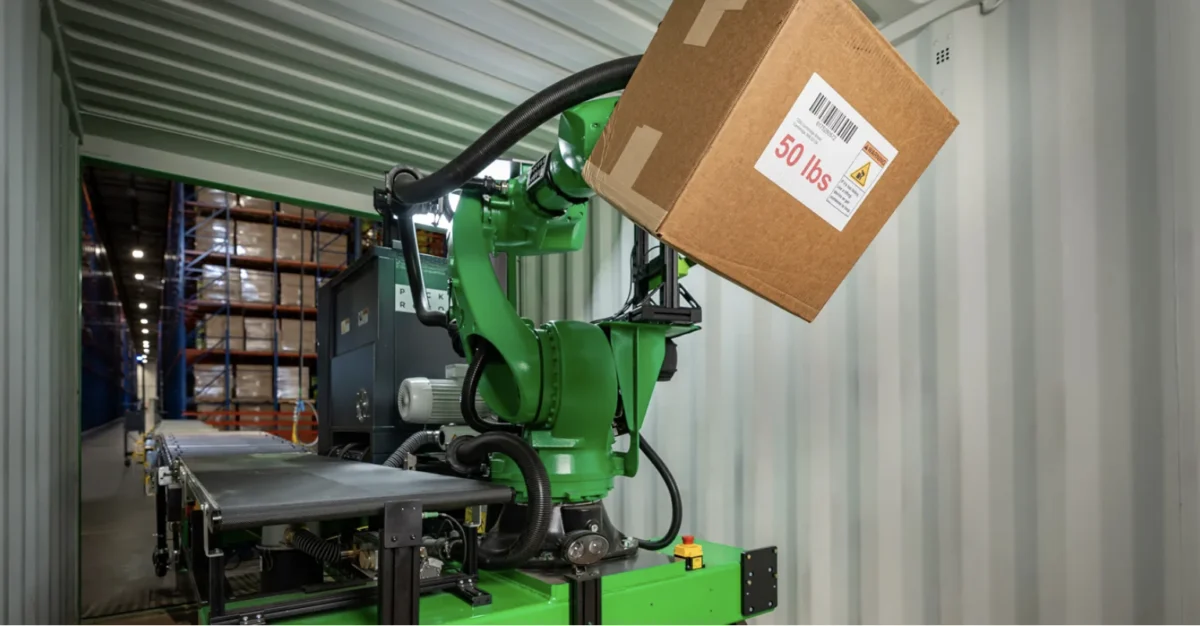

The landscape of global logistics and supply chain management is undergoing a fundamental shift as the integration of advanced computer vision, machine learning, and process mining moves from back-office software into the gritty, high-intensity environment of the warehouse loading dock. At the center of this transition is Pickle Robot Company, a Charlestown, Massachusetts-based firm founded by MIT alumni Ariana Eisenstein, AJ Meyer, and Dan Paluska. Since its inception, the company has focused on a singular, high-complexity problem: the autonomous unloading of non-palletized goods from trucks, trailers, and shipping containers. In a significant advancement for the industry, Pickle Robot recently collaborated with Celonis and LeafLabs to launch the Celonis Robotic Systems Intelligence Manager. Announced in February 2026, this application represents the first major effort to bridge the gap between raw robotic telemetry and enterprise-grade process intelligence, effectively treating physical robotic movements as measurable business processes.
The move comes at a time when the logistics sector is grappling with unprecedented labor shortages and rising operational costs. Traditionally, the unloading of "floor-loaded" containers—where boxes are stacked loosely rather than on pallets—has been a manual, grueling task prone to high injury rates and turnover. By deploying "Physical AI," Pickle Robot seeks to automate this bottleneck. Unlike traditional robotics companies that may attempt to program specific movements for specific scenarios, Pickle Robot identifies as a physical AI entity. This distinction is critical to their methodology; the AI is the core of the system, designed to navigate the chaotic and unpredictable environment of a trailer where boxes may have shifted, crushed, or tilted during transit.
The Technological Foundation of Physical AI
The architecture of the Pickle Robot system is built on a mobile manipulation platform equipped with a custom end effector and a proprietary sensor suite. The software stack is designed to manage everything from low-level motor actuation to high-level cognitive decision-making. According to CTO Ariana Eisenstein, the complexity of the task requires a massive amount of data processing. Each robot in the field generates approximately 100 gigabytes of telemetry data per day. This data includes everything from joint torque and spatial coordinates to visual recognition logs and error codes.
The deployment model for these systems is notably aggressive. In an industry where automation projects often take months or years to realize, Pickle Robot has refined a cycle that allows a unit to arrive at a customer site on a Monday, achieve full connectivity by Wednesday, and reach production-level throughput by Friday. This speed is essential for customers like UPS, Yusen Logistics, and Ryobi Tools, who require immediate scalability to meet fluctuating demand. However, the sheer volume of data generated by these rapid deployments initially presented a significant hurdle: the "data problem."
Addressing the Data Bottleneck through Process Intelligence
Prior to the partnership with Celonis, the engineering and operations teams at Pickle Robot operated in a largely reactive mode. Telemetry data was unstructured, and identifying the root cause of a performance dip often required manual "log-diving"—a process where engineers sifted through millions of lines of code and sensor readings to understand why a robot failed to grasp a specific package. This approach was not only time-consuming but also decoupled from the business metrics that warehouse managers prioritize.
The breakthrough occurred when Pickle Robot integrated its systems with the Celonis Process Intelligence Platform. Celonis, a leader in process mining, had spent years perfecting the "Process Intelligence Graph," a semantic layer that maps how different objects and actions interact within a business system. By working with LeafLabs, a firm specializing in Petri Nets and complex data structuring, Pickle Robot was able to translate robotic movements into a structured process map.
In this framework, every action the robot takes—reaching for a box, grasping it, pulling it from the stack, and placing it on a conveyor—is treated as a discrete step in a business process. This allows the system to be analyzed using the same mathematical rigor applied to global supply chains or financial audits. The result of this integration was a 50 percent acceleration in core processing development for the robot’s more advanced capabilities, as engineers could now see exactly where the "process" of unloading was breaking down in real-time.
Quantifiable Gains: The Re-Grasp Case Study
The power of this structured approach is best illustrated through the optimization of the robot’s "re-grasp" behavior. In the messy reality of a shipping container, a robot may not always secure a perfect grip on a package on the first attempt. Previously, the system was programmed to try three times before signaling for human intervention. This number was based on anecdotal engineering observations.
However, once the data was funneled through the Celonis Robotic Systems Intelligence Manager, a different story emerged. Analysis across the entire fleet revealed that the third attempt had a statistically negligible success rate. More importantly, that third attempt added an average of four seconds to the cycle time. In an environment where the average cycle time is only six seconds, the third attempt was a massive drain on efficiency. By simply adjusting the configuration to eliminate the third attempt and move immediately to a different package or strategy, Pickle Robot was able to instantly increase the "tempo" of the entire warehouse. This change, which previously would have taken weeks of data collection and validation, was identified and implemented in a fraction of the time.
Aligning Engineering Metrics with Business KPIs
A recurring theme in the evolution of Pickle Robot is the alignment of internal technical performance with external customer Key Performance Indicators (KPIs). In many robotics startups, success is measured by "uptime" or "successful picks." While these are important, they do not always translate to the bottom line of a logistics provider. By using the Celonis platform, Pickle Robot has shifted its language to match that of its clients.
"Pickle Robot’s whole thesis is about delivering a complete product," Eisenstein noted during the launch. "By putting the robot’s data into a process structure, we’re all now speaking the language of customer KPIs, which ultimately drives up to the KPIs of the whole warehouse."
This alignment is particularly relevant when considering the "first node" problem. The unloading dock is the entry point for all goods into a facility. Any delay at this stage creates a bullwhip effect that impacts downstream sorting, storage, and eventual outbound shipping. By optimizing the unload process through process intelligence, Pickle Robot ensures that the "pulse" of the warehouse remains consistent, allowing for better labor planning and throughput predictability.
Safety and the Human Element
Beyond the technical and economic metrics, the deployment of Pickle Robot systems addresses a critical human factor: workplace safety. The Occupational Safety and Health Administration (OSHA) and the Bureau of Labor Statistics consistently rank warehouse material handling as one of the most hazardous occupations in the United States. Unloading floor-loaded containers is particularly dangerous due to the risk of musculoskeletal injuries from repetitive heavy lifting, as well as the danger of falling objects.
In many facilities, shifts for manual unloaders are restricted to four hours because the human body cannot sustainably perform the task for a full eight-hour workday. This leads to complex staffing requirements and high turnover. By automating this specific role, companies are not just seeking efficiency; they are looking to significantly reduce their workplace injury liability. The ROI for these systems is increasingly calculated not just in boxes per hour, but in the reduction of workers’ compensation claims and the stabilization of the workforce.
The Future: A Global Lingua Franca for Robotics
The long-term vision for Pickle Robot and Celonis extends far beyond a single loading dock. As more automation assets—such as autonomous forklifts, scan tunnels, and automated storage and retrieval systems (ASRS)—are deployed, the need for a unified "observability point" becomes paramount. The Pickle Robot acts as a data-gathering node, capturing dimensions, weights, and handling characteristics of every package that enters the building.
The ambition for 2026 and beyond is to create a hierarchical stack of processes. In this vision, a single robot’s "reach-grasp-pull" cycle is a sub-process within the warehouse’s "receive-sort-store" process, which is itself a node in a global logistics network connected by ships, planes, and trucks. Eisenstein suggests that for the "explosion of physical AI" to be truly effective, there must be a "lingua franca"—a common language—that allows different robotic systems from different manufacturers to communicate and coordinate.
By utilizing process intelligence as this common language, the industry can move toward a future where the entire supply chain is visible and optimizable in real-time. The partnership between Pickle Robot and Celonis serves as a blueprint for this transition, proving that the most valuable part of a robot may not be its mechanical arm, but the data-driven intelligence that guides it. As physical AI continues to mature, the focus will likely remain on this intersection of mechanical capability and process transparency, ensuring that automation serves the broader strategic goals of the global economy.
