
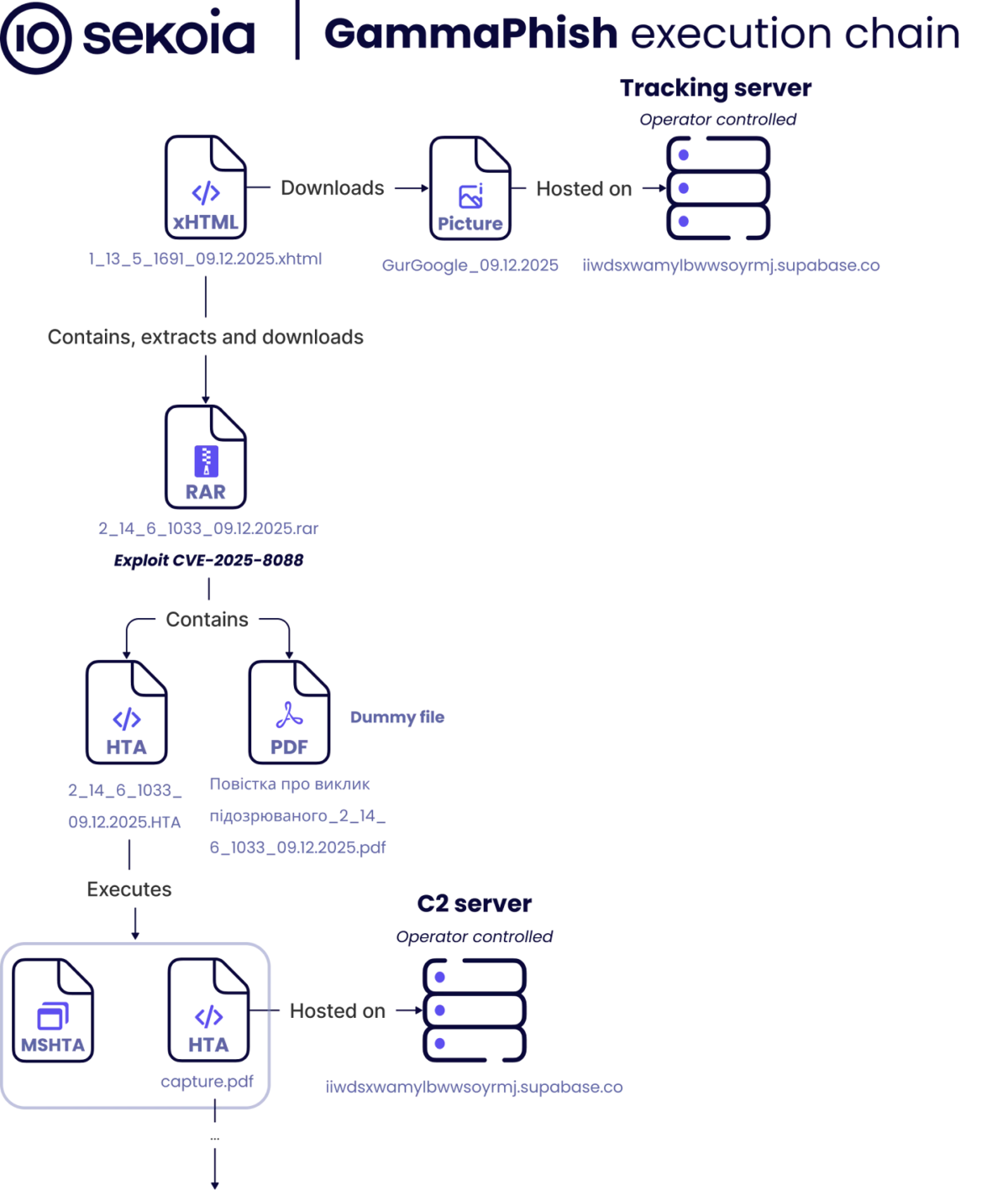

The prolific Russian state-sponsored hacking collective, known as Gamaredon and officially linked to the Federal Security Service (FSB), has been unequivocally identified as the orchestrator behind an ongoing, sophisticated campaign that exploits a critical WinRAR vulnerability, CVE-2025-8088. This multi-pronged attack aims to disseminate a diverse array of malware families, primarily focused on extensive data exfiltration and widespread propagation across targeted networks, with a particular emphasis on Ukrainian government, military, and critical infrastructure entities. The resilience and adaptability of this operation underscore the evolving nature of cyber warfare and the persistent threat posed by nation-state actors.
Anatomy of a Sophisticated Infection Chain
The latest intelligence, meticulously compiled and released by French cybersecurity firm Sekoia in January 2026, details a complex infection chain initiated through the weaponization of CVE-2025-8088. This vulnerability, classified as a path traversal flaw within the popular WinRAR archiving software, allows attackers to craft malicious archives that, when extracted, can place files in arbitrary locations on a user’s system, bypassing security controls and enabling the execution of malicious payloads. This critical flaw provides Gamaredon with an initial foothold, paving the way for a deeper infiltration.
The initial phase of the attack involves delivering an HTML Application (HTA) payload, cleverly dubbed "GammaPhish." HTA files, being executable scripts that can run in the context of Internet Explorer (even if not the default browser), offer a versatile method for attackers to execute code and interact with the operating system. Once GammaPhish is activated, it acts as a primary dropper, retrieving subsequent malicious components.
Following GammaPhish, an intermediate Visual Basic Script (VBScript) downloader, codenamed "GammaLoad," is deployed. Sekoia’s analysis highlights GammaLoad’s critical functions within the infection process: its initial task is to meticulously fingerprint the host system, gathering vital information about the compromised environment. Subsequently, it updates network configurations within the system’s registry, often leveraging "dead drop resolvers" (DDRs) to obscure its command-and-control (C2) infrastructure. The ultimate objective of GammaLoad is to fetch and execute arbitrary VBScript payloads directly from these C2 servers, allowing Gamaredon to dynamically adapt its attack based on the target’s environment and their specific objectives. This modular approach grants the attackers significant flexibility and stealth.

Malware Arsenal: GammaWorm and GammaSteel
Among the most prominent payloads delivered by GammaLoad is "GammaWorm," a sophisticated VBScript worm designed for sustained persistence and lateral movement. GammaWorm achieves persistence by establishing scheduled tasks, ensuring its execution even after system reboots. A key characteristic of this worm is its propagation mechanism: it systematically hides legitimate directories on network shares and connected USB drives, replacing them with malicious Windows Shortcut (LNK) files. When an unsuspecting user attempts to access these seemingly legitimate directories, they inadvertently trigger the LNK file, which then executes arbitrary code retrieved from GammaWorm’s C2 server. This technique is highly effective for spreading within an organization and across air-gapped networks via removable media.
To maintain covert communication with its C2 infrastructure, GammaWorm employs an ingenious method: it initiates GET requests via the curl utility to a hard-coded public Telegram channel. By leveraging legitimate communication platforms like Telegram, Gamaredon aims to camouflage its C2 traffic amidst regular network activity, thereby evading traditional detection mechanisms and sustaining long-term espionage operations. Furthermore, GammaWorm utilizes NTFS Alternate Data Streams (ADS) to conceal its core modules. ADS is a feature of the NTFS file system that allows data to be associated with an existing file without altering its primary data stream, effectively making the hidden data invisible to standard file system browsers and antivirus scans, thus enhancing the malware’s stealth capabilities.
Another critical component of Gamaredon’s arsenal, also delivered via GammaLoad, is "GammaSteel." This modular information stealer is engineered to systematically search for and exfiltrate files matching specific extensions. The stolen data is then uploaded to attacker-controlled Amazon Web Services (AWS) S3 buckets, providing a robust and scalable exfiltration channel. In instances where the primary AWS S3 exfiltration fails, GammaSteel is equipped with fallback mechanisms to transmit data to alternative attacker-controlled servers, ensuring data theft even under adverse conditions. Sekoia’s research indicates that the infection sequences observed are versatile enough to distribute other malware families, such as "GammaWipe" (also known as "GamaWiper"), depending on the specific objectives and strategic priorities of the threat actor for a given target. This modularity highlights Gamaredon’s operational flexibility and their ability to tailor attacks.
The Threat Actor: Gamaredon’s History and Modus Operandi
Gamaredon, also tracked by the cybersecurity community under various aliases such as Primitive Bear and UAC-0010, is a highly active and persistent Russian state-sponsored intrusion set. Their operational focus has historically been almost exclusively on Ukraine, particularly targeting government agencies, military organizations, law enforcement, and critical infrastructure sectors. This consistent targeting aligns with Russia’s geopolitical objectives and ongoing conflict in the region, suggesting that Gamaredon’s activities are integral to broader intelligence gathering and disruption efforts.

The group’s typical initial access vector involves spear-phishing emails containing malicious attachments. These emails are meticulously crafted to appear legitimate, often impersonating trusted entities or containing enticing subject lines relevant to the recipient’s role or current events. The attachments frequently take the form of booby-trapped RAR archives, leveraging the very vulnerability now under scrutiny, CVE-2025-8088, to kickstart their intricate infection process. Gamaredon’s campaigns are characterized by their high volume, consistent evolution, and a relentless pursuit of intelligence, making them one of the most significant cyber threats to Ukraine.
Timeline and Chronology of Exploitation
The WinRAR path traversal vulnerability, CVE-2025-8088, likely came to public attention or was patched sometime prior to its observed exploitation, given the nature of CVE disclosures. While the exact date of its public disclosure isn’t specified in the provided context, the fact that Gamaredon is actively weaponizing it in 2026 suggests it has been a known flaw for a period, or that Gamaredon has been quick to integrate new vulnerabilities into their toolkit. Sekoia’s observation of this specific infection chain in January 2026 provides a concrete timeline for the current campaign.
Gamaredon’s consistent activity throughout 2025 and into 2026 underscores their strategic importance to Russian intelligence. Previous reports from September 2025 highlighted Gamaredon’s activities alongside another Russian group, Turla, in similar espionage efforts. In April 2025, the group was noted for its use of infected removable media to spread malware, indicating a long-standing reliance on propagation techniques that bypass network defenses. The evolution of their toolset, from simpler initial access methods to the current multi-stage, highly obfuscated modular design, reflects a continuous effort to improve their operational effectiveness and evade detection.
Expert Analysis and Broader Implications
Sekoia’s assessment of Gamaredon’s current campaign points to a "resilient, massive, and highly obfuscated modular design." Cybersecurity experts concur that this architecture, combined with the operator’s ability to update configurations on the fly via C2 servers, makes it highly probable that these tactics and tools will be reused in future operations. The adaptability demonstrated by Gamaredon, particularly in leveraging legitimate platforms like Telegram for C2 and stealth techniques like NTFS ADS, poses a significant challenge for defensive measures.

The continued targeting of Ukraine by groups like Gamaredon is not an isolated phenomenon but part of a broader, persistent cyber warfare landscape. The current developments coincide with reports of other Russia-aligned groups intensifying their attacks against Ukraine:
- UAC-0184: This group has been observed targeting Ukrainian military-related entities, utilizing LNK lures to deliver an executable associated with a legitimate program, PassMark BurnInTest. This tactic, documented in January 2026, relies on social engineering to trick users into executing seemingly benign files.
- UAC-0247 (formerly UAC-0244): This threat cluster has specifically singled out drone operators in Ukraine, deploying HTML Application (HTA) droppers via ZIP archives. Their campaigns, active in April 2026, culminate in the deployment of a backdoor capable of establishing a reverse shell to attacker-controlled infrastructure, providing direct remote access.
- APT28 (Fancy Bear, Strontium): Another prominent Russian state-sponsored group, APT28, has also seen the evolution of its "PixyNetLoader" malware loader. Threat hunters from ExaTrack have charted its progression, noting its detection in the wild since December 2024, with recent iterations discovered as recently as April 15, 2026. This loader has been linked to campaigns exploiting a Microsoft Office vulnerability (CVE-2026-21509) to extract a COVENANT Grunt implant, a sophisticated post-exploitation framework.
These parallel activities underscore the multi-faceted nature of the cyber threat facing Ukraine, involving a diverse array of state-sponsored actors employing various vulnerabilities and sophisticated malware to achieve intelligence and strategic objectives. The use of common software vulnerabilities (WinRAR, Microsoft Office) highlights a persistent reliance on known weaknesses, even as malware capabilities evolve.
Mitigation and Defensive Strategies
In light of Gamaredon’s persistent and evolving threat, organizations, particularly those in Ukraine and sectors relevant to national security, must implement robust cybersecurity measures:
- Prompt Patching: The immediate and critical step is to ensure all software, especially widely used archiving tools like WinRAR and office productivity suites, are updated to the latest versions. Patching CVE-2025-8088 and CVE-2026-21509 is paramount to closing known exploitation avenues.
- Enhanced Endpoint Detection and Response (EDR): Advanced EDR solutions are crucial for detecting the anomalous behaviors associated with multi-stage attacks, such as the execution of HTA or VBScript files from unusual locations, attempts to create scheduled tasks, or the use of NTFS ADS.
- Network Monitoring and Threat Intelligence: Continuous monitoring of network traffic for suspicious C2 communications, especially those attempting to blend in with legitimate services like Telegram, is vital. Organizations should integrate up-to-date threat intelligence feeds to identify indicators of compromise (IoCs) associated with Gamaredon and similar groups.
- User Awareness Training: Given the reliance on spear-phishing and malicious attachments, comprehensive and ongoing cybersecurity awareness training for all employees is essential. Users must be educated on identifying phishing attempts, exercising caution with unexpected attachments (especially RAR or ZIP archives), and the dangers of executing unknown files.
- Data Backup and Recovery: Regular, off-site backups are critical to ensure business continuity and data recovery in the event of a successful data theft or destructive malware attack.
- Principle of Least Privilege: Implementing the principle of least privilege for user accounts and applications can limit the potential damage should a system become compromised.
- Disable Unnecessary Features: Where feasible and not critical for business operations, disabling features like VBScript execution in certain contexts or blocking access to public communication platforms from enterprise networks can reduce the attack surface.
The ongoing exploitation of the WinRAR vulnerability by Gamaredon serves as a stark reminder of the persistent and adaptive nature of state-sponsored cyber threats. As cyber warfare continues to evolve, a layered defense strategy combining technical controls, robust threat intelligence, and a vigilant human element remains the most effective approach to safeguarding critical systems and sensitive information. The international cybersecurity community remains committed to tracking and exposing these threats to bolster global digital defenses against sophisticated adversaries.
