
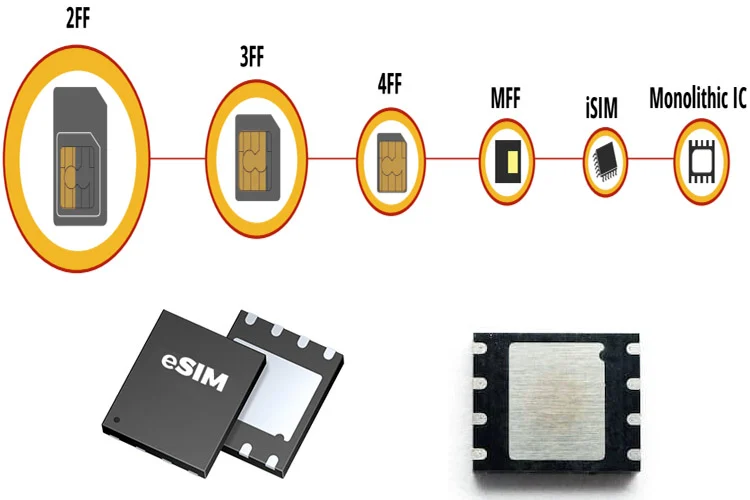

The global telecommunications landscape is currently undergoing its most significant structural transformation since the inception of the mobile phone. Central to this shift is the transition from the traditional, removable Subscriber Identity Module (SIM) to the embedded SIM, or eSIM. While the physical SIM card has been a staple of mobile technology since 1991, the emergence of the eSIM represents a move toward software-defined connectivity, offering a more flexible, secure, and space-efficient alternative for manufacturers and consumers alike. An eSIM is essentially a small chip soldered directly onto a device’s motherboard, functioning as a digital version of the traditional SIM card that allows users to activate a cellular plan without the need for a physical insert.
The Chronological Evolution of SIM Technology
To understand the impact of the eSIM, one must look at the trajectory of SIM technology over the last three decades. The first SIM card, introduced by Giesecke+Devrient in 1991, was the size of a credit card (1FF). As mobile devices became more compact, the industry saw the introduction of the Mini-SIM (2FF) in 1996, the Micro-SIM (3FF) in 2003, and the Nano-SIM (4FF) in 2012. Each iteration focused on reducing the physical footprint to allow more room for internal components like batteries and cameras.
The concept of the eSIM (eUICC) was first standardized by the GSMA in 2016, initially targeting the Internet of Things (IoT) and wearable markets, where space is at a premium. The technology gained mainstream momentum in 2018 when Apple integrated eSIM capabilities into the iPhone XS and XR series. A watershed moment occurred in September 2022, when Apple announced that all iPhone 14 models sold in the United States would be "eSIM only," effectively signaling the beginning of the end for the physical SIM tray in flagship consumer devices.
Technical Architecture and Remote Provisioning
The fundamental difference between a traditional SIM and an eSIM lies in the "Remote SIM Provisioning" (RSP) capability. Traditional SIM cards are "pre-provisioned," meaning the network credentials are baked into the chip during manufacturing. To change carriers, a user must physically replace the chip. In contrast, an eSIM is "re-programmable" over-the-air (OTA).
The eSIM architecture utilizes a specialized microchip called the eUICC (Embedded Universal Integrated Circuit Card). This chip interacts with a Subscription Manager Data Preparation (SM-DP+) server, which securely encrypts and downloads the "profile"—containing the IMSI (International Mobile Subscriber Identity) and authentication keys—directly to the device. This process is usually initiated by scanning a QR code or through a carrier’s mobile application. Because the chip can store multiple profiles, users can toggle between different network providers via their device settings, a feature that has revolutionized international roaming and dual-SIM functionality.
Market Adoption and Global Data Trends
According to data from GSMA Intelligence, the adoption of eSIM technology is accelerating at a rapid pace. By the end of 2023, more than 800 mobile operators globally had launched commercial eSIM services for smartphones. Market analysts project that by 2030, there will be over 3.4 billion eSIM-enabled devices in active use, representing a significant portion of the global mobile market.
The growth is not limited to smartphones. The automotive industry has become a primary driver of eSIM adoption. Modern "connected cars" utilize eSIMs to provide real-time navigation, emergency services (eCall), and in-vehicle Wi-Fi. Similarly, the industrial IoT sector employs eSIMs in smart meters, shipping containers, and environmental sensors, where the ability to manage thousands of connections remotely is a logistical necessity.
Strategic Advantages for Stakeholders
The transition to eSIM technology offers distinct advantages for various sectors of the economy:
- For Consumers: The most immediate benefit is the elimination of the "SIM ejector tool" and the need to visit a physical retail store. For international travelers, the eSIM allows for the purchase of local data plans before they even land in a foreign country, bypassing expensive roaming fees. Furthermore, the ability to maintain two numbers—one for business and one for personal use—on a single device has become significantly easier to manage.
- For Manufacturers: Removing the physical SIM tray allows engineers to reclaim internal space. A standard Nano-SIM tray occupies approximately 12.3mm x 8.8mm of space, which is substantial in the context of modern smartphone architecture. This space can be repurposed for larger batteries, better thermal management, or additional sensors. Additionally, removing the SIM slot improves the device’s structural integrity and water resistance by eliminating an entry point for dust and moisture.
- For Carriers: While some carriers initially resisted the eSIM due to fears of increased "churn" (customers switching providers more easily), many now view it as a cost-saving measure. Digital distribution of profiles eliminates the overhead costs associated with manufacturing, shipping, and storing physical plastic cards.
- Security and Theft Prevention: From a security standpoint, an eSIM is superior. If a device is stolen, a thief cannot simply remove the SIM card to prevent the device from being tracked. The eSIM remains active and locked to the device, making it easier for owners to locate their hardware via cloud services.
Activation Protocols: A Step-by-Step Overview
The activation process for an eSIM is designed to be user-friendly, though it varies slightly between operating systems.
On iOS Devices:
Users typically navigate to Settings > Cellular > Add eSIM. Apple provides several methods: "eSIM Carrier Activation," where the carrier assigns the eSIM to the device at the time of purchase; "eSIM Quick Transfer," which allows users to transfer a SIM from an old iPhone to a new one; and the standard QR code method. Once the profile is downloaded, the device identifies the new line, allowing the user to label it (e.g., "Travel" or "Business") and choose which line to use for data or voice.
On Android Devices:
The process is similar, generally found under Settings > Network & Internet > SIMs > Add SIM. Android users scan the provider-supplied QR code, and the device handles the background handshake with the carrier’s server. Major manufacturers like Samsung and Google have streamlined this process to ensure that the transition from a physical SIM to an eSIM is nearly instantaneous.
Challenges and Industry Responses
Despite the advantages, the transition to a purely digital SIM ecosystem is not without challenges. One of the primary concerns involves "device portability." With a physical SIM, moving a phone number from a broken phone to a backup device is as simple as moving the card. With an eSIM, if a device’s screen is shattered and unresponsive, transferring the digital profile may require contacting the carrier’s customer support, which can be a point of friction for users.
Furthermore, there is a "digital divide" in carrier support. While major tier-one providers in North America, Europe, and East Asia have fully embraced eSIM, many smaller regional carriers and providers in developing markets still rely exclusively on physical SIM cards. This has led to a fragmented experience for global travelers who may find that their "eSIM-only" device cannot connect to local networks in certain parts of the world.
To address these issues, the GSMA is working on updated standards to make "eSIM Transfer" more seamless across different hardware brands. Software developers are also creating "eSIM Discovery" services that automatically notify a device when a new profile is available, removing the need for QR codes entirely.
Environmental Impact and Sustainability
The environmental implications of the eSIM transition are profound. Every year, billions of physical SIM cards are produced, involving the use of plastic, gold, and silicon. These cards are often shipped in large plastic holders, leading to significant waste. By moving to a digital-first model, the telecommunications industry can drastically reduce its plastic footprint and the carbon emissions associated with the logistics and distribution of physical goods. Many major telecommunications groups have cited eSIM adoption as a key component of their Environmental, Social, and Governance (ESG) strategies.
Future Outlook: From eSIM to iSIM
As the industry matures, the next phase of evolution is already appearing on the horizon: the iSIM (Integrated SIM). While the eSIM is a separate chip soldered to the motherboard, the iSIM integrates the SIM functionality directly into the device’s main processor (the System-on-Chip or SoC). This further reduces power consumption and frees up even more space. Qualcomm and Thales have already demonstrated functional iSIM technology, which is expected to become the standard for the next generation of ultra-compact IoT devices and high-end smartphones.
In conclusion, the eSIM is more than just a technological convenience; it is a fundamental reimagining of how we connect to the world. By decoupling the subscriber identity from a physical piece of plastic, the industry has unlocked new levels of flexibility for consumers and efficiency for manufacturers. While the transition period may present minor logistical hurdles, the data suggests that the era of the physical SIM card is rapidly drawing to a close, giving way to a more integrated and digital future.
