

The world is rapidly embracing Artificial Intelligence (AI) to enhance efficiency and safety across diverse sectors, from creative endeavors and autonomous vehicle development to groundbreaking drug discovery. Underpinning these advancements is a fundamental element: code. AI models are trained and built using code, and sophisticated tooling augments these raw models into functional applications. While early AI development relied on human-written code, the current landscape is witnessing AI self-generating code at an unprecedented scale and speed, far surpassing human capabilities. This surge is placing immense strain on existing platforms, with GitHub forecasting a tenfold increase to 14 billion commits by 2026. While the accessibility to building applications has dramatically lowered, this convenience conceals significant long-term cleanup costs.
The Architects and Consumers of AI-Generated Code: Unpacking the Cleanup Challenge
The proliferation of AI-generated code raises critical questions: who is developing it, who is utilizing it, and what are the cumulative cleanup costs associated with its widespread adoption? The users of AI-generated code can be broadly categorized into several archetypes. While the foundational and distribution layers of AI are pervasive, this analysis will focus on the "Building" layer, encompassing engineering organizations, independent developers, and citizen developers – those who actively generate, deploy, and maintain the code. It is within this layer that the hidden costs are most concentrated, and where effective solutions must be implemented. Before delving into these costs, it is essential to acknowledge the substantial benefits AI-generated code offers.
AI has empowered developers to achieve unprecedented velocity in development and deployment. New API endpoints can be created, tested, and shipped within mere hours, while bug fixes and prototypes are addressed with remarkable speed. Internal tools and automation are also being developed at an accelerated pace, leading to significant productivity gains across organizations. This allows lean teams and solo entrepreneurs to expand their capacity without the need for additional headcount.
Furthermore, AI is driving the democratization of development. As seasoned engineers tackle complex features, citizen developers can now independently create prototypes or resolve minor issues, streamlining product enhancements. End-users of AI-enabled products also benefit from increased agility, with the ability to interact with and leverage AI capabilities from their mobile devices. A compelling example of this was shared by a Webflow customer on LinkedIn, detailing how they utilized an AI assistant, Claude, integrated with Webflow’s Mobile Content Platform (MCP), to extract hundreds of CMS items into a CSV file directly from their phone. This demonstrated the seamless integration of AI tools into production workflows, enabling efficient data management without requiring technical expertise or immediate access to a desktop environment.
A less frequently discussed but significant benefit is AI-augmented learning, review, and testing. AI assistants are now embedded within collaboration platforms, code repositories, and various online resources. This integration lowers the barrier to entry for learning new technologies and significantly enhances the efficiency and speed of understanding existing codebases and architectural designs. Developers often leverage AI assistants for planning their work before embarking on actual implementation.
Unlike human developers, AI does not experience fatigue and can consistently apply best practices for development and code reviews, ensuring adherence to established patterns and promoting consistency. For junior developers, AI can act as a safety net, identifying and flagging obvious errors early in the development cycle.
While these benefits are substantial and drive AI’s widespread adoption, it’s crucial to recognize that many of these advantages are front-loaded. The long-term hidden costs often emerge later, disproportionately impacting the overall lifecycle of software development and maintenance.
Unveiling the Cleanup Costs Across the Development Spectrum
The cumulative impact of AI-generated code manifests in distinct ways across different developer archetypes.

Engineering Organizations
Engineering organizations have been the primary beneficiaries of AI augmentation, but they are also accumulating the most significant long-term cleanup costs. Human oversight remains indispensable for high-risk changes, with senior engineers bearing the burden of reviewing code that demands deep contextual understanding.
Developers who heavily rely on AI, particularly those early in their careers, risk the erosion of their core software engineering skills. This dependence may impede their career progression if their problem-solving and critical thinking abilities are not independently developed.
A substantial hidden cost associated with AI-generated code is the accumulation of "quality debt." In the pursuit of rapid development, especially when AI handles lower-risk tasks or initial reviews, code can become prone to duplication and subtle logical flaws that may be exploited in the future. This also leads to a weaker long-term contextual understanding of AI-augmented work. Incidents may also escalate due to a lack of clear ownership and a comprehensive understanding of the affected system’s surface area.
Engineering organizations also face availability risks stemming from AI vendor concentration. Downtime from a critical AI coding vendor can cripple engineering productivity. If the AI vendor powering product integrations experiences an outage, customers directly feel the impact. When products become entirely reliant on AI without manual fallback workflows, AI vendor downtime directly translates to business downtime.
The productivity gains from AI do not come without a considerable operating cost. Many companies still grapple with understanding AI budgeting, with increased token consumption per developer being erroneously glorified as a metric for higher productivity, potentially leading to wasteful expenditure.
Finally, the security implications of AI-generated code present a significant and escalating cleanup bill, warranting a dedicated examination. The overall risk level for engineering organizations is high, though distributed across various functions.
Independent Developers
Independent developers, including freelancers, open-source maintainers, and third-party application developers, stand to gain considerably from AI adoption. However, this also introduces risks to their personal brand and professional reputation. The sheer volume of AI-generated code makes comprehensive review challenging, especially in environments lacking dedicated peer review processes. The absence of legal teams to scrutinize copyright compliance leaves developers vulnerable to accidental infringements. Unintended mistakes or poor-quality code reviews can lead to suspensions from freelance platforms or the removal of applications from digital ecosystems. A single vulnerable plugin distributed to thousands of customers, a license violation in a freelance deliverable, or a buggy release on an app store can irrevocably damage a developer’s standing within their respective ecosystems.
A stark illustration of this challenge is highlighted by open-source maintainers, who face a significant asymmetry: a contributor can generate a low-quality AI-powered pull request in mere minutes, while the maintainer may spend hours verifying and ultimately rejecting it. This unsustainable burden contributed to the curl project’s decision to end its bug bounty program in January 2026, a sentiment echoed by other projects struggling with the influx of AI-generated, often low-quality, contributions. The overall risk for independent developers is high and intensely personal.
Citizen Developers
This emerging archetype, comprising product managers, designers, marketers, and analysts, is now empowered to prototype and showcase their ideas without relying on engineering resources. They can also address minor issues that, while low-priority, significantly enhance user experience. Furthermore, citizen developers can now build internal tools that previously required extensive justification and prioritization within engineering backlogs.

However, the code produced by citizen developers often exhibits quality issues. While it may solve an immediate problem, it can lack robust error handling, logging, comprehensive testing, and security considerations. In high-risk areas such as authentication or the handling of personally identifiable information (PII), engineering review becomes crucial to address these shortcomings and impart best practices. Lighter, low-risk changes might bypass rigorous scrutiny and move directly to production. While individual instances of poor code from citizen developers are less likely to destabilize a company, a high concentration of such contributions can degrade overall code quality over time.
When citizen developers contribute code to production environments, their focus is typically on problem resolution rather than long-term maintainability or incident response. If issues arise later, the original author may lack the depth of knowledge to effectively debug them, placing the burden of testing and shipping fixes squarely on the engineering organization, thereby increasing their workload. The overall risk for citizen developers is medium, but it possesses the potential to aggregate rapidly.
The Ecosystem Problem
Beyond the individual developer’s cleanup costs, a significant second-order effect arises when independent developers build applications for ecosystems or platforms managed by larger corporations. This includes not only major app stores from Apple and Google but also marketplaces from platforms like Webflow, Shopify, and GitHub. Ecosystem owners share a degree of responsibility for the AI-generated code produced by individual developers within their purview.
When customers encounter issues with an installed application, they typically attribute blame to the platform rather than the developer, as the marketplace has vetted and approved the application’s presence. Each substandard application that bypasses scrutiny erodes customer confidence in the entire ecosystem.
With the advent of AI, independent developers are releasing their creations at an accelerated rate, leading to an exponential increase in submissions and reviews for ecosystem owners. This influx includes a high volume of submissions characterized by low-quality and insecure code. Previously, manual review of all applications was feasible; however, this is no longer tenable given the AI-augmented submission rate. Emerging ecosystems are now heavily investing in automated review processes, robust security guidelines, and comprehensive developer education.
Beyond new app submissions, existing approved applications are also evolving with AI assistance. Developers are releasing updated versions with enhanced capabilities, but these updates can inherit the aforementioned problems, such as requiring elevated permissions, containing insecure code, or introducing license contamination. Ecosystem owners must navigate these challenges without alienating their developer communities.
GitHub, functioning as both an enterprise solution and a community code-hosting platform, faces significant infrastructure and resilience challenges due to the sheer volume of AI-generated code produced by its AI products and hosted on its platform. This underscores the broader issue of large ecosystems grappling with scaling limitations and escalating operating costs. The overall risk for ecosystems is high, though often understated.
The Escalating Security Cleanup Bill
The Proliferation of Code, The Persistence of Bugs
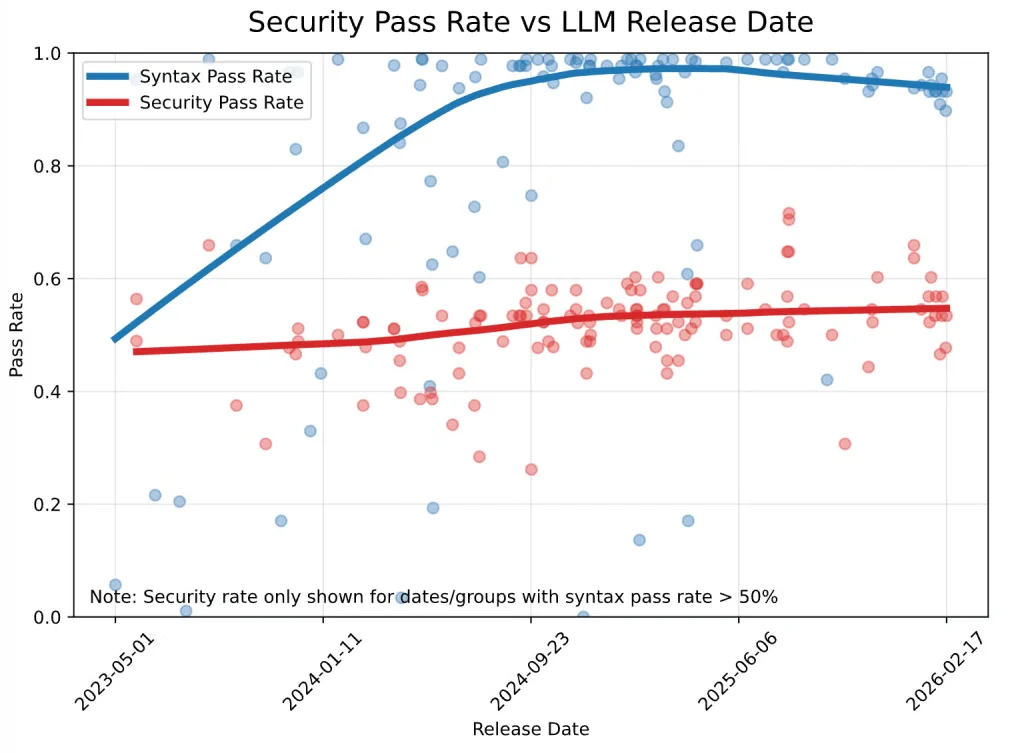
AI models have evolved considerably, demonstrating proficiency in syntactic and semantic correctness. However, in the absence of explicit security guidelines, improvements in security benchmarks have been notably sluggish.
A concerning trend, as highlighted by Veracode’s Spring 2026 GenAI Code Security Update, indicates that AI-generated code security pass rates have remained largely stagnant since 2023. This is particularly alarming given that a significant and increasing percentage of code is now AI-generated, with OpenAI reporting this figure at 80%. Current AI models continue to produce code with a low security pass rate for critical vulnerabilities, including Cross-Site Scripting and Log Injection attacks. Furthermore, AI models exhibit poor security performance with programming languages like Java.

While AI hallucinations concerning software dependencies appear to have improved, research indicates that AI-generated code can still invent or misspells package names. This creates an exploitable opportunity for typosquatting attackers to perpetrate supply chain attacks.
The Vanishing Patch Window
While AI models are actively generating insecure code, their offensive capabilities have witnessed a dramatic surge. The barrier to entry for vulnerability research has diminished, with AI models now demonstrating reasoning capabilities that rival, and in some cases surpass, those of top security researchers. Over the past two years, the timeframe between a vulnerability’s existence in a system and its exploitation has contracted from months to days, and in numerous instances, exploitation commences even before a patch is released.
Anthropic’s collaboration with critical software providers under Project Glasswing, which involved sharing its unreleased model, Claude Mythos, revealed its capacity to identify 271 vulnerabilities in Firefox alone, including issues that had evaded human security review for decades.
The open-source community is rapidly catching up. Hadrian’s research team has cataloged 70 open-source AI penetration testing tools, a significant increase from just five in April 2023. These tools can relentlessly and concurrently scan the internet for vulnerabilities in all forms of software and code.
Defender Burnout
The escalating volume of code, the persistence of bugs, and the accelerated pace of exploitation are contributing to severe burnout among security practitioners. While the number of vulnerabilities and the overall noise have increased, security headcount has not kept pace. Security professionals are now dedicating more time to addressing zero-day vulnerabilities, often stemming from relentless package supply chain incidents.
Recent security incidents at Vercel and Mercor exemplify this trend. Vercel was breached through a compromised AI tool’s OAuth token, while Mercor lost approximately 4 terabytes of data via the LiteLLM open-source AI gateway, exposing training methodologies for major AI players like OpenAI, Anthropic, and Meta. Both incidents point to a critical vulnerability: AI tooling has become the new supply chain attack surface, compelling security practitioners to bridge the growing attacker-to-defender capacity gap.
The Cloud Security Alliance (CSA) has issued guidance urging security leaders to develop "Mythos-ready" security programs and prepare for burnout, anticipating a surge in vulnerability disclosures that will dwarf previous experiences. They recommend that security teams increase their capacity and adopt agentic workflows for security assessments and incident response.
The bug bounty landscape has also been transformed, with amateur hackers leveraging AI to discover and report vulnerabilities. Public bug bounty programs are now inundated with AI-generated "slop" rather than substantive reports. The overwhelming volume of triage, even with AI assistance, has been so severe that programs like curl’s and HackerOne’s Internet Bug Bounty have been suspended.
FIRST, a leading security non-profit, forecasts that 2026 will surpass 50,000 CVEs for the first time. Their guidance to organizations is to scale their security operations, a task that many are struggling to accomplish.

Even NIST, the agency responsible for anchoring the world’s vulnerability metadata, is facing unprecedented challenges. In April 2026, the agency announced it would cease enriching most CVEs in the National Vulnerability Database, citing a 263% surge in submissions between 2020 and 2025. This decision signifies a critical inflection point, indicating potential future struggles for similar vulnerability data ecosystems.
Mitigating the Cleanup Cost: Strategies for a Sustainable Future
The cleanup cost associated with AI-generated code is undeniable and multifaceted, with no single solution available. However, teams and ecosystems that successfully navigate this challenge often share common strategies, tailored to where the costs are most acutely felt. A prioritized approach to addressing the most impactful risk categories is essential.
The Road Ahead: Balancing Innovation with Responsibility
AI-augmented development represents a paradigm shift on par with the industrial revolution. Just as machinery reshaped human labor and production, AI is fundamentally altering software creation and expanding who can participate. The lowered barrier to entry fuels innovation at an unprecedented pace, redefining entire categories of work within months rather than decades.
However, the hidden costs are equally significant, often surfacing far from the initial gains in development velocity. These include reviewer fatigue within engineering organizations, reputational risks for independent developers, quality issues that manifest years after deployment, ecosystem-wide trust erosion, and a security landscape where attackers operate at machine speed while defenders struggle to keep pace with human limitations. The fundamental cost is defined by the asymmetry between the speed of creation and the speed of cleanup.
Ultimately, the organizations and ecosystems that will thrive in the era of AI-generated code will not be those that simply move the fastest. They will be the ones that have meticulously planned for the cleanup, integrating a comprehensive strategy from the outset. AI will continue to push the boundaries of human imagination and capability. The critical question remains whether the practices and methodologies surrounding AI development can evolve sufficiently to keep pace with its relentless advancement.
This article was originally published on May 12, 2026, on webflow.com.
