


The integration of artificial intelligence into enterprise systems is no longer a futuristic vision but a present-day imperative. However, the journey from a powerful AI model to a seamlessly functioning business solution is fraught with complexities. Companies are discovering that the efficacy of their AI investments hinges not solely on the sophistication of the underlying models, but critically on their successful deployment and integration within existing operational frameworks. This challenge has propelled the emergence and rapid growth of a specialized engineering role: the Forward Deployed Engineer (FDE).
Initially, the allure of cutting-edge AI models, accessible via APIs, provided a swift demonstration of value for early-stage AI use cases. This approach, however, proved to be a fleeting solution. As AI began to permeate larger, more intricate systems, dependencies multiplied, and the integration process transformed into a significant hurdle. The core challenge shifted from model development to making these advanced AI systems reliably function within established infrastructure, which often includes legacy software, stringent compliance regulations, and workflows not originally designed to accommodate AI’s unique operational demands.
A comprehensive study by MIT’s NANDA Initiative, which analyzed 300 public AI projects, underscored this pervasive issue. The research revealed a startling statistic: 95% of enterprise AI pilot projects yielded little to no measurable impact on profit and loss. This data strongly suggests that the bottleneck was not in the AI models themselves, but rather in the methodologies and execution of their implementation. The problem was rooted in "how they were put into use."
This realization did not escape leading AI innovators. Companies like OpenAI and Anthropic, upon engaging with large enterprises, encountered the very same implementation challenges. To circumvent these obstacles, they began to strategically embed engineers directly within client organizations. These dedicated engineers work collaboratively with in-house teams, focusing on integrating the AI system, overseeing its launch into production environments, and continuously refining it as issues arise. This hands-on, deeply integrated approach significantly shortened feedback loops, accelerated deployment timelines, and substantially increased the likelihood of successful production-level operation. This practice has since been formalized and widely recognized as Forward Deployed Engineering (FDE).
The increasing prominence of FDE is evident across the industry. OpenAI established its dedicated Forward Deployed Engineering team in 2024 and has since experienced substantial growth in this area. Anthropic has similarly announced plans to expand its Applied AI group to meet escalating demand. Job postings for forward deployed engineers saw an extraordinary surge of over 800% between January and September 2025, signaling a widespread industry consensus that the future of AI adoption is intrinsically linked to effective deployment strategies, rather than solely focusing on incremental improvements in model quality.
The Genesis of Forward Deployed Engineering
The foundational concept of forward deployed engineering predates the current AI boom, tracing its origins back approximately two decades to the pioneering work at Palantir. Palantir, known for its data intelligence software tailored for government agencies and large financial institutions, operates in environments characterized by exceptionally complex infrastructure, rigorous compliance mandates, and intricate operational demands that standard off-the-shelf software often fails to address. In such demanding scenarios, the conventional model of simply shipping a product with accompanying documentation, leaving the customer to manage the integration and deployment, proved insufficient.
To overcome these limitations, Palantir introduced a novel role: "Deltas." These individuals are software engineers specifically tasked with working directly alongside clients. Their mandate is to build and adapt solutions within the client’s unique operational environment, ensuring the system functions effectively in real-world conditions. Unlike traditional software engineers who typically design features for a broad customer base, Deltas adopt a more focused approach. They dedicate themselves to understanding a single organization at a time, delving into its specific infrastructure, data architecture, and existing workflows, and then meticulously tailoring the software to align with the organization’s actual operational realities. This bespoke approach was so central to Palantir’s success that, until 2016, the company employed more Deltas than core software engineers, a significant deviation from the typical software company structure where client-facing roles are usually a smaller fraction of the engineering workforce.

This core philosophy – placing engineers in close proximity to the customer and their operational challenges – remains at the heart of modern forward deployed engineering. Understanding the specific responsibilities of FDEs further illuminates the efficacy of this model.
The Multifaceted Role of Forward Deployed Engineers
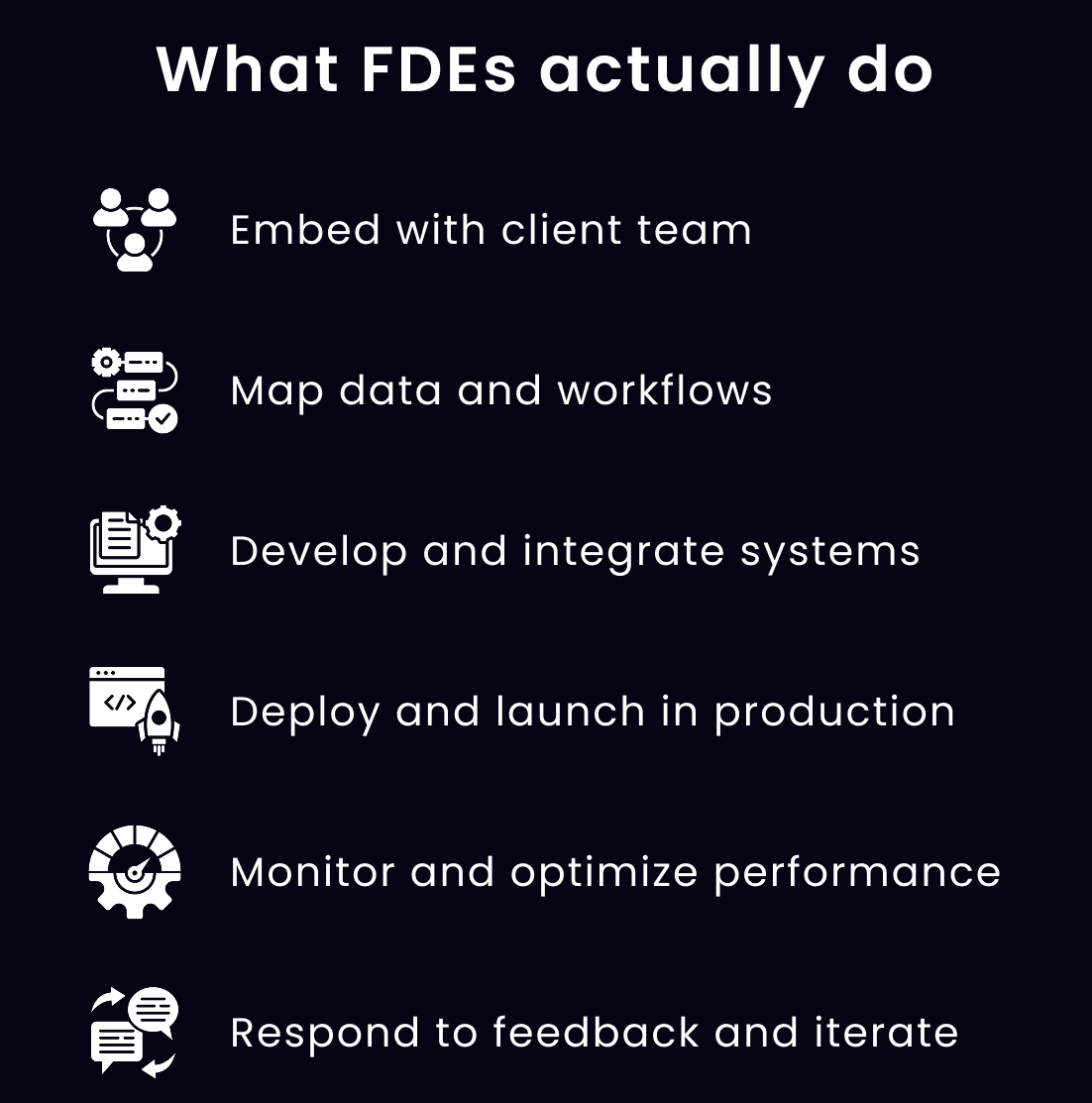
Forward Deployed Engineers operate directly within a client’s ecosystem with a singular, overarching objective: to ensure the successful deployment and sustained, smooth operation of AI systems in production. This practical engagement translates into becoming an integral part of the client’s technical fabric. An FDE typically joins the client’s internal communication channels, collaborates closely with product and engineering teams, and directly builds solutions utilizing the client’s own data and systems.
This role encompasses not only the technical execution of building and integrating systems but also contributes significantly to the strategic decision-making process, influencing what needs to be built and how. Crucially, FDEs assume accountability for the performance and reliability of the system post-launch. This hybrid role demands a confluence of strong software engineering skills, insightful product understanding, and practical operational acumen. Success is ultimately measured not by the hours invested, but by the effective utilization and performance of the deployed system.
A typical engagement begins with an in-depth immersion into the client’s operational realities. This involves mapping intricate data flows, identifying specific areas where AI can introduce automation or enhance efficiency, and understanding how various teams will interact with and leverage the AI-generated insights. Following this diagnostic phase, the FDE proceeds to build and integrate the necessary systems to meet these identified needs. Once the system is live, the FDE’s involvement continues. They remain engaged to make necessary adjustments, enhance system reliability, and incorporate user feedback to continuously improve the AI’s performance and usability.
As one FDE aptly described the intricacies of the role: "The model is usually the cleanest part. The hard part is finding the workflow nobody documented, the data source people actually trust, and the person who knows why the process works that way." This highlights the critical difference between theoretical model performance and the messy, often undocumented realities of enterprise operations.
This hands-on, long-term engagement distinguishes the FDE role from traditional consulting. While consultants are often engaged for a defined period and judged by their deliverables, Forward Deployed Engineers are evaluated by the sustained functionality and ongoing value realization of the system long after its initial launch. Their responsibility does not conclude with a handover; instead, they remain involved until the AI system is fully integrated into daily operations and the client’s own team is fully capable of managing and maintaining it.
Why AI Demands FDE More Than Traditional Software Engineering
The distinction between the needs of AI systems and traditional software in terms of deployment becomes clearer when examining the inherent risks associated with each. In traditional software development, the majority of risks are concentrated at the initial stages of design, integration, and testing. Once a traditional system is successfully implemented and operational, it tends to remain stable, and any failures are typically straightforward to diagnose and rectify.
AI systems, however, introduce a different category of risk due to their probabilistic nature. A model that performs exceptionally well in controlled testing environments may exhibit degraded performance when exposed to the dynamic and unpredictable nature of real-world production data and live user interactions. Rather than failing abruptly, these systems can become subtly unreliable, producing inconsistent or irrelevant outputs that gradually erode user trust and confidence.
The conventional software delivery model is ill-equipped to handle this type of evolving failure. Internal engineering teams are typically structured and incentivized to deliver new features, not to provide sustained, hands-on support for systems that are inherently dynamic and subject to drift over time. Similarly, external consultants, operating under fixed scopes and deadlines, typically move on once their contracted period concludes. In both scenarios, crucial ownership and expertise can dissipate precisely when an AI system requires the most dedicated attention to maintain its stability and efficacy.
Forward Deployed Engineers directly address this critical gap. By embedding themselves within the client’s operational environment, they are uniquely positioned to identify emerging issues as they arise, implement swift adjustments, and continuously refine the AI system in real time. This proximity is instrumental in transforming a promising AI model from a theoretical concept into a reliably functioning and dependable asset.
Enhancing Accessibility of the FDE Model
The FDE model, as practiced by leading AI companies, has traditionally been cost-prohibitive for smaller organizations. Large enterprises with substantial budgets can afford to allocate multiple engineers, sometimes entire teams, to a single client deployment. Smaller businesses, while facing the same complex implementation challenges, often lack the necessary engineering capacity to dedicate significant resources to open-ended integration work.
To bridge this accessibility gap, several innovative approaches are now emerging. AI laboratories are expanding their deployment support services. OpenAI, for instance, has launched a dedicated deployment company, while Anthropic, OpenAI, and Cohere are increasing their investments in forward-deployed or applied AI roles. Major consulting firms are also stepping in to fill the void through strategic partnerships aimed at assisting enterprises in moving AI initiatives beyond pilot phases. Concurrently, platform companies, such as Bit Cloud, are democratizing the FDE model by equipping a single engineer with comprehensive tooling. This allows a solo FDE to introduce a production-ready starting point into a customer’s environment, significantly reducing the need to build each integration from scratch.
These evolving strategies share a common thread: the recognition that the primary bottleneck in AI adoption has shifted. The challenge is no longer solely about developing advanced models, but rather about cultivating the expertise of engineers who can effectively navigate customer systems, comprehend real-world workflows, and deliver robust, production-ready solutions.
Conclusion: The Imperative of Deployment for AI Success
Forward Deployed Engineering emerged as a direct response to a tangible, real-world problem. Organizations found themselves with access to increasingly powerful software tools but often struggled to integrate these systems into their daily operations. The fundamental issue was not a deficit in technological capability, but a disconnect between the capabilities offered by the software and the specific requirements of an organization’s unique infrastructure, data landscape, and existing workflows.
AI laboratories have, in essence, encountered the same implementation hurdles that Palantir identified two decades ago. The most effective and reliable method for ensuring the successful integration of complex systems has proven to be placing engineers in close proximity to the end-users, the data they rely on, and the problems the systems are intended to solve.
As artificial intelligence continues its integration into the core operational systems of businesses, a distinct competitive advantage will accrue to those teams capable of moving beyond mere prototypes and establishing repeatable, scalable deployment processes. Whether this crucial support originates from an internal engineering team, an AI lab, or a specialized platform provider, the companies that master this deployment challenge will be the ones whose significant AI investments translate into tangible, impactful results in production environments.
