
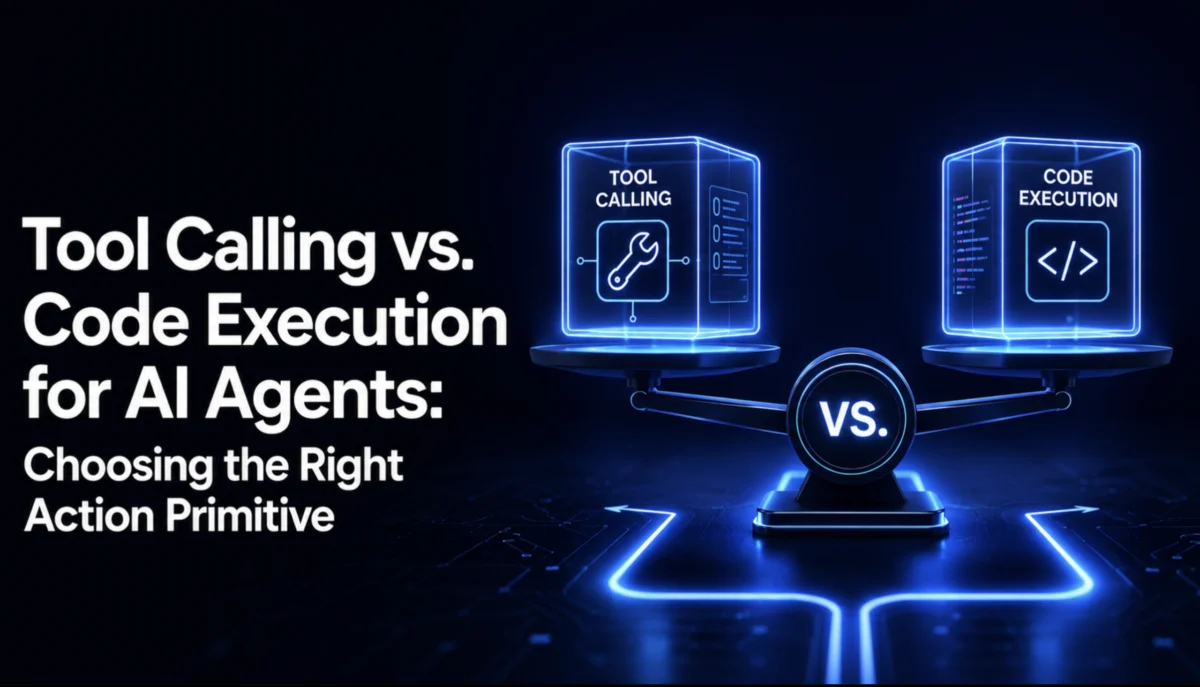

The evolution of autonomous AI agents has reached a critical juncture where developers must move beyond simple prompt engineering to sophisticated architectural design. At the heart of this transition is the selection of an action primitive—the fundamental mechanism that allows a large language model (LLM) to interact with external systems, databases, and software environments. While "tool calling" has served as the industry standard for years, the emergence of "code execution" represents a significant shift in how agents handle complex, multi-step operations. This choice is no longer merely a matter of developer preference; it is a strategic decision that directly influences system latency, operational costs, token consumption, and the overall accuracy of agentic workflows.
The Mechanics of Action: A Technical Evolution
To understand the divergence between these two primitives, one must look at how they manage the flow of information. Tool calling, the traditional approach, relies on a discrete, synchronous loop. When a model determines that an external action is required, it generates a structured JSON payload—a request defined by a rigid schema. The host application pauses the model’s generation, executes the requested function in the local environment, and feeds the result back into the model’s conversation context. This process is inherently iterative; every intermediate step is treated as a new turn in the conversation, forcing the model to re-process the entire history of the task, including every piece of data retrieved from the tool.
Code execution, by contrast, operates on a "programmatic" model. Instead of requesting a single action, the agent is granted the authority to write and execute a script—typically in Python or TypeScript—within a secure, sandboxed environment. This paradigm shift, heavily influenced by research into "CodeAct" and frameworks like Anthropic’s Model Context Protocol (MCP), allows the agent to handle logic, loops, conditionals, and error handling internally. Crucially, intermediate data never reaches the model’s context window. Only the final, processed output of the script is returned to the LLM, dramatically reducing the "noise" in the model’s reasoning process.
The Problem of Context Bloat: A Case Study in Efficiency
The primary driver behind the adoption of code execution is the "context tax." Consider a scenario where an enterprise agent is tasked with identifying which of twenty employees exceeded their Q3 travel budget. Using standard tool calling, the agent would be required to perform twenty individual API calls. Each call returns a JSON object containing dozens of line items, such as flight details, hotel stays, and meal receipts. In a standard tool-calling architecture, all 2,000+ line items would be injected into the model’s context window. This creates a massive data footprint—often exceeding 50KB—that the model must parse simply to perform a basic arithmetic summation.
This process is not only inefficient but also prone to error. LLMs, despite their reasoning capabilities, are fundamentally optimized for language prediction rather than high-precision arithmetic or large-scale data aggregation. By contrast, a code-execution-enabled agent can write a short script to fetch the expense data, perform the summation in a dedicated execution environment, and return only the final "budget exceeded" report. This approach can reduce token usage by as much as 90% in complex workflows, directly impacting both the latency of the user experience and the financial cost of operating the agent.
Historical Context and Research Milestones
The development of these primitives did not happen in a vacuum. Throughout 2024 and 2025, major AI research labs and infrastructure providers have prioritized the refinement of agentic capabilities. The 2024 "CodeAct" paper by Wang et al. provided the foundational academic evidence that agents utilizing executable code outperform those relying on JSON-formatted tool calling by as much as 20% on multi-step reasoning tasks.
Following this, the industry saw the rise of the Model Context Protocol (MCP), which standardized how models connect to external data sources. In November 2025, advancements in programmatic tool calling reached a point of maturity, allowing developers to define "allowed_callers" in their tool schemas. This feature effectively created a bridge between the two primitives, allowing developers to specify which tools could be triggered by an agent’s code and which required direct, human-auditable model oversight.
Data-Driven Impact: Performance and Accuracy
Empirical data from major industry players suggests that code execution is more than just a cost-saving measure; it is an accuracy-enhancing intervention. Anthropic’s internal benchmarks, released alongside their advanced tool-use documentation, revealed that on complex research tasks, token usage dropped by approximately 37% when moving from standard tool calling to code execution. More importantly, accuracy on the GAIA (General AI Assistants) benchmark increased from 46.5% to 51.2%.
These figures indicate that offloading logic to a sandboxed execution environment prevents the model from "losing track" of variables, a common failure mode when an agent attempts to hold multiple intermediate state values in its active context. By utilizing a deterministic environment—the standard Python interpreter—the agent offloads the heavy lifting of state management to the very systems that were built for it, leaving the model to focus on the high-level intent of the user.
Strategic Decision Framework
Choosing between these primitives requires an objective assessment of the task at hand. The following criteria serve as a standard rubric for modern AI architecture teams:
- Task Complexity: If the task requires a single, atomic lookup (e.g., "What is the weather in London?"), tool calling is the superior choice due to its simplicity and lower infrastructure overhead. For multi-step tasks involving fan-out and aggregation (e.g., "Summarize financial reports for all regional offices"), code execution is essential.
- Data Sensitivity: In environments where PII (Personally Identifiable Information) or proprietary data is involved, code execution offers a superior security posture. By keeping data within a sandboxed environment and only passing final summaries to the model, the risk of data leakage via the model’s context window is significantly mitigated.
- Infrastructure Readiness: Implementing secure, sandboxed code execution requires a mature DevOps environment. For organizations lacking existing containerization or sandboxing infrastructure, the operational cost of implementing code execution may outweigh the benefits for simple tasks.
- Auditability: Tool calling generates a clear, linear log of every action taken. For highly regulated industries, this audit trail is often a compliance requirement. While code execution can be logged, the internal logic of a script is inherently more complex to inspect post-hoc than a sequence of discrete JSON requests.
The Hybrid Reality of Production Systems
Despite the technical advantages of code execution, it is a fallacy to assume it will entirely replace tool calling. Most production-grade agents utilize a hybrid model. A well-architected agent uses plain tool calling for initial intent classification and simple data retrieval, then dynamically switches to code execution when it detects a bottleneck, such as a large dataset or a complex computational requirement.
This "adaptive orchestration" is becoming the industry gold standard. Rather than choosing a single primitive for the life of an agent, developers are increasingly building systems that can "promote" a task from a simple tool call to an executable script. As we move into the next phase of agentic development, the focus will likely shift from the primitives themselves to the intelligence of the orchestrator that manages them.
Implications for the Future
The shift toward code-based action primitives underscores a broader maturation of the AI industry. We are moving away from the era of "black box" agents that attempt to reason through everything, toward a modular, systems-based approach where models act as the orchestrators of specialized, deterministic tools. This transition promises to make AI agents more reliable, cost-effective, and capable of handling real-world complexity. As documentation and standardized protocols like MCP continue to evolve, the distinction between "code" and "model reasoning" will continue to blur, likely resulting in a future where agents can self-select the most efficient path to completion for any given task. For developers and enterprises, the message is clear: the architecture you choose today will determine the scale and reliability of the intelligent systems you deploy tomorrow.
