
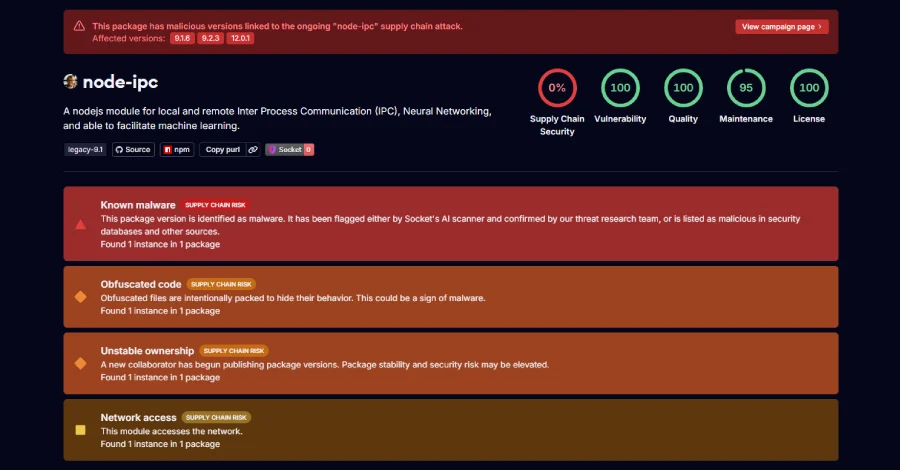

Cybersecurity researchers are sounding a definitive alarm regarding a highly sophisticated and deeply concerning malicious activity detected within recently published versions of the widely-used node-ipc npm package. This incident represents a significant escalation in software supply chain attacks, moving beyond simple disruption to targeted, infrastructure-aware credential harvesting operations. The discovery, brought to light by detailed analyses from security firms Socket and StepSecurity, confirms that three distinct versions of the package have been deliberately compromised, embedding a stealthy information stealer and backdoor designed to pilfer a vast array of sensitive developer and cloud secrets.
The compromised versions identified are [email protected], [email protected], and [email protected]. Early analysis by Socket indicated that these versions contain "obfuscated stealer/backdoor behavior." The malware’s operational methodology is disturbingly comprehensive: it meticulously fingerprints the host environment, enumerates and reads local files, compresses and chunks the collected data, wraps the payload in a cryptographic envelope, and subsequently attempts exfiltration through a network endpoint dynamically selected via sophisticated DNS/address logic. This multi-stage approach underscores a calculated effort to maximize data theft while minimizing detection.
The Anatomy of a Stealthy Credential Harvesting Operation
The core of the threat lies in a heavily obfuscated payload that is triggered immediately when the package is required at runtime within a Node.js application. StepSecurity’s investigation revealed that this payload is engineered to exfiltrate a broad spectrum of critical developer and cloud secrets to an external command-and-control (C2) server. The sheer breadth of targeted credentials is alarming, encompassing an estimated 90 different categories. This includes, but is not limited to, highly sensitive access keys and configuration files for major cloud providers such as Amazon Web Services (AWS), Google Cloud Platform (GCP), and Microsoft Azure. Beyond cloud credentials, the malware targets SSH keys, Kubernetes tokens, GitHub CLI configurations, settings for development tools like Claude AI and Kiro IDE, Terraform state files (which often contain infrastructure configurations and secrets), database passwords, and even shell history, which can reveal sensitive commands and access patterns. Once harvested, this treasure trove of data is compressed into a GZIP archive, ready for clandestine transmission.
The primary exfiltration channel for this compressed data is an HTTPS POST request directed to the domain sh.azurestaticprovider[.]net. The choice of a domain mimicking a legitimate Azure service provider is a classic tactic to blend malicious traffic with expected network activity, making it harder for standard security tools to flag as anomalous.

Advanced Anti-Detection and Persistence Mechanisms
What truly distinguishes this attack is its arsenal of sophisticated anti-detection and persistence techniques, signaling a professional and well-resourced adversary. The malware notably sidesteps conventional npm lifecycle hooks such as preinstall, install, or postinstall scripts. Instead, the malicious payload is appended as an Immediately Invoked Function Expression (IIFE) to the end of the node-ipc.cjs file. This ingenious method ensures that the malware fires unconditionally and automatically every single time require('node-ipc') is invoked within an application, bypassing common security checks that focus on lifecycle scripts.
Further adding to its stealth, the payload incorporates a SHA-256 fingerprint check. This check compares a dynamically generated hash of the primary module path against a hard-coded hash, which itself is assembled from eight obfuscated table fragments embedded within the malicious code. Sai Likhith, a researcher at StepSecurity, elaborated on this, explaining that "This means 12.0.1 is entirely inert on any machine whose primary module path does not hash to the target value." This precision targeting indicates that the attacker may have specific projects or developers in mind, pre-computing the hash of their entry point before publishing the malicious version. In contrast, the 9.x versions of the malware lack this gate, executing their full payload on any system that loads them, suggesting a broader, less targeted initial sweep.
Beyond the primary HTTPS exfiltration, the malware implements a second, highly covert channel: encoding chunks of the stolen data as DNS TXT records. To facilitate this, it first overrides the system’s default DNS resolver, setting it to Google Public DNS (1.1.1.1 as primary, 8.8.8.8 as fallback). After resolving sh.azurestaticprovider[.]net to obtain the C2 IP, the malware then re-targets the resolver directly at this C2 IP for all subsequent exfiltration queries. StepSecurity highlighted this "direct-to-C2 DNS sink" as a significant anti-detection technique. By bypassing public DNS resolvers, the exfiltration queries never appear in public DNS logs. This renders organizations relying solely on corporate DNS logging blind to this specific traffic, allowing the data to egress undetected.
For persistence, the malware takes another alarming step: it attempts to continue execution independently of the original Node.js process. It achieves this by forking itself into a detached background child process. This ensures that the exfiltration activity can continue silently even after the parent application, which initially loaded the malicious node-ipc package, has been terminated. This capability makes detection and remediation significantly more challenging, as the malicious process can linger on compromised systems long after initial infection.
The Compromise Vector: An Expired Domain Account Takeover
The origin of these malicious versions has been traced back to an npm account named "atiertant." Crucially, this account has no prior publishing history connected to the node-ipc package and no discernible connection to "riaevangelist," the package’s original and legitimate author. The previous legitimate update to the node-ipc package occurred in August 2024. The sudden re-emergence of activity after a 21-month dormancy, particularly for a high-download package, immediately raised red flags, suggesting either a newly compromised "atiertant" credential or the account being specifically added as a maintainer to facilitate the malicious publication.

Further investigation, notably by Ian Ahl, Chief Technology Officer (CTO) at Permiso Security, revealed a more precise and alarming compromise vector: an account takeover facilitated by an expired email domain. Ahl’s findings, shared via an X (formerly Twitter) post, indicated that the email address associated with "atiertant’s" npm account was hosted on the domain "atlantis-software[.]net." This domain had reportedly expired on January 10, 2025, but was subsequently re-registered on May 7, 2026—a mere week before the malicious node-ipc versions were published.
This timeline is critical. As Socket explained, "Assuming the npm account recovery email for atiertant was indeed hosted on atlantis-software[.]net, the new domain owner was then able to trigger a standard npm password reset, receive the reset email at a mailbox under their control, and gain publish rights without ever compromising any of the maintainer’s own infrastructure." This sophisticated yet surprisingly simple method of account takeover, leveraging a lapsed domain registration, highlights a significant vulnerability in the broader ecosystem of digital identity and software package management, particularly when maintainer accounts are linked to domains that are not vigilantly managed.
A Troubled History: Previous node-ipc Incidents
This is not the first instance of the node-ipc npm package being embroiled in controversy or found to contain malicious functionality. In March 2022, the package’s original maintainer deliberately introduced destructive capabilities into versions 10.1.1 and 10.1.2. This "protestware" was designed to overwrite files on systems identified as being located in Russia or Belarus, an act of protest following Russia’s military invasion of Ukraine. Subsequently, versions 11.0.0 and 11.1.0 also incorporated the "peacenotwar" dependency, a similar module published by the same maintainer, intended as a "non-violent protest against Russia’s aggression."
While the previous incidents stemmed from politically motivated actions by the original maintainer, the current compromise of node-ipc versions 9.1.6, 9.2.3, and 12.0.1 is fundamentally different in its intent and methodology. Socket emphasized that the latest incident "appears to involve a suspicious republishing or reintroduction of malicious code into versions of a known package, rather than a typosquatting attempt." This distinction is crucial, as it points towards an account takeover or direct injection into a legitimate package rather than the creation of a deceptively named, look-alike package. The package’s history, therefore, paints a picture of a critical component repeatedly exploited, either by its own maintainer or by external adversaries, for purposes ranging from political protest to sophisticated financial or espionage-driven credential theft.
Broader Implications for Software Supply Chain Security
This incident serves as a stark reminder of the escalating and evolving threats within the software supply chain. As Avital Harel, security research lead at Upwind, succinctly put it, "This campaign reflects how software supply chain attacks are evolving beyond simple malicious packages into infrastructure-aware credential harvesting operations." Harel’s statement underscores a critical trend: attackers are increasingly targeting the identities and automated systems that power modern software delivery pipelines. The malware’s design, specifically crafted to blend into normal developer and application behavior, exemplifies this shift.

The reliance on open-source packages like node-ipc, which boasts a high download count and is integrated into countless projects, makes them irresistible targets for adversaries. A compromise at this level can have a devastating ripple effect across an entire ecosystem of dependent applications and organizations. The sophisticated nature of the attack, particularly its ability to bypass common security controls (like DNS logging) and persist silently in the background, highlights the growing challenge faced by cybersecurity professionals. It necessitates a "shift-left" security paradigm, where security considerations are integrated much earlier into the development lifecycle, alongside robust runtime monitoring.
The impact of such credential theft can be catastrophic. Compromised cloud provider keys can lead to unauthorized access to critical infrastructure, data breaches, resource hijacking, and even complete takeover of cloud environments. Stolen SSH keys, Kubernetes tokens, and GitHub configurations can grant attackers deep access into development workflows, source code repositories, and CI/CD pipelines, enabling further lateral movement, intellectual property theft, or the injection of more pervasive backdoors. The long-term consequences of such a compromise can be far-reaching and incredibly difficult to fully mitigate.
Urgent Recommendations and Proactive Defenses
In light of this severe threat, cybersecurity researchers and organizations have issued urgent recommendations for all users and organizations that may be impacted:
- Immediate Remediation: Users are strongly advised to identify and remove any compromised versions of
node-ipc(9.1.6,9.2.3, and12.0.1) from their projects and systems. Re-installing known clean versions, specifically9.2.1and12.0.0, is the recommended course of action. - Credential Rotation: Assume compromise. All credentials and secrets that could have been accessible during the window of vulnerability, including but not limited to AWS, GCP, Azure, SSH, Kubernetes, and GitHub tokens, must be immediately rotated. This is a critical step to invalidate any stolen access keys.
- Audit npm Activity: Organizations should meticulously audit npm publish activity for any packages accessible with the rotated tokens. This helps identify if the compromised credentials were used for further malicious publications or modifications.
- Review Workflow Logs: Thoroughly review workflow run logs, especially those pertaining to CI/CD pipelines, for any suspicious activity or unauthorized deployments during the period of potential compromise.
- Cloud Log Analysis: Audit cloud logs to ascertain if any unauthorized actions were performed by IAM identities whose credentials were available on systems running the compromised
node-ipcpackage. This includes examining access patterns, resource modifications, and data exfiltration attempts. - Network Egress Blocking: Implement network security controls to block all egress traffic to the identified command-and-control (C2) domain,
sh.azurestaticprovider[.]net. This will prevent further data exfiltration if any compromised systems remain active.
Beyond these immediate steps, organizations must adopt more comprehensive software supply chain security measures. This includes leveraging dependency scanning tools to identify known vulnerabilities and malicious packages, maintaining a comprehensive Software Bill of Materials (SBOM) for all applications, enforcing multi-factor authentication (MFA) for all critical developer and maintainer accounts, implementing strict least-privilege principles, and continuously monitoring network traffic for anomalous patterns, especially DNS queries. The node-ipc incident underscores that vigilance, robust security practices, and a proactive defense posture are no longer optional but essential in the ongoing battle against sophisticated cyber adversaries targeting the very foundations of modern software development.
