
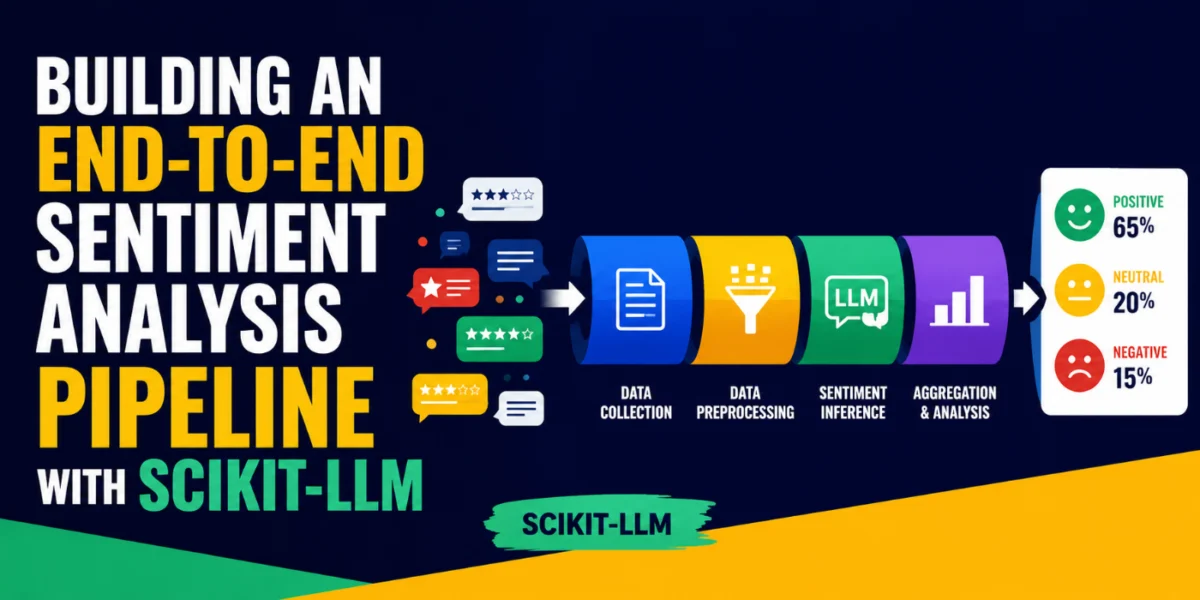

The landscape of natural language processing has undergone a profound transformation over the past decade. Historically, sentiment analysis, a crucial domain-specific form of text classification, relied heavily on rule-based systems or traditional machine learning (ML) models. Early approaches involved meticulously curated lexicons of positive and negative words, coupled with linguistic rules to infer sentiment. While interpretable, these systems often struggled with nuance, sarcasm, and context-dependent language.
The advent of traditional machine learning brought more robust solutions. Pipelines for tasks like text classification typically involved extracting structured, numerical features from raw text. Techniques such as TF-IDF (Term Frequency-Inverse Document Frequency) or various forms of token embeddings transformed text into vectors, which were then fed into classical models like logistic regression, support vector machines (SVMs), or ensemble methods. These models offered improved accuracy and generalization but still demanded significant effort in feature engineering and often required substantial labeled datasets for training. Despite their effectiveness, adapting these models to new domains or handling subtle linguistic variations remained a challenge, necessitating extensive re-training or feature re-engineering.
The recent proliferation of large language models (LLMs) has fundamentally reshaped this paradigm. LLMs, trained on vast corpora of text data, possess an inherent understanding of language, context, and even reasoning capabilities. This enables them to perform complex language tasks, including sentiment analysis, with remarkable proficiency, often requiring minimal or no task-specific training data. Concepts like zero-shot and few-shot learning have emerged, where pre-trained LLMs can classify text based on instructions or a few examples, rather than extensive fine-tuning. This shift dramatically reduces the data and computational resources traditionally required for new NLP applications.
Scikit-LLM emerges as a pivotal Python library in this evolving ecosystem. It acts as a crucial bridge, connecting the established, user-friendly API of Scikit-learn with the powerful, modern capabilities of LLM API calls. For data scientists and ML engineers accustomed to Scikit-learn’s intuitive fit, predict, and transform methods, Scikit-LLM provides a seamless integration point, allowing them to leverage state-of-the-art LLMs within familiar pipeline structures. This democratizes access to advanced LLM functionalities, enabling practitioners to build sophisticated NLP applications without needing to delve into the intricate details of LLM architectures or specialized frameworks.
A key component in achieving rapid inference for this pipeline is the Groq API. Groq has distinguished itself by developing an innovative Language Processing Unit (LPU) inference engine, specifically designed to accelerate LLM workloads. Unlike traditional GPUs, which are optimized for parallel processing across various computational tasks, Groq’s LPU is purpose-built for the sequential nature of LLM inference, resulting in significantly faster token generation rates. This hardware advantage, coupled with Groq’s commitment to serving open-source LLMs, offers a compelling solution for developers seeking high-performance and cost-effective deployment of language models. The integration of Scikit-LLM with Groq’s backend models allows for the construction of an end-to-end sentiment analysis pipeline that delivers reasonably fast inference results, even with large, realistically sized datasets.
Architecting the Sentiment Analysis Pipeline: A Technical Chronology
The construction of this sentiment analysis pipeline begins with essential prerequisites and a robust setup. The Scikit-LLM library must first be installed, typically via pip, to enable its functionalities. Following installation, the critical step involves configuring API credentials to connect Scikit-LLM to an LLM API endpoint. For this demonstration, the Groq API serves as the chosen backend. Users are required to register on the Groq console and generate a unique API key. This key is then programmatically configured within the Python environment using Scikit-LLM’s configuration utilities: SKLLMConfig.set_gpt_url("https://api.groq.com/openai/v1") and SKLLMConfig.set_openai_key("YOUR-API-KEY-GOES-HERE"). It is noteworthy that Scikit-LLM leverages an endpoint function compatible with OpenAI’s API by default, which is strategically routed to Groq’s custom URL to facilitate internal requests. This compatibility ensures a smooth transition for developers already familiar with OpenAI’s interface.
With the environment configured, the next stage involves acquiring and preparing the dataset. The IMDB Movie Reviews dataset, comprising approximately 50,000 instances, is a standard benchmark for sentiment analysis. Each instance consists of a text review accompanied by a sentiment label, either ‘positive’ or ‘negative’, thus framing the task as a binary classification problem. For convenience and to ensure reproducibility, the dataset is fetched directly from a publicly available GitHub repository in CSV format.
A practical consideration for demonstrating LLM pipelines, particularly with free-tier API access, is the potential for triggering quota limits or incurring significant computational time when processing massive datasets. To circumvent this, a subset of 500 rows from the IMDB dataset is sampled for demonstration purposes. This sample size allows for effective illustration of the pipeline’s execution without excessive resource consumption, though users with paid API access can easily adjust this parameter to utilize more data. The sampled data is then split into features (X, containing the review text) and labels (y, containing the sentiment), and subsequently partitioned into training and testing sets using train_test_split with an 80/20 ratio, ensuring a robust evaluation methodology.
Building the Sentiment Analysis Pipeline: Preprocessing and Model Integration
The core of any data science pipeline lies in its sequential processing steps, encompassing preprocessing, cleaning, data preparation, model setup, inference, and evaluation. For text-based scenarios like sentiment analysis, effective preprocessing is paramount. The IMDB dataset, being derived from web content, often contains HTML tags and other formatting noise, making a robust cleaning step essential. Scikit-learn’s FunctionTransformer provides an elegant mechanism to encapsulate custom preprocessing functions within a pipeline, maintaining API consistency. A clean_text_data function is defined to remove HTML tags using regular expressions (<[^>]+>) and normalize whitespace, ensuring that the raw text inputs are standardized before being fed to the LLM. This transformer is then instantiated as text_cleaner.
The final step in pipeline construction involves integrating this preprocessing component with the LLM. The Scikit-learn Pipeline class orchestrates these steps seamlessly. The sentiment_pipeline is defined as a sequence: first, the text_cleaner processes the raw text, and then the cleaned text is passed to the ZeroShotGPTClassifier. Crucially, the LLM classifier is configured to use Groq’s llama-3.1-8b-instant model via the model="custom_url::llama-3.1-8b-instant" parameter. Llama 3.1 8B is a powerful, open-source LLM, and its deployment through Groq ensures high-speed inference. It’s important to note that for zero-shot classification, the fit() method does not involve traditional weight-based training of the LLM. Instead, it merely registers the unique classification labels present in the training set (positive, negative), informing the LLM of the possible output categories.
Inference and Performance Evaluation
Once the pipeline is fitted, it is ready for inference on unseen data. Using familiar Scikit-learn syntax, the predict() method is invoked on the X_test dataset. This single call executes the entire sequence: cleaning the test reviews and then querying the Groq-powered Llama 3.1 8B model to predict the sentiment for each.
The evaluation of the pipeline’s performance is conducted using Scikit-learn’s classification_report, which provides a comprehensive summary of key metrics: precision, recall, f1-score, and support for each class, along with overall accuracy. For the 100 test samples, the pipeline demonstrates commendable performance:
--- Classification Report ---
              precision    recall  f1-score   support

    negative       0.95      0.97      0.96        60
    positive       0.95      0.93      0.94        40

    accuracy                           0.95       100
   macro avg       0.95      0.95      0.95       100
weighted avg       0.95      0.95      0.95       100
An overall accuracy of 0.95 indicates that 95% of the test reviews were correctly classified. Breaking down the metrics, for the ‘negative’ class, a precision of 0.95 signifies that 95% of the reviews predicted as negative were indeed negative, while a recall of 0.97 means that 97% of all actual negative reviews were correctly identified. Similarly, for the ‘positive’ class, precision stood at 0.95 and recall at 0.93. The F1-score, which is the harmonic mean of precision and recall, remained high for both classes (0.96 for negative, 0.94 for positive), underscoring the model’s balanced performance. The support values (60 negative, 40 positive) reflect the class distribution in the test set. These results confirm that the pipeline, leveraging Groq’s Llama 3.1 8B via Scikit-LLM, performs a solid job at classifying sentiment, even with the inherent complexities of movie reviews.
To further illustrate its capability, a few sample predictions are displayed:
- Review: "I saw mommy…well, she wasn’t exactly kissing Santa Clause; he has his hand on her thigh and wicked…"
Actual: negative | Predicted: negative - Review: "This entry is certainly interesting for series fans (like myself), but yet it is mostly incomprehens…"
Actual: negative | Predicted: negative - Review: "Ingrid Bergman (Cleo Dulaine) has never been so beautiful. Gary Cooper as "Cleent" so perfectly cast…"
Actual: positive | Predicted: positive
These examples showcase the pipeline’s ability to accurately infer sentiment from diverse textual content, including potentially ambiguous or context-rich reviews. The execution of these steps, encompassing data fetching, preprocessing, and LLM inference for 100 test samples, typically completes within a few minutes, highlighting the efficiency gained through Groq’s accelerated inference.
Broader Impact, Implications, and Future Outlook
The successful implementation of an end-to-end sentiment analysis pipeline using Scikit-LLM and Groq represents a significant milestone with broad implications for the AI and data science communities. This approach democratizes access to powerful LLMs, enabling a wider range of developers and organizations to integrate advanced NLP capabilities into their applications without the steep learning curve traditionally associated with LLM development. By bridging the gap between familiar Scikit-learn syntax and cutting-edge LLM APIs, Scikit-LLM empowers data scientists to leverage their existing skill sets to build sophisticated AI solutions.
For businesses, the implications are substantial. Fast and accurate sentiment analysis is invaluable for understanding customer feedback, monitoring brand reputation across social media, analyzing product reviews, and refining marketing strategies. Groq’s high-speed inference is a game-changer for applications requiring real-time sentiment detection, such as live customer service chat analysis or instantaneous social media trend monitoring. The ability to deploy open-source models like Llama 3.1 8B through such an efficient API also offers a cost-effective alternative to proprietary LLMs, reducing operational expenses for large-scale deployments.
However, the rapid adoption of LLM-powered pipelines also brings considerations. Data privacy remains a paramount concern, as API calls inherently involve sending sensitive text data to third-party services. Organizations must carefully review the data handling policies of API providers and implement appropriate anonymization or data governance strategies. Ethical AI considerations, such as potential biases inherited from the LLM’s training data, must also be addressed to ensure fair and equitable outcomes. While zero-shot classification is powerful, highly nuanced or domain-specific sentiment tasks might still benefit from a small amount of fine-tuning or few-shot examples to achieve optimal performance.
Looking ahead, this synergy between classical ML frameworks and modern LLM APIs is likely to continue evolving. We can anticipate further advancements in efficiency, the integration of multimodal capabilities (analyzing sentiment from text, audio, and video), and increasingly sophisticated real-time processing at scale. The convergence demonstrated by Scikit-LLM and Groq sets a precedent for how accessible, powerful, and versatile AI can become, paving the way for a new generation of intelligent applications across industries.
In conclusion, this article has elucidated a robust, efficient, and accessible methodology for performing end-to-end sentiment classification. By strategically combining Scikit-LLM’s intuitive framework with the high-performance inference capabilities of Groq’s API and the power of open-source LLMs, developers can construct sophisticated NLP pipelines with unprecedented ease and speed. This approach not only streamlines development workflows but also significantly expands the practical applicability of advanced AI in real-world scenarios, marking a pivotal step towards democratizing access to cutting-edge language intelligence.
