
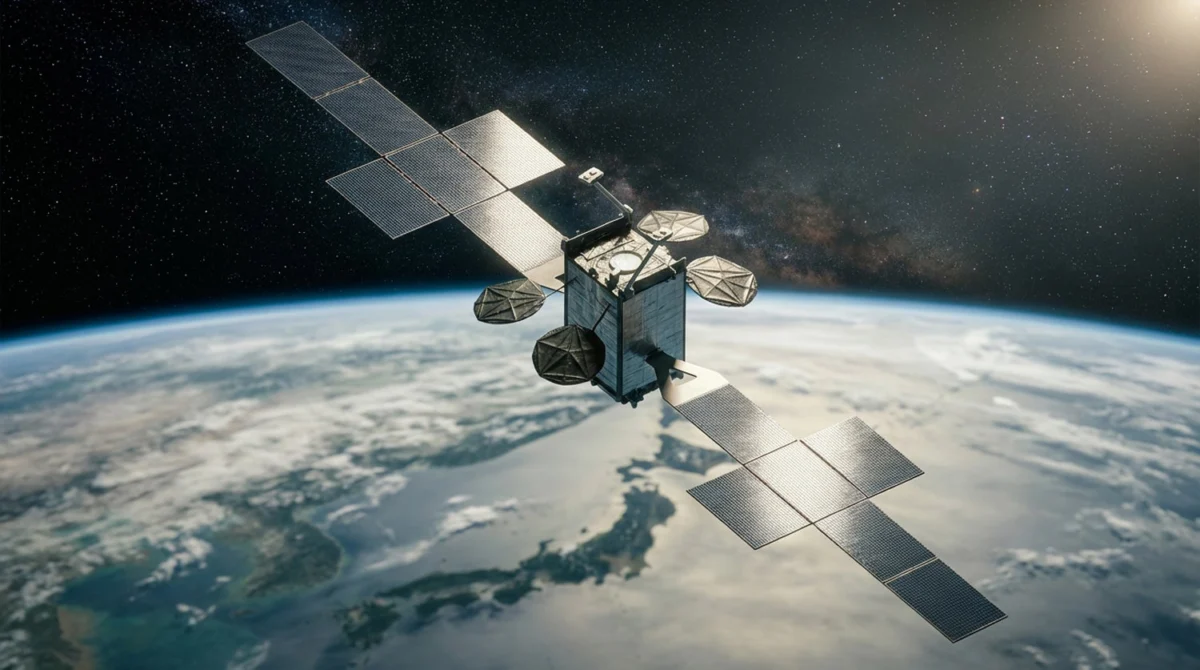

MDA Space, a leading provider of advanced technology and services to the rapidly expanding global space industry, has officially announced its selection by Mitsubishi Electric Corporation (MELCO) to provide key mission-critical components for Japan’s upcoming defense communications satellite. This next-generation satellite is slated to replace the existing Kirameki-2 (DSN-2) spacecraft, marking a significant upgrade in the Japan Ministry of Defense’s orbital capabilities. The contract underscores the growing international collaboration in the defense sector and highlights the increasing demand for sophisticated, software-defined satellite technology in an era of heightened geopolitical tension.
The agreement positions MDA Space as a primary supplier for the digital payload, antennas, and various critical subsystems of the new satellite. This partnership follows the Japan Ministry of Defense’s decision in February to award Mitsubishi Electric the prime contract for the development of the satellite and its associated ground systems. The prime contract, valued at approximately 123.5 billion yen (roughly $800 million USD), sets a delivery deadline for the end of March 2030. While the specific financial terms of the subcontract awarded to MDA Space have not been publicly disclosed, the scope of the work indicates a multi-million dollar commitment involving MDA’s facilities in both Canada and the United Kingdom.
Evolution of Japan’s Military Satellite Communications
The upcoming satellite represents the next chapter in Japan’s "Kirameki" (meaning "glitter" or "sparkle") program, officially known as the X-band Defense Communication Satellite-2 series. To understand the significance of this new project, it is essential to look at the history of the DSN (Defense Satellite Network) program. Japan’s Ministry of Defense transitioned to its own dedicated X-band communications network to ensure secure, high-capacity communications for the Japan Self-Defense Forces (JSDF).
The first satellite in the series, Kirameki-1 (DSN-1), faced early setbacks when it was damaged during transport to its launch site in French Guiana in 2016, leading to a delayed launch in 2018. Consequently, Kirameki-2 (DSN-2) became the first to reach orbit, launched via an H-IIA rocket in January 2017. These satellites provide the backbone for JSDF operations, facilitating encrypted communications between command centers, naval vessels, and ground troops.
The decision to replace Kirameki-2 by 2030 reflects the standard operational lifespan of geostationary satellites, which typically ranges from 12 to 15 years. However, this replacement is not merely a "one-for-one" hardware swap. The next-generation satellite is being designed to address a radically different electronic warfare environment than the one that existed when Kirameki-2 was commissioned. The new platform will feature significantly enhanced interference protection and a much larger communication capacity to handle the data-heavy requirements of modern military operations, including real-time drone feeds and high-resolution situational awareness data.
Technical Specifications and MDA Space’s Role
MDA Space will leverage its global footprint to deliver the sophisticated technology required for the Ministry of Defense’s objectives. The project will be a collaborative effort between MDA’s specialized teams in the United Kingdom and Canada, showcasing the company’s ability to integrate diverse technical expertise across international borders.
Digital Payload and Beamforming
The core of the new satellite’s superiority lies in its anti-jamming, multi-beam digital payload. MDA Space’s U.K. team will lead the development of this technology. Unlike traditional "bent-pipe" satellites that simply receive and retransmit signals, the next-generation Japanese satellite will utilize digital beamforming. This technology allows the satellite to dynamically shape and direct its communication beams. In a combat scenario, if an adversary attempts to jam a signal, the satellite can "null" the interference while simultaneously strengthening the signal toward friendly receivers.
Furthermore, the payload is designed to be reconfigurable in orbit. This "software-defined" approach means that the Japan Ministry of Defense can adjust the satellite’s functions, frequency allocations, and coverage areas long after it has been launched, allowing the JSDF to respond to evolving threats without needing to launch new hardware.
Antenna Solutions and Mechanical Subsystems
MDA Space’s Montreal facility, renowned for its heritage in satellite hardware manufacturing, will be responsible for the production and testing of the antenna solutions. This includes the analog repeater, a vital component that interfaces with the digital processor to ensure signal integrity across the X-band spectrum.
Beyond the electronics, MDA Space will provide "legacy products" for the satellite’s physical infrastructure. These include the deployable mechanisms for the thrusters and the large reflectors. These mechanical systems are critical for the satellite’s positioning in geostationary orbit and its ability to maintain a precise orientation toward the Japanese archipelago and its surrounding maritime territories.
Strategic Importance and Official Responses
The selection of a Canadian-headquartered company with significant U.K. operations to support a Japanese defense mission highlights the deepening ties between "Five Eyes" nations (and their close partners) and Japan. This "minilateral" approach to defense procurement is becoming increasingly common as democratic nations seek to build resilient supply chains for critical space infrastructure.
Mike Greenley, the Chief Executive Officer of MDA Space, emphasized the importance of this long-standing relationship with Mitsubishi Electric. "It’s an honor for us to once again be collaborating with long-time customer Mitsubishi Electric, this time to provide key technology for Japan’s critical defense communication infrastructure," Greenley stated. He further noted that MDA’s "advanced dual-use technologies," which serve both commercial and military markets, position the company to meet the "robust demand for sovereign missions with secure and flexible capabilities."
Mitsubishi Electric, acting as the prime contractor, will oversee the entire project from its facilities in Japan. The company will be responsible for the final assembly, integration, and testing (AIT) of the spacecraft. This ensures that while international partners provide high-tech components, the final oversight and "sovereign" control of the defense asset remain within Japanese borders—a key requirement for the Ministry of Defense.
Broader Implications for Indo-Pacific Security
The development of this next-generation satellite comes at a time when Japan is significantly overhauling its defense posture. In late 2022, the Japanese government updated its National Security Strategy, committing to nearly doubling its defense spending over five years. A major pillar of this strategy is the "Space Domain Mission Area," which focuses on enhancing space-based intelligence, surveillance, and reconnaissance (ISR) as well as secure communications.
The Indo-Pacific region is currently witnessing a rapid militarization of space. With China’s expansion of its Beidou navigation system and its own series of high-capacity military communication satellites, Japan views the modernization of the Kirameki constellation as a defensive necessity. The ability to maintain communication links in a contested environment is essential for Japan’s "counterstrike capability"—the ability to strike enemy bases in response to an imminent attack—which requires precise, real-time data transmission.
Moreover, the satellite will likely play a role in Japan’s cooperation with the United States and Australia. As these nations move toward more integrated joint operations, the compatibility and resilience of their communication networks become paramount. By incorporating MDA Space’s anti-jamming technology, Japan ensures that its domestic network can withstand the sophisticated electronic warfare tactics currently being developed by regional rivals.
Financial Analysis and Market Trends
The 123.5 billion yen price tag for the prime contract reflects the high cost of specialized military space hardware. Unlike commercial satellites, which can often be mass-produced (such as those for Starlink or OneWeb), defense satellites like the Kirameki-2 replacement are bespoke, high-reliability assets designed to operate in harsh environments under the threat of intentional disruption.
For MDA Space, this contract represents a steady stream of revenue through the end of the decade. It also reinforces the company’s pivot toward the "sovereign" satellite market. As nations increasingly prioritize domestic control over their space assets, they are looking for trusted partners in allied nations to provide the high-end components they cannot produce locally. MDA Space’s ability to offer "dual-use" technology—tech that is refined in the competitive commercial sector but hardened for military use—gives them a significant advantage in this market.
The delivery date of March 29, 2030, also suggests a meticulous development timeline. The six-year window from the contract award to delivery allows for rigorous testing of the new digital payloads and ensures that the satellite will be ready to take over the duties of Kirameki-2 without a gap in service.
Conclusion
The partnership between Mitsubishi Electric and MDA Space for the next-generation Japanese defense communications satellite is a landmark event in international aerospace collaboration. By integrating advanced digital beamforming, reconfigurable payloads, and robust anti-jamming capabilities, the Japan Ministry of Defense is preparing for a future where the space domain is as much a battlefield as the land or sea.
As the 2030 delivery date approaches, this project will be closely watched by defense analysts as a bellwether for the future of sovereign military satellite programs. It demonstrates that in the modern era, national security is no longer just about the hardware on the ground, but about the invisible digital links maintained thousands of miles above the Earth. Through this contract, MDA Space and Mitsubishi Electric are not just replacing a satellite; they are reinforcing the digital backbone of one of the world’s most strategic defense forces.
