

The increasing reliance on digital infrastructure for business operations, data exchange, and communication has amplified the critical need for robust network security and meticulous policy management. In this landscape, the Network Policy Server (NPS) stands out as a cornerstone technology, providing network administrators with the capability to create and enforce comprehensive policies for network access. This versatile tool plays a pivotal role in centralized authentication, authorization, and accounting (AAA) for users and devices connecting to an organization’s network, ensuring that only authorized entities can access sensitive resources. Essentially, NPS is Microsoft’s implementation of a Remote Authentication Dial-In User Service (RADIUS) server and proxy within Windows Server operating systems, making it a crucial component for maintaining network integrity and security.
To fully appreciate the significance of NPS, it is important to first understand the underlying principles of network security and policy management, the foundational RADIUS protocol, and then delve into the specific purpose, benefits, roles, and best practices associated with NPS.
The Imperative of Network Security and Policy Management
In today’s hyper-connected world, networks and servers have become prime targets for cyber threats. The volume and sophistication of these threats are escalating, making a proactive and well-defined approach to network security and policy management not just advisable, but absolutely essential for business continuity and data protection.
The primary reasons for the critical importance of network security and policy management include:
- Protection Against Cyber Threats: Robust security measures, enforced through well-defined policies, are the first line of defense against malware, ransomware, phishing attacks, denial-of-service (DoS) attacks, and sophisticated intrusion attempts. Without these, organizations are highly vulnerable to data breaches, financial losses, and reputational damage.
- Ensuring Data Confidentiality and Integrity: Sensitive company data, customer information, and intellectual property must be protected from unauthorized access and modification. Strict access controls and data handling policies are vital for maintaining confidentiality and ensuring data integrity.
- Maintaining Compliance with Regulations: Many industries are subject to stringent regulatory requirements (e.g., GDPR, HIPAA, PCI DSS) that mandate specific security controls and data handling practices. Effective policy management is key to meeting these compliance obligations and avoiding hefty fines.
- Optimizing Network Performance and Resource Utilization: Clear policies can govern how network resources are accessed and used, preventing overuse by unauthorized or unnecessary activities. This leads to improved network performance, reduced bandwidth consumption, and more efficient allocation of IT resources.
- Enhancing Operational Efficiency: Centralized policy management simplifies the administration of network access, user permissions, and device authentication. This reduces the manual effort required from IT staff, allowing them to focus on more strategic initiatives.
- Enabling Remote Access and BYOD (Bring Your Own Device) Security: With the rise of remote work and the adoption of personal devices in the workplace, managing secure access becomes more complex. NPS, through its policy enforcement capabilities, is instrumental in enabling secure remote access and managing access from a diverse range of devices.
- Facilitating Auditing and Forensics: Comprehensive logging and accounting features, integral to policy management systems like NPS, provide a detailed audit trail of network activity. This is invaluable for troubleshooting, identifying security incidents, and conducting forensic investigations.
Understanding the RADIUS Protocol: The Foundation of Network Access Control
At the heart of many network authentication and authorization systems lies the Remote Authentication Dial-In User Service (RADIUS) protocol. Developed in 1991, RADIUS has become a de facto standard for providing centralized Authentication, Authorization, and Accounting (AAA) management for users connecting to and utilizing network services. Its widespread adoption stems from its robust capabilities and its ability to manage access across diverse network devices and services.
The RADIUS protocol operates on a client-server model, with the RADIUS client typically being a network access server (NAS) – such as a VPN concentrator, wireless access point, or dial-up server – that facilitates user connections. The RADIUS server, in turn, processes these connection requests.
Authentication: Verifying Identity
The first "A" in AAA, Authentication, is the process of confirming a user’s identity. When a user attempts to access a network resource, they are prompted to provide credentials, commonly a username and password, or sometimes more advanced factors like certificates or multi-factor authentication tokens. The RADIUS client forwards these credentials to the RADIUS server. The server then consults its user database, which could be Active Directory or another directory service, to verify the authenticity of these credentials. This rigorous verification ensures that only legitimate users gain entry to the network, preventing unauthorized access from the outset.
Authorization: Defining Access Rights
Following successful authentication, the second "A," Authorization, comes into play. This phase determines what actions an authenticated user is permitted to perform and which network resources they can access. For instance, a standard user might have access to shared drives and email, while an administrator might have elevated privileges to manage server configurations or deploy software. RADIUS servers manage these permissions by sending back authorization attributes to the RADIUS client, dictating the level of access granted. This granular control ensures that users can only interact with the network and its resources in accordance with their defined roles and responsibilities, minimizing the risk of accidental or malicious misuse.
Accounting: Tracking Usage and Activity
The final "A," Accounting, involves meticulously tracking and recording a user’s network activity. This includes details such as connection start and end times, the amount of data transferred, the services accessed, and the specific network resources utilized. The RADIUS server sends accounting information back to the RADIUS client, which then logs this data. This accounting information is invaluable for several reasons:
- Billing and Cost Allocation: For service providers or internal departments with chargeback models, accounting data provides the basis for accurate billing.
- Auditing and Compliance: Regulatory bodies often require detailed logs of network access and usage for auditing purposes. Accounting data provides the necessary evidence to demonstrate compliance.
- Performance Monitoring and Capacity Planning: Understanding how network resources are being consumed helps IT departments identify bottlenecks, plan for future capacity needs, and optimize network performance.
- Security Investigations: In the event of a security incident, accounting logs can help reconstruct the timeline of events, identify the source of a breach, and understand the extent of the compromise.
RADIUS servers, therefore, are not merely gatekeepers but also comprehensive record-keepers, providing critical insights into network utilization and security posture.
The Purpose and Functionality of the Network Policy Server (NPS)
Microsoft’s Network Policy Server (NPS) is a robust implementation of a RADIUS server and proxy, designed to centralize and streamline the entire AAA process for network access within a Windows Server environment. Its primary purpose is to enhance network security by enforcing granular access policies, ensuring that only authenticated and authorized users and devices can connect to network resources, and to provide detailed accounting of their usage.
NPS acts as a central authority for network access requests, significantly simplifying the management of security policies across an organization’s infrastructure. This centralized approach reduces the complexity of configuring individual network devices and ensures consistent policy enforcement.
Centralized Authentication and Authorization in Practice
NPS plays a critical role in establishing a secure perimeter around network resources. By consolidating authentication and authorization processes, it ensures that every connection attempt is vetted against predefined security criteria.
- Streamlined User and Device Verification: NPS integrates seamlessly with Active Directory, allowing administrators to leverage existing user accounts and group memberships for authentication. This means that credentials used to log into a Windows computer can also be used to authenticate to the network via VPN, Wi-Fi, or other access methods. Device authentication can also be incorporated using certificates.
- Granular Access Control: NPS enables administrators to define precise policies that dictate who can access what, when, and from where. This can be based on user group membership, time of day, location, device compliance status, and other factors. For example, a policy might allow sales team members to access customer databases only during business hours from corporate-issued laptops.
- Network Access Protection (NAP) Integration: NPS can integrate with Microsoft’s Network Access Protection (NAP) feature to enforce health policies. Before granting access, NAP can verify if a device is running the latest antivirus software, has applied critical security updates, or meets other health requirements. Non-compliant devices can be quarantined or granted limited access until they are remediated. This proactive approach significantly strengthens the overall security posture by preventing compromised devices from infecting the network.
Accounting and Compliance: Ensuring Accountability and Adherence
The accounting capabilities of NPS are vital for maintaining accountability and meeting regulatory requirements.
- Comprehensive Logging of Network Activity: NPS logs all authentication, authorization, and accounting requests and responses. This detailed audit trail provides a historical record of network access, enabling administrators to monitor usage patterns, detect anomalies, and investigate security incidents.
- Facilitating Audits and Reporting: The logged data can be easily accessed and analyzed for compliance audits. NPS can generate reports on user connection times, resource access, and data transfer volumes, demonstrating adherence to internal policies and external regulations.
- Supporting Security Investigations: In the event of a security breach, the accounting logs from NPS are invaluable for forensic analysis. They can help trace the origin of unauthorized access, identify compromised accounts, and understand the scope of the incident. For instance, if a data breach occurs, accounting logs can reveal which users had access to the affected data and when.
- Chargeback and Resource Management: For organizations that need to track resource usage for billing or internal chargeback purposes, NPS accounting data provides the necessary metrics to allocate costs accurately.
Policy-Based Network Management: Tailoring Access to Organizational Needs
NPS excels at enabling policy-based network management, allowing organizations to tailor security and access rules to their specific requirements.
- Dynamic Policy Creation and Enforcement: Administrators can create a wide range of network access policies based on various conditions. These policies can be dynamic, adapting to changing organizational needs and security threats.
- Conditional Access: Policies can be configured to grant or deny access based on a multitude of criteria, including:
- User Group Membership: Granting access based on Active Directory group affiliations.
- Time of Day: Restricting access during non-business hours.
- Location: Allowing access only from specific IP address ranges or subnets.
- Device Health: As mentioned with NAP, ensuring devices meet security standards.
- Connection Type: Differentiating access for wired, wireless, or VPN connections.
- Centralized Management Console: NPS provides a graphical interface within the Windows Server operating system for creating, managing, and monitoring these policies, simplifying the administrative burden.
- Integration with Other Security Systems: NPS can be integrated with other security tools and systems, such as firewalls and intrusion detection systems, to create a more cohesive and layered security approach.
The Multifaceted Benefits of Implementing NPS
The deployment of NPS offers a compelling set of advantages that significantly enhance both the security posture and operational efficiency of an organization’s network infrastructure. These benefits underscore why NPS is considered an essential component for modern network management.

- Enhanced Network Security: By centralizing authentication and authorization, NPS ensures that only verified and permitted users and devices can access network resources. This drastically reduces the attack surface and mitigates the risk of unauthorized access and data breaches. The ability to enforce granular policies based on various conditions further strengthens security by limiting access to what is strictly necessary for each user or device.
- Streamlined Administration: Managing network access policies across numerous devices can be a complex and time-consuming task. NPS consolidates this management into a single console, simplifying the creation, modification, and monitoring of access rules. This reduces the administrative overhead and the potential for configuration errors.
- Improved Compliance: The detailed logging and accounting features of NPS are invaluable for meeting regulatory compliance requirements. Organizations can generate comprehensive reports to demonstrate adherence to standards such as GDPR, HIPAA, and PCI DSS, thereby avoiding potential fines and legal repercussions.
- Scalability and Flexibility: NPS is designed to scale with the organization’s growth. It can handle a large volume of authentication requests and can be deployed in various configurations, including clustered deployments for high availability and load balancing. Its flexibility allows it to support a wide range of network access technologies, including VPNs, wireless networks, and dial-up connections.
- Cost-Effectiveness: As a built-in feature of Windows Server, NPS offers a cost-effective solution for robust network access control, especially for organizations already invested in the Microsoft ecosystem. It eliminates the need for purchasing and maintaining third-party RADIUS solutions, reducing overall IT expenditure.
- Centralized Control: NPS provides a single point of control for network access policies, ensuring consistency across the entire network. This eliminates the discrepancies that can arise from configuring access rules on individual devices, leading to a more predictable and secure network environment.
- Support for Remote Access and BYOD: In an era where remote work and personal device usage are prevalent, NPS is crucial for enabling secure remote access solutions like VPNs and for managing access from a diverse range of devices, ensuring that corporate data remains protected regardless of the access method or device.
The Three Distinct Roles of NPS in Network Management
Network Policy Server (NPS) fulfills three primary and interconnected roles within an organization’s network infrastructure, each contributing to its comprehensive network management capabilities. Understanding these roles is key to leveraging NPS effectively.
1. NPS as a RADIUS Server: The Gatekeeper of Access
In its most fundamental role, NPS functions as a RADIUS server. This means it directly processes authentication and authorization requests originating from network access servers (NAS). When a user or device attempts to connect to the network, the NAS forwards the credentials and connection details to NPS. NPS then evaluates these requests against its configured policies, which are typically linked to Active Directory user accounts and groups.
- Verification and Policy Evaluation: NPS performs the critical task of verifying user identities against its database and determining their access privileges based on the established network policies. This ensures that only legitimate users are granted entry.
- Interoperability with Network Access Servers: NPS is designed to work with a wide array of network access devices, including VPN servers, wireless access points (WAPs), dial-up servers, and even some network switches. This broad compatibility makes it a versatile solution for securing various types of network connections.
- Centralized Authentication Hub: By acting as a RADIUS server, NPS centralizes the authentication process. Instead of each NAS needing its own user database or authentication logic, all requests are directed to NPS, significantly simplifying management and enhancing security.
2. NPS as a RADIUS Proxy: Orchestrating Requests in Complex Environments
In larger or more distributed network environments, NPS can be configured to act as a RADIUS proxy. In this capacity, NPS does not directly authenticate users but instead acts as an intermediary, forwarding authentication and configuration requests to other RADIUS servers or RADIUS proxy servers.
- Load Balancing and Request Distribution: A RADIUS proxy can distribute incoming authentication requests across multiple RADIUS servers. This load balancing distributes the processing burden, preventing any single server from becoming a bottleneck and improving overall system responsiveness and availability.
- Failover and High Availability: By routing requests to different servers, a RADIUS proxy can provide failover capabilities. If one RADIUS server becomes unavailable, the proxy can automatically redirect requests to an active server, ensuring uninterrupted network access for users.
- Managing Distributed Networks: In organizations with multiple physical locations or distinct network segments, a RADIUS proxy can consolidate authentication requests and forward them to the appropriate RADIUS server responsible for that segment or location. This simplifies the management of authentication across a geographically dispersed infrastructure.
- Policy Enforcement at the Proxy Level: While primarily forwarding requests, a RADIUS proxy can also perform some level of policy enforcement before forwarding. This might include initial filtering of requests or adding certain attributes based on the proxy’s own policies.
3. NPS as a Network Policy Server: The Architect of Access Rules
This role encapsulates the core function of NPS – defining and enforcing network access policies. This is where administrators dictate the conditions under which users and devices are allowed or denied network access.
- Policy Definition and Conditions: NPS allows administrators to create highly specific policies based on a wide range of conditions, including user group membership, time of day, day of the week, specific network access servers, the type of connection (e.g., VPN, Wi-Fi), and even the health status of a client device (when integrated with NAP).
- Enforcement of Access Rights: Based on the defined policies, NPS determines whether to grant or deny network access. This can range from granting full network access to allowing access to only specific resources or to restricting access entirely.
- Integration with Network Access Protection (NAP): As previously noted, NPS plays a crucial role in enforcing NAP policies. It can query NAP health policies and grant or deny access based on whether a device meets the organization’s security requirements, such as having up-to-date antivirus software or system patches. This proactive security measure is critical for preventing the spread of malware and protecting the network from compromised endpoints.
NPS Best Practices: Ensuring Optimal Performance and Security
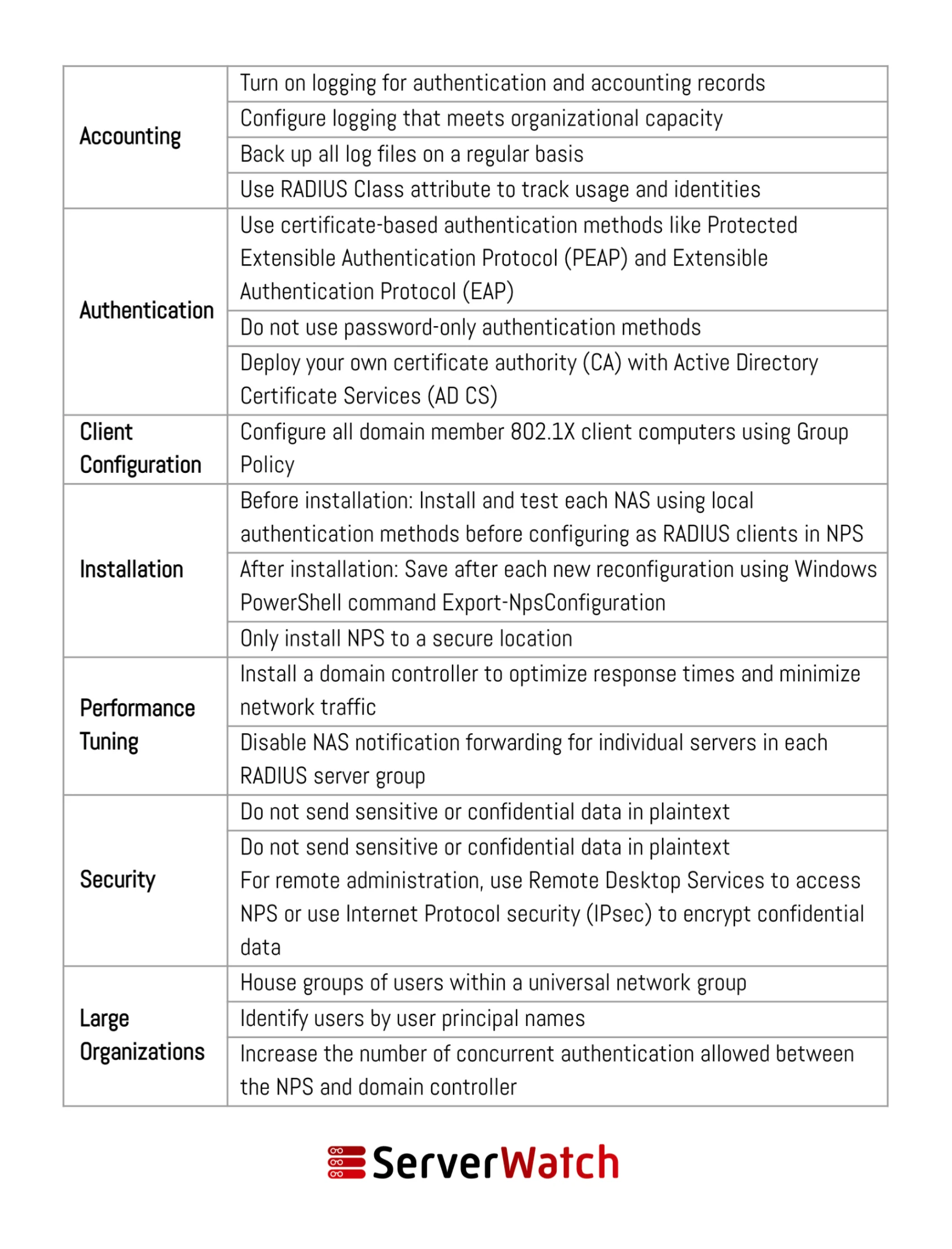
To maximize the effectiveness and security of a Network Policy Server (NPS) deployment, adhering to established best practices is paramount. These guidelines, often provided by Microsoft and seasoned IT professionals, ensure that NPS operates efficiently, securely, and in alignment with organizational goals.
Microsoft’s Recommendations and Additional Best Practices:
-
Secure RADIUS Communication:
- Shared Secrets: Always use strong, complex shared secrets between NPS servers and RADIUS clients (network access servers). These secrets should be changed regularly.
- IPsec Encryption: For enhanced security, consider using Internet Protocol Security (IPsec) to encrypt communication between NPS servers and RADIUS clients. This protects RADIUS packets from interception and tampering.
- Network Segmentation: Deploy NPS on a secure network segment, separate from general user access. Restrict access to the NPS server itself to authorized administrators only.
-
Leverage Active Directory for Authentication:
- User and Group Management: Utilize Active Directory for managing user accounts and groups. NPS policies should be based on these AD groups for centralized and efficient access control.
- Service Accounts: Use dedicated service accounts with the minimum necessary permissions for NPS to interact with Active Directory.
-
Implement Granular and Specific Policies:
- Least Privilege: Apply the principle of least privilege when defining policies. Grant users and devices only the access they absolutely need to perform their functions.
- Clear Naming Conventions: Use descriptive names for your network policies to make them easily understandable and manageable.
- Order of Policies: Be mindful of the order in which policies are evaluated. NPS processes policies from top to bottom, and the first matching policy is applied. Place more specific policies above broader ones.
-
Configure Robust Accounting:
- Enable Accounting: Always enable RADIUS accounting on your NPS server and on your RADIUS clients.
- Centralized Logging: Consider forwarding accounting logs to a centralized logging server or Security Information and Event Management (SIEM) system for easier analysis, long-term storage, and correlation with other security events.
- Regular Review: Schedule regular reviews of accounting logs to identify unusual activity or potential security threats.
-
Maintain High Availability and Disaster Recovery:
- Clustering: For critical environments, configure NPS in a cluster for high availability. This ensures that network access continues even if one NPS server fails.
- Backup and Restore: Regularly back up your NPS configuration and ensure you have a tested disaster recovery plan in place.
-
Monitor NPS Performance:
- Performance Counters: Utilize Windows Server performance counters to monitor NPS resource utilization (CPU, memory, network).
- Event Logs: Regularly review NPS event logs for errors, warnings, and critical security events.
- Alerting: Set up alerts for key performance indicators or critical error events to proactively address issues.
-
Stay Updated:
- Patching: Keep your Windows Server operating system and NPS component updated with the latest security patches and updates from Microsoft.
- Documentation: Maintain comprehensive documentation of your NPS configuration, policies, and any custom scripts or integrations.
Bottom Line: The Integral Role of NPS in Modern Network Management
The Network Policy Server (NPS) has firmly established itself as an indispensable tool for organizations seeking to fortify their network security and streamline access management. Its robust functionality as a RADIUS server and proxy, coupled with its powerful policy enforcement capabilities, provides a comprehensive and flexible solution for ensuring secure and efficient network operations.
The integration of NPS into an organization’s IT infrastructure offers a dual benefit: it significantly enhances security by enforcing rigorous access policies and controls, thereby mitigating risks associated with unauthorized access and data breaches. Simultaneously, it simplifies administrative tasks related to user and device authentication and authorization, leading to more efficient management of network resources. By centralizing these critical functions, NPS reduces the complexity of network security management and allows IT teams to focus on strategic initiatives rather than routine access control tasks.
Furthermore, by adhering to the best practices outlined for deployment and ongoing management, organizations can maximize the benefits of NPS, ensuring its optimal performance, resilience, and security. This proactive approach is crucial for maintaining a secure and seamless operational flow in today’s dynamic and threat-laden digital landscape. As businesses continue to rely heavily on networked resources, the role of NPS in providing secure, controlled, and auditable access will only become more critical, making it a foundational element of any modern network security strategy.
For organizations looking to further optimize their NPS functionality and performance, exploring specialized RADIUS server testing and monitoring tools can provide invaluable insights and proactive management capabilities. These tools, often reviewed by industry experts, can help identify potential issues before they impact users and ensure the continued reliability of network access.
