
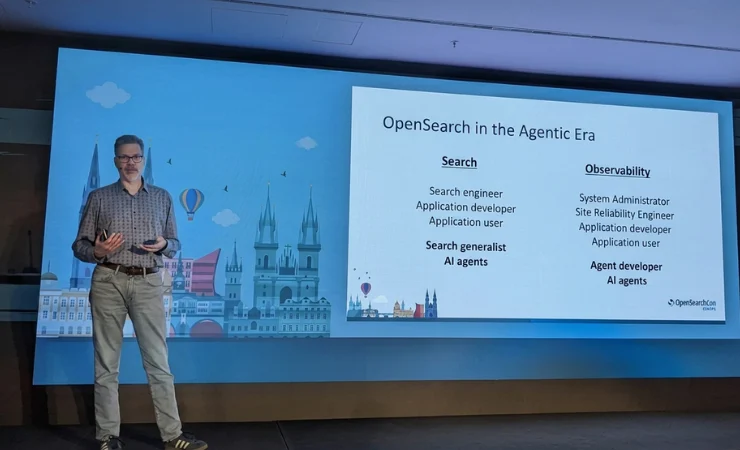

The OpenSearch Software Foundation has reached a critical inflection point in its evolution, marking a transition from a community-driven open-source project to a cornerstone of enterprise-grade infrastructure. At the OpenSearchCon Europe 2026 conference held in Prague, leadership addressed the growing friction between high-velocity open-source innovation and the stringent requirements of global enterprise procurement. The event served as a platform to unveil a structured Long-Term Support (LTS) program and a broader strategy aimed at decoupling the enterprise AI data layer from proprietary vendor lock-in.
The central theme of the conference, echoed by keynotes and technical sessions alike, suggests that the primary bottleneck in artificial intelligence has migrated. While 2024 and 2025 were defined by the race for more powerful large language models (LLMs), 2026 has seen the industry’s focus shift toward the data layer. For enterprises, the challenge is no longer just accessing a model, but ensuring the data fed into those models is searchable, secure, and governed by predictable lifecycle management.
The Evolution of OpenSearch: A Brief Chronology
To understand the current trajectory of the OpenSearch Software Foundation, it is necessary to examine the timeline of its development. The project was born out of necessity in early 2021, following a significant licensing change by Elastic NV for its Elasticsearch and Kibana products. Amazon Web Services (AWS) initiated the fork under the Apache License 2.0 to ensure a truly open-source search and analytics suite remained available to the public.
By 2023, the project had gained significant momentum, with major players like Oracle, Red Hat, and SAP contributing to the codebase. The pivotal moment for the project’s governance occurred in late 2024, when OpenSearch officially transitioned to the Linux Foundation. This move provided the legal and organizational framework necessary to establish a neutral ground for competitors to collaborate.
In 2025, the community focused on "Vector Search" capabilities, responding to the explosion of interest in Retrieval-Augmented Generation (RAG). However, by the time OpenSearchCon Europe 2026 convened in Prague, the narrative had matured. The focus has moved beyond the "hype" of vectors toward the "reliability" of the infrastructure supporting them.
Bridging the Procurement Gap through LTS Accreditation
Bianca Lewis, Executive Director of the OpenSearch Software Foundation, highlighted a recurring obstacle during the Prague summit: the "procurement wall." While technical teams within Global Fortune 500 companies frequently utilize open-source tools for prototyping, formal enterprise-wide adoption often stalls when faced with legal and procurement requirements.
Enterprise buyers typically demand three core assurances that traditional open-source projects struggle to provide: formal vendor-backed support, comprehensive security documentation with a clear liability chain, and long-term version stability. Without these, critical systems often remain tied to proprietary vendors who offer "one neck to choke" in the event of a system failure.
The Foundation’s solution is a novel LTS accreditation model. Under this program, the Foundation certifies independent vendors to provide official support for designated LTS releases. Currently, BigData Boutique, Eliatra, and Resolve Technology have been named as the inaugural accredited partners. These vendors are bound by a conformance agreement that requires them to contribute all security patches and bug fixes back to the upstream OpenSearch project.
This structure allows an enterprise to build on an LTS version of OpenSearch with the guarantee that the version will be maintained for a multi-year cycle. Crucially, it eliminates vendor lock-in; a company can switch between accredited support providers without the need for data migration or replatforming.
Data Sovereignty as a Global Architectural Standard
A significant portion of the discourse in Prague focused on the evolving regulatory landscape. While the European Union’s Cyber Resilience Act (CRA) has been a primary driver of compliance discussions in the West, Lewis noted that data sovereignty is no longer a regional "compliance story" but a universal architecture requirement.
Global regulations are tightening at an unprecedented rate. In Vietnam, cybersecurity legislation has introduced requirements that exceed the complexity of the CRA. Similarly, strict data handling laws in China, California, and New York are forcing enterprises to adopt more flexible data architectures.
The OpenSearch Foundation’s model addresses this by allowing for localized sovereignty. A European enterprise can select a European-based accredited vendor to manage its OpenSearch deployment, ensuring compliance with local laws while utilizing the same global open-source codebase as its Asian or American counterparts. This "federated trust" model is designed to handle a world where data cannot always move freely across borders, but software standards must.
Beyond the Vector Hype: Search for Decision Support
As the industry moves past the initial excitement surrounding AI, the technical requirements for search engines are becoming more sophisticated. Dom Couldwell of IBM, speaking during a keynote session, challenged the prevailing notion that vector search is a "silver bullet" for AI applications.
Carl Meadows, Chair of the Governing Board and Director of Product Management for OpenSearch at AWS, observed that many organizations follow a predictable—and often painful—learning curve. Most start with a pure vector database to support LLMs, only to realize that real-world applications require geospatial filtering, lexical search, and complex metadata tagging to be effective.
The Foundation is now positioning OpenSearch not merely as a search engine or a vector store, but as a "decision support" layer. The goal is to provide results that are not just statistically relevant (the hallmark of many vector-only systems) but accurate enough to base high-stakes business decisions upon. This requires a hybrid approach that combines traditional keyword search with modern neural search capabilities.
The Economics of Neutrality and the Role of AWS
The relationship between AWS and the OpenSearch Software Foundation remains a point of interest for industry analysts. Meadows addressed the balance between his role at AWS and his leadership on the governing board, characterizing the relationship as one of "pragmatic alignment."
AWS’s business model differs fundamentally from that of traditional software-as-a-service (SaaS) companies. While a subscription-based vendor relies on owning the application to drive revenue, AWS generates profit through the consumption of compute and storage infrastructure. Consequently, AWS benefits when a broad, healthy community uses OpenSearch, regardless of whether they run it on AWS, in a private data center, or on a competing cloud.
The transition to the Linux Foundation has codified this neutrality. Lewis emphasized that her fiduciary duty is to ensure the project remains viable even in extreme scenarios. The governance structure is designed to be "meteorite-proof," ensuring that if any single major contributor—including AWS—were to withdraw or face a catastrophic event, the project would continue to innovate and serve its members.
The membership roster reflects this growing institutional trust. Current premier members include industry giants such as IBM, SAP, and Uber. Notably, CERN has joined as an associate member, signaling the project’s utility in high-consequence scientific research environments.
Technical Implications for the AI Data Layer
The strategic shifts discussed in Prague have immediate implications for how CTOs and architects view their AI stacks. By providing a stable, LTS-backed version of OpenSearch, the Foundation is making it possible for the "Data Layer" to be as durable as the "Infrastructure Layer."
Industry data suggests that the cost of "replatforming" search infrastructure is one of the highest hidden costs in modern software development. By offering a guarantee against forced upgrades and providing a path for multi-vendor support, OpenSearch is lowering the total cost of ownership for open-source search.
Furthermore, the introduction of the OpenSearch Observability Stack and Agent Hub suggests that the project is expanding its footprint. These tools are designed to give developers better insight into how their AI agents are interacting with data, providing a level of transparency that is often missing from "black box" proprietary AI platforms.
Analysis: The Future of Open-Source Enterprise Trust
The OpenSearch Software Foundation’s strategy represents a sophisticated maturation of the open-source business model. By acknowledging the realities of enterprise procurement and global regulation, the Foundation is moving away from the "move fast and break things" ethos of early-stage open source and toward a model defined by "predictable innovation."
The success of the LTS program will likely serve as a blueprint for other large-scale open-source projects. If the Foundation can successfully manage the accreditation of third-party vendors while maintaining a high bar for security and performance, it will have solved one of the most persistent problems in the software industry: how to make open source safe for the most conservative enterprise environments.
As OpenSearchCon Europe 2026 concludes, the message to the market is clear. The era of treating search as a simple utility is over. In the age of AI, search is the bridge between raw data and actionable intelligence. By securing that bridge with long-term support and global compliance standards, the OpenSearch Software Foundation is positioning itself as an indispensable architect of the modern enterprise.
