

AWS has unveiled managed daemon support for Amazon Elastic Container Service (ECS) Managed Instances, a significant enhancement designed to empower platform engineers with independent control over essential software agents like monitoring, logging, and tracing tools. This new capability, building on the ECS Managed Instances experience introduced in September 2025, promises to streamline operations, bolster reliability, and foster greater agility by decoupling the lifecycle management of these critical agents from application deployments. The announcement, widely anticipated by the cloud-native community, addresses a long-standing operational challenge for organizations running containerized workloads at scale, marking a pivotal step towards more autonomous and efficient cloud operations.
The Evolving Landscape of Container Orchestration and Operational Challenges
The adoption of containers and microservices architectures has surged dramatically over the past decade, transforming how applications are built, deployed, and managed. Amazon ECS, a fully managed container orchestration service, has been at the forefront of this revolution, providing a highly scalable and performant environment for running Docker containers on AWS. Its appeal lies in its deep integration with other AWS services and its operational simplicity compared to self-managed alternatives. However, as organizations scale their containerized workloads to hundreds or thousands of services, the complexities of managing the underlying infrastructure and operational tooling have also grown exponentially.
Platform engineers, often operating within dedicated platform teams or as part of Site Reliability Engineering (SRE) functions, bear the crucial responsibility of maintaining the health, performance, and security of these large-scale environments. This includes everything from ensuring infrastructure availability and scaling to patching host operating systems and deploying critical operational agents. These agents—such as the Amazon CloudWatch Agent for metrics and logs, security scanning tools, or custom tracing daemons—are indispensable for maintaining observability, compliance, and incident response capabilities.
Historically, the lifecycle management of these operational agents has been tightly coupled with the application deployment process. To update a monitoring agent, for instance, platform teams often had to coordinate extensively with application development teams, modify application task definitions, and then trigger a redeployment of entire applications. This intricate coordination and dependency introduced significant operational friction, leading to slower update cycles, increased risk of human error, and considerable overhead, particularly in environments with continuous deployment pipelines. The inability to independently manage these critical daemons created bottlenecks, impacting both operational agility and the consistency of observability data across the fleet.
The introduction of Amazon ECS Managed Instances in September 2025 provided a foundational layer for this latest innovation. Managed Instances simplified the provisioning and scaling of ECS cluster instances, automating tasks like instance provisioning, scaling, and agent installation. However, the direct management of specific daemons still presented a challenge that this new managed daemon support aims to unequivocally resolve.
A Deep Dive into Managed Daemon Functionality
The core innovation lies in the introduction of a dedicated "managed daemons construct" within Amazon ECS. This new construct enables platform teams to define, deploy, and manage operational tooling centrally, entirely decoupled from application task definitions. This separation of concerns is a game-changer for several reasons:
-
Independent Lifecycle Management: Platform engineers can now independently deploy and update monitoring, logging, and tracing agents without requiring any modification to application task definitions or coordination with application teams for redeployments. This significantly accelerates the update cadence for operational tools, allowing teams to respond faster to security vulnerabilities, incorporate new features, or adapt to changing compliance requirements.
-
Guaranteed Reliability and Consistency: Managed daemons are guaranteed to start before any application tasks on an instance and drain last when an instance is being shut down or updated. This "start before stop" approach ensures that essential observability and security agents are always operational before an application begins processing traffic and remain active until the application tasks have fully drained. This eliminates gaps in data collection for logging, tracing, and monitoring, providing a consistent and comprehensive view of the environment’s health at all times. Furthermore, ECS enforces the consistent use of required tools across all instances within a specified capacity provider, eliminating configuration drift and ensuring uniform operational coverage.
-
Flexible Deployment and Resource Management: Platform engineers gain granular control over daemon deployment. They can deploy managed daemons across multiple capacity providers or target specific capacity providers, offering flexibility in how agents are rolled out across different infrastructure segments (e.g., production vs. staging, specific compliance zones). Resource management for daemons is also centralized and decoupled. Teams can define specific CPU and memory parameters for daemon tasks separately from application configurations. This not only optimizes resource utilization—as each instance runs exactly one daemon copy shared across multiple application tasks—but also negates the need to rebuild Amazon Machine Images (AMIs) or update application task definitions for daemon-related changes.

-
Advanced Host-Level Access: Operational tooling often requires deep access to the underlying host system for comprehensive data collection. Managed daemons support advanced host-level access capabilities, allowing platform engineers to configure daemon tasks as privileged containers, add additional Linux capabilities, and mount paths directly from the underlying host filesystem. These capabilities are crucial for agents performing tasks like collecting detailed system metrics, monitoring low-level processes, or implementing host-based intrusion detection systems.
-
Automated Rolling Deployments with Rollbacks: Updating daemons is a critical but often delicate operation. ECS now handles this automatically through intelligent rolling deployments. When a daemon is updated, ECS provisions new instances with the updated daemon, ensures the daemon starts first, then gracefully migrates application tasks to these new instances before terminating the old ones. This process, governed by a configurable drain percentage, ensures continuous daemon coverage and application availability. Crucially, the system also supports automatic rollbacks, providing a safety net for daemon updates and boosting confidence in operational changes.
The User Experience: A Practical Walkthrough
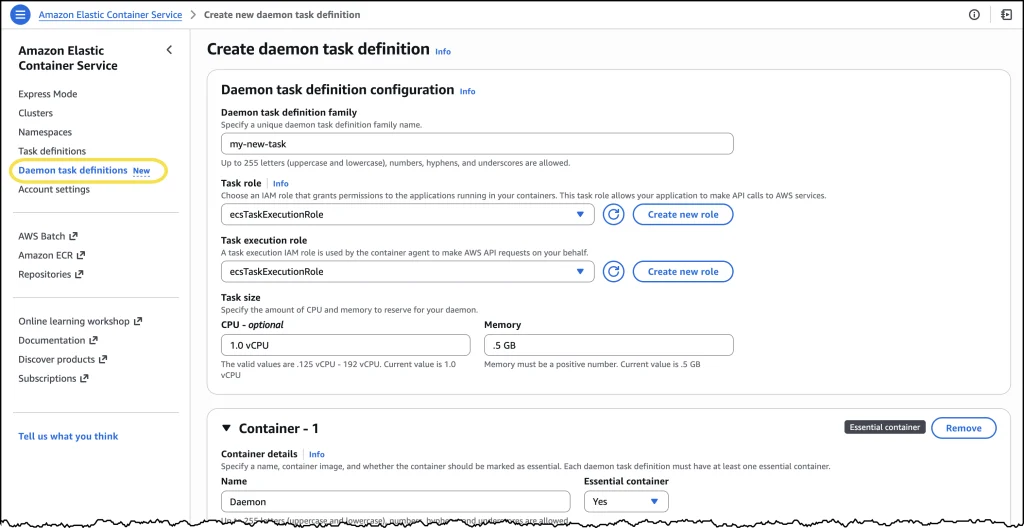
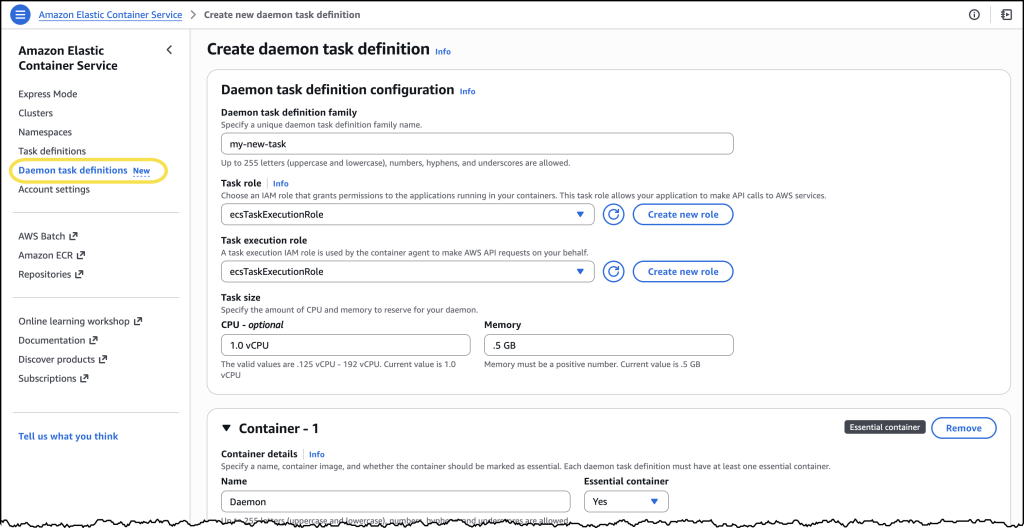
The integration of managed daemon support into the AWS console is intuitive and streamlined. Platform engineers will find a new "Daemon task definitions" option within the Amazon Elastic Container Service console’s navigation pane. Here, they can define new daemon task definitions, specifying container images (e.g., public.ecr.aws/cloudwatch-agent/cloudwatch-agent:latest), resource allocations (e.g., 1 vCPU, 0.5 GB memory), and task execution roles.
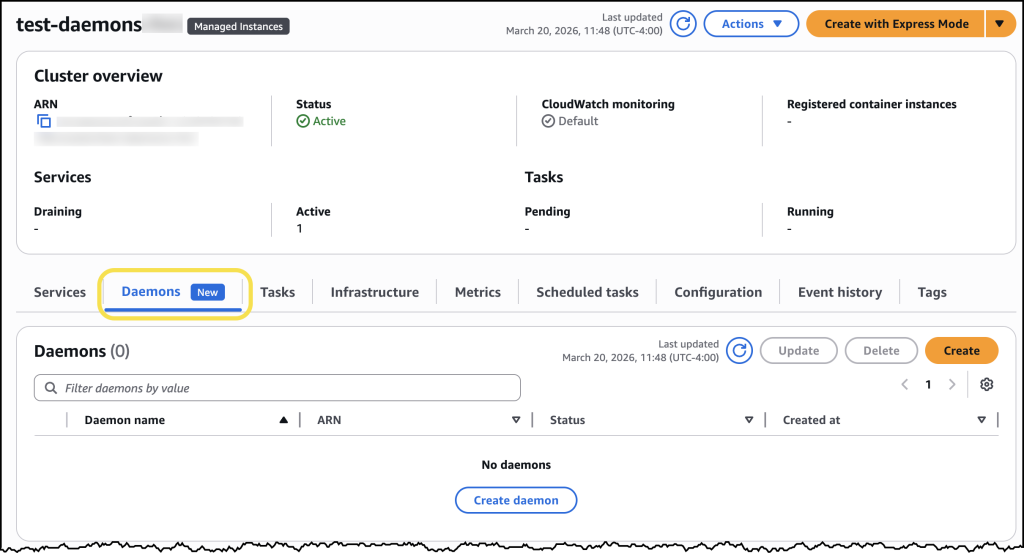
Once a daemon task definition is created, engineers can navigate to their ECS Clusters page, where a new "Daemons" tab provides an interface to deploy and manage these daemons. By simply clicking "Create daemon," selecting the desired daemon task definition family, assigning a name, and choosing the target ECS Managed Instances capacity provider, the daemon is deployed. ECS then automatically ensures that the daemon task launches first on every provisioned ECS managed instance within the selected capacity provider.
For example, deploying the Amazon CloudWatch Agent as a managed daemon means that every instance in the designated capacity provider will consistently run the latest version of the agent, collecting vital metrics and logs, without any manual intervention required from application teams or complex orchestration scripting. This hands-on approach simplifies the entire process from definition to deployment and ongoing management.
Transformative Benefits for Cloud Operations and Platform Engineering
The introduction of managed daemon support is poised to deliver a multitude of benefits across various dimensions of cloud operations:
- Enhanced Operational Agility: By decoupling daemon updates from application deployments, platform teams can iterate faster on their operational tooling. This agility is crucial for responding quickly to security advisories, adopting new monitoring best practices, or integrating advanced observability features without impacting application development velocity.
- Unprecedented Reliability and Consistency: The guarantee that daemons start before applications and drain last significantly improves the reliability of observability data. It ensures that every instance consistently runs the required agents, reducing the risk of blind spots in monitoring or logging that could lead to missed incidents or delayed troubleshooting. This consistency is fundamental for maintaining high service levels and robust incident response.
- Streamlined Resource Optimization: Dedicated resource management for daemons, combined with the "one daemon per instance" model, prevents resource contention with application tasks and optimizes compute utilization. Engineers can fine-tune daemon resource allocations without affecting application configurations, leading to more efficient use of infrastructure and potentially lower operational costs.
- Improved Security Posture: The ability to consistently deploy and update security agents (e.g., vulnerability scanners, intrusion detection agents) across the entire container fleet without application team coordination is a major boost for security. Advanced host-level access capabilities allow these agents to perform deep system inspections, enhancing the overall security posture and compliance adherence.
- Simplified Compliance and Auditing: For organizations operating in regulated industries, demonstrating consistent deployment and operation of logging, monitoring, and security agents is paramount for compliance. Managed daemons provide a centralized and auditable mechanism to enforce these requirements across the infrastructure, simplifying compliance efforts and reducing audit burdens.
- Reduced Operational Overhead and Cognitive Load: By automating the deployment, scaling, and updating of daemons, platform engineers are freed from repetitive manual tasks and complex coordination efforts. This reduction in operational overhead allows teams to focus on higher-value activities, such as innovation, architectural improvements, and proactive problem-solving, rather than reactive maintenance. The clear separation of concerns also reduces cognitive load for both platform and application teams.
Industry Reactions and Strategic Implications
Industry experts and DevOps professionals have largely welcomed this announcement as a critical evolution in container orchestration. "This feature directly addresses a major pain point that platform teams have wrestled with for years," noted a prominent cloud architect. "The ability to manage operational agents independently, with guaranteed lifecycle behaviors, is a game-changer for maintaining consistent observability and security in large-scale container environments. It truly embodies the ‘platform engineering’ ethos by providing robust, self-service capabilities for infrastructure management."
AWS spokespersons emphasized that this development underscores AWS’s commitment to simplifying complex cloud operations and empowering engineering teams. "Our customers consistently tell us they need more granular control and greater autonomy over their operational tooling," stated an AWS product manager during a recent briefing. "Managed daemon support for Amazon ECS Managed Instances is a direct response to that feedback, providing a robust, scalable, and reliable solution that allows platform engineers to move faster and with greater confidence."
Strategically, this enhancement strengthens Amazon ECS’s position in the competitive container orchestration market. By directly tackling a nuanced operational challenge that often requires significant custom tooling or workarounds in other environments, AWS is further differentiating ECS as a highly opinionated yet flexible platform optimized for operational excellence. It aligns with broader industry trends towards automated, self-healing, and observable infrastructure, enabling organizations to achieve higher levels of service reliability and operational efficiency.
Availability and Future Outlook
Managed daemon support for Amazon ECS Managed Instances is available today across all AWS Regions where Amazon ECS is offered. There is no additional cost specifically for using managed daemons; customers only pay for the standard compute resources consumed by their daemon tasks, consistent with AWS’s pay-as-you-go model. To get started, platform engineers can visit the Amazon ECS console or consult the comprehensive Amazon ECS documentation and the newly updated Application Programming Interface (APIs).
Looking ahead, this foundational capability opens doors for further innovations in autonomous cloud operations. AWS is likely to continue building on this decoupled management paradigm, potentially offering more integrated tooling, enhanced policy enforcement for agents, and deeper insights into daemon performance and health. As organizations continue their journey towards fully automated, observable, and resilient cloud-native architectures, features like managed daemon support will be indispensable in empowering engineering teams to build and operate at an unprecedented scale and speed.
