
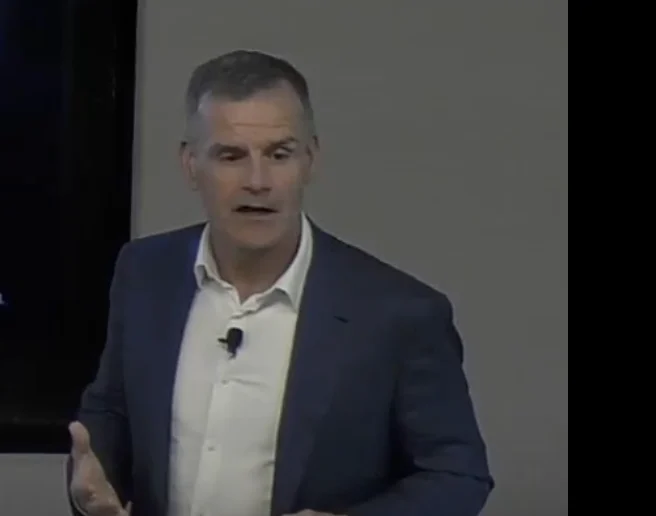

Freshworks, the Nasdaq-listed software-as-a-service (SaaS) provider, has formally signaled a major strategic pivot, repositioning itself as an enterprise-grade Employee Experience (EX) firm rather than a provider primarily focused on the small-to-medium business (SMB) and Customer Experience (CX) sectors. This transition was the central theme of the company’s "Refresh" customer conference held recently in New York City, where CEO Dennis Woodside addressed investors, analysts, and customers regarding the firm’s future trajectory. The announcement comes at a pivotal moment for the company, following a strong fiscal quarter and a simultaneous workforce reduction of 11%, a move the company attributed to the increasing role of artificial intelligence in automating internal operations and coding tasks.
While Freshworks has historically been recognized for its customer support software, Freshdesk, the company’s internal data suggests a rapid evolution. According to Woodside, the traditional market perception of Freshworks as a "CX-centric" or "SMB-centric" business is no longer reflective of its revenue reality or its developmental focus. The company is now aggressively pursuing the mid-market and enterprise sectors, focusing on its Freshservice platform, which is designed to manage internal IT and employee-facing operations.
The Strategic Realignment: From CX Roots to EX Dominance
The shift in Freshworks’ identity is grounded in significant changes to its Annual Recurring Revenue (ARR) composition. At the time of its initial public offering (IPO) in 2021, the EX segment of the business accounted for approximately 37% of its total revenue. Since then, the company has seen a dramatic acceleration in this sector. Woodside confirmed that the EX business is projected to reach 60% of the company’s total ARR by the end of the current fiscal year, with expectations for it to climb to 70% by 2028.
This shift represents more than just a change in marketing; it is a fundamental reallocation of the company’s research and development resources. Woodside noted that both organic engineering efforts and inorganic growth strategies, such as the recent acquisition of Device42 for IT asset management, are now strictly aligned with the EX-first vision. The company’s flagship EX product, Freshservice, is currently on a trajectory to reach $1 billion in ARR within the next 30 months. This growth is being driven by a customer base that has expanded fivefold over the last five years, now totaling over 20,000 global organizations.
Market Dynamics and the Competitive Landscape
The Total Addressable Market (TAM) for the services Freshworks is targeting—which includes IT Service Management (ITSM), IT Asset Management (ITAM), IT Operations Management (ITOM), and Enterprise Service Management (ESM)—is estimated by Gartner to be worth approximately $45 billion, with a projected annual growth rate of 13%. Freshworks is specifically focusing on the segment of this market comprised of organizations with up to 20,000 employees. This segment represents roughly 60% of the total TAM, and notably, no single competitor currently holds more than a 20% market share.
Woodside categorized the competitive landscape into four distinct tiers:
- Legacy Providers: Older systems such as BMC and Ivanti, which are often perceived by the market as lacking in innovation and modern agility.
- SMB-Focused Tools: Simple help desk solutions like Zendesk, SysAid, or ManageEngine, which may lack the depth required for complex enterprise operations.
- Developer-Centric Tools: Platforms like Atlassian’s Jira, which, while powerful, are often criticized for being difficult for non-technical employees to navigate.
- The High-End Incumbent: ServiceNow, which remains the dominant force in the enterprise sector but is frequently cited by customers as being prohibitively expensive and overly complex to implement.
Freshworks’ value proposition, summarized by the tagline "enterprise-grade without that enterprise complexity," aims to sit in the "Goldilocks zone" between these categories—offering the power of a legacy incumbent with the user-friendliness of a modern SaaS application.
The Role of Artificial Intelligence in the "Agentic World"
Central to Freshworks’ new strategy is the integration of generative AI through its "Freddy" AI suite. The company is positioning AI not as a peripheral feature but as a foundational element of its platform. This is particularly evident in the deployment of Freddy Copilot, which assists human agents by summarizing tickets, suggesting responses, and automating repetitive workflows.
Internal metrics released by the company indicate that agents using Freddy Copilot are capable of addressing 50% more tickets than those working without AI assistance. Woodside emphasized that the company’s AI strategy focuses on "speed-to-value," claiming that their AI capabilities can be operational within hours, rather than the months-long implementation cycles typically associated with larger enterprise competitors.
The company is also moving toward an "agentic" model, where AI agents can autonomously handle complex multi-step processes. To ensure these tools deliver measurable value—a common pain point for enterprises currently experimenting with AI—Freshworks has introduced monitoring tools that measure employee productivity through AI-driven scoring, rather than relying solely on traditional Service Level Agreements (SLAs).
Enterprise Proof Points: New Balance and Seagate
To substantiate its claims of enterprise readiness, Freshworks highlighted two significant customer success stories during the Refresh event.
The first involves the global athletic brand New Balance. With approximately 7,000 employees, New Balance operates in a highly competitive market against much larger entities like Nike. To remain agile, New Balance required a unified IT operation that could bridge silos across marketing, sales, and global production without the heavy overhead of legacy systems. By integrating Freshworks’ solutions, including the newly acquired Device42 capabilities, New Balance was able to consolidate its IT operations and is currently expanding the platform’s use into non-IT departments.
The second case study focused on Seagate, the data storage giant with 30,000 employees. Seagate had utilized a legacy provider for 14 years but struggled to extract value from modern AI capabilities or modify workflows to meet changing business needs. After evaluating several modern platforms, Seagate migrated to Freshworks and went live in just three months—a timeline significantly shorter than industry averages for an enterprise of that scale. Woodside used this example to challenge the notion that "sticky" legacy systems are impossible to replace, positioning Freshworks as a viable alternative for the world’s most sophisticated CIOs.
Fiscal Discipline and Workforce Restructuring
The strategic pivot to EX occurs against the backdrop of a significant workforce reduction. The decision to lay off 11% of the staff was described by the company as a "prudent" move to align headcount with the new AI-driven operational model. CFO Tyler Sloat explained that the company had previously solved operational problems by increasing headcount, leading to inefficiencies. Over the last two years, Freshworks has reduced its total headcount by 20% while continuing to grow its top-line revenue.
Sloat indicated that while the company is still hiring for specific high-growth roles, the overall approach to personnel will remain conservative. This restructuring is partly driven by the fact that AI is now performing a "majority" of the coding work that was previously handled by junior developers, allowing the company to maintain a leaner engineering organization focused on high-level architecture and innovation.
The Future of the Customer Experience (CX) Business
The heavy emphasis on Employee Experience has raised questions regarding the future of Freshworks’ original core product, Freshdesk. Management clarified that while CX remains a component of the business, the go-to-market (GTM) strategy for this segment is being narrowed.
The company recently completed a year-long "re-platforming" of its CX products, migrating 80% of its customer base to a new unified platform under the Freshdesk and Freshdesk Omni names. However, Sloat noted that future efforts in the CX space will be "inbound only" and highly prescriptive. This suggests that while Freshworks will continue to support and update its CX offerings for existing customers and incoming SMB leads, its proactive sales and marketing investments will be overwhelmingly directed toward the EX enterprise market.
Broader Industry Implications and Analysis
The transformation of Freshworks reflects a broader trend in the SaaS industry where providers are forced to choose between being a niche "point solution" or a comprehensive platform. By moving into the EX and ESM space, Freshworks is directly challenging the hegemony of established players like ServiceNow and Atlassian.
The success of this pivot will likely depend on three factors:
- The Continued Growth of Freshservice: Reaching the $1 billion ARR milestone will be the ultimate validation of the EX-first strategy.
- AI Execution: As more companies demand proof of AI ROI, Freshworks must continue to demonstrate that its "Freddy" suite provides tangible productivity gains rather than just incremental improvements.
- Enterprise Perception: Overcoming the "SMB brand" stigma remains a hurdle. While wins like Seagate are significant, the company must consistently secure contracts with the Global 2000 to solidify its status as a top-tier enterprise vendor.
As Freshworks moves into the final quarter of the fiscal year, the market will be watching closely to see if the reduction in force and the aggressive focus on AI-driven Employee Experience will translate into sustained margin expansion and market share gains in the highly competitive enterprise software landscape.
