

The rapid integration of Artificial Intelligence into corporate operations has outpaced the financial oversight capabilities of many organizations, creating a significant blind spot in their spending. What began as a manageable series of API calls and token-based charges has ballooned into a fast-moving and often opaque cost category, leaving finance teams struggling to accurately track and forecast expenditures. This burgeoning challenge is precisely what Ramp, the $32 billion fintech giant, is now addressing with a new product designed to bring clarity to AI spend. The New York-based company, renowned for its corporate cards and expense management solutions, announced its initiative to directly ingest token-level usage data from AI providers into its platform, aiming to furnish finance departments with an unprecedented level of detail regarding their AI investments.
The Escalating Cost of AI: A Growing Shadow in Corporate Budgets
Artificial Intelligence is no longer a niche or experimental line item in corporate budgets. It has rapidly ascended to become one of the most dynamic and fastest-growing areas of corporate expenditure, yet it lacks the established oversight mechanisms common to other financial categories. This is a trend that Ramp itself has experienced firsthand. The company has been a proactive adopter of AI internally, developing sophisticated systems capable of generating and validating code as part of its own development lifecycle. This internal immersion provided Ramp with a clear, front-row view of how quickly AI usage, and consequently costs, can escalate. The realization of this challenge became particularly acute when its own finance team attempted to quantify the company’s internal AI expenditures.
Karim Atiyeh, Ramp’s co-founder and Chief Technology Officer, articulated the genesis of this problem in a blog post published Thursday. He recounted an instance where a seemingly straightforward internal inquiry revealed the depth of the visibility gap: "Last quarter, I asked our Finance team a simple question: how much are we spending on AI and where is it going? The analysis took days and still couldn’t provide the level of detail I wanted." This anecdote underscores a widespread issue across industries, where the inherent nature of AI billing models creates significant accounting hurdles.
Unlike traditional software agreements characterized by fixed pricing tiers, AI costs are intrinsically linked to usage. This usage is frequently measured in discrete units known as "tokens," and the volume of these tokens can fluctuate dramatically based on the complexity and frequency of model interactions. "AI inference behaves nothing like the spend categories finance teams are used to managing," Atiyeh explained. "It’s usage-based and volatile." This inherent unpredictability makes it exceptionally difficult for finance departments to accurately categorize spending or reliably forecast future AI-related expenses.

Ramp’s internal data offers a stark illustration of this volatility. The company reports that average monthly token spend has surged thirteenfold since January 2025. For organizations that are heavy users of AI, costs can escalate by 50% or more within a single fiscal quarter. This rapid and often unpredictable growth pattern creates a disconnect between the engineering teams, who are typically at the forefront of AI implementation and usage, and the finance teams responsible for budget allocation, reporting, and overall financial health. Atiyeh noted that existing tools, while capable of surfacing raw usage data, often fall short in translating this information into actionable financial insights. "It doesn’t tell the controller whether a given API key’s spend belongs in COGS [cost of goods sold] or OpEx [operating expenses]," he stated.
Bridging the Gap: Integrating Financial Context with AI Usage
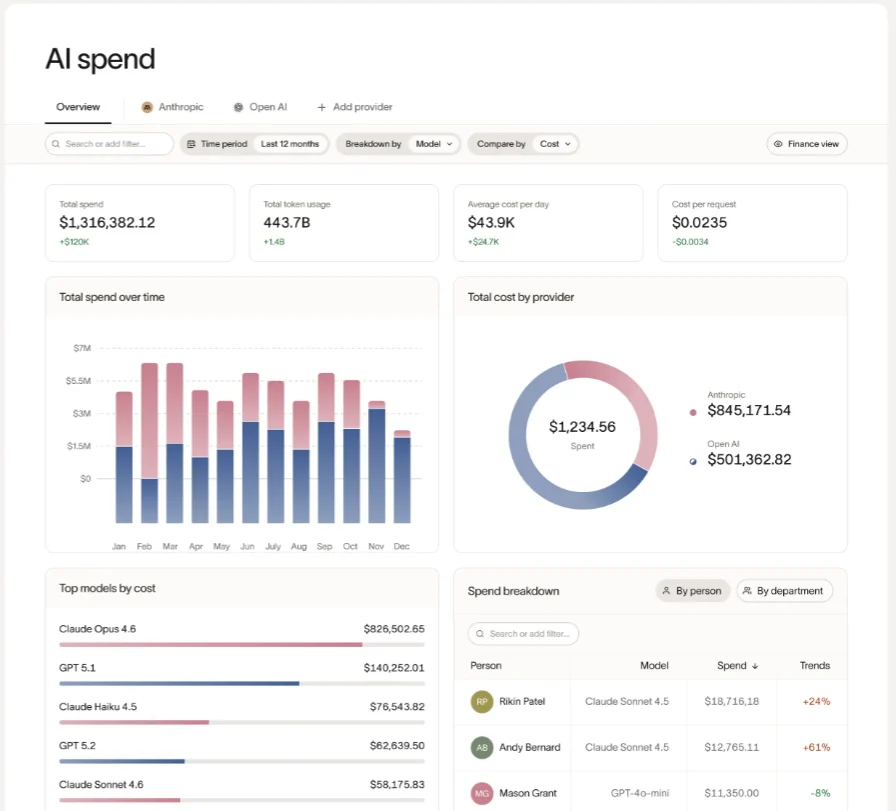
Ramp’s strategic response to this pervasive problem is to unify billing data with granular usage data within a single, integrated system. By establishing direct integrations with leading AI providers such as OpenAI and Anthropic, as well as with model gateways like OpenRouter, Ramp’s platform gains the capability to meticulously track token consumption across different teams and projects within an organization. The core objective of this initiative is to transcend mere raw usage metrics and imbue them with meaningful financial context.
This entails not only monitoring total spend alongside token utilization but also analyzing metrics such as average cost per day and cost per request. Crucially, the platform facilitates the breakdown of these costs by provider, specific AI model, team, and even individual users. This granular visibility empowers finance teams to pinpoint which products or features are the primary drivers of AI expenditure. Furthermore, it enables them to accurately classify these costs into standard accounting categories, such as cost of goods sold or operating expenses, thereby aligning AI spend with established financial frameworks.
Atiyeh emphasized that the primary obstacle for most companies has not been a scarcity of data, but rather an absence of a clear, actionable framework for interpreting it. "The missing layer is financial context," he asserted. "AI is on track to become one of the largest cost centers in business. For some companies, it’s already exceeding what they spend on payroll." This statement highlights the profound shift AI is causing in corporate financial structures, moving from a peripheral technology to a core operational expense.
Ramp’s newly launched product is built with finance teams, rather than developers, as its primary audience. Beyond enhanced visibility, the platform offers a suite of controls designed to empower financial oversight. These include the ability to set budgets at the project or team level, configure alerts for unusual spending patterns, and directly link cost spikes to specific operational changes, such as the rollout of a new feature or a strategic shift in model utilization. The system also streamlines the reconciliation process between reported usage and provider invoices, ensuring that companies are billed accurately for their consumption and that these costs are appropriately allocated across the business.

A New Layer in the AI Infrastructure Stack
The introduction of Ramp’s AI spend visibility tool signifies a broader evolution in how businesses are approaching AI infrastructure. Historically, the dominant focus in AI tooling has been on developers, offering dashboards that track critical performance metrics like latency, model output quality, and prompt engineering effectiveness. While these observability tools are indispensable for optimizing AI performance, Ramp is positioning its offering as a complementary layer, specifically targeting the needs of finance and operations departments.
The fundamental question this new layer aims to answer is distinct from that of traditional observability tools: not "how well does the model perform?" but "what does it cost, and is that cost justified by the business value derived?" This distinction is poised to become increasingly critical as AI transitions from experimental phases into the core operational fabric of businesses.
Moreover, Ramp posits that enhanced financial visibility can proactively influence the very way businesses deploy AI. Armed with clear data on costs and their associated returns on investment, teams may be more inclined to refine their usage of AI models, prioritize certain features, or even adjust their own product pricing strategies to better reflect the value and cost of AI integration. "The companies that build financial discipline around it now will make better decisions about where to invest, where to cut, and how to price their own products," Atiyeh concluded. "The ones that don’t will be guessing." This forward-looking perspective suggests that financial acumen in the AI era will be a key differentiator for competitive success.
The implications of this trend extend beyond individual company expenditures. As AI becomes more deeply embedded in global commerce, the standardization of AI cost management practices will become crucial for industry-wide financial stability and predictable growth. The ability for finance teams to effectively manage, forecast, and report on AI spend will not only mitigate financial risks for individual organizations but also contribute to a more mature and sustainable AI ecosystem overall. Companies that proactively adopt solutions like Ramp’s will likely gain a significant advantage in navigating the complex financial landscape of artificial intelligence, ensuring that their AI investments are both strategically sound and financially responsible.
