

AWS has announced two significant updates to Amazon Cognito, its comprehensive identity management service: the introduction of multi-Region replication for enhanced resilience and support for customer managed keys (CMKs) for superior encryption control. These advancements are poised to revolutionize how developers and enterprises build highly available and secure user and machine-to-machine authentication systems, addressing long-standing challenges in maintaining business continuity and compliance across distributed cloud environments.
The Evolving Landscape of Authentication and the Quest for High Availability
In today’s interconnected digital ecosystem, reliable and secure authentication is the bedrock of virtually every application, from consumer-facing mobile apps to complex enterprise microservices. The proliferation of agentic AI, microservices architectures, extensive automation, and service accounts has dramatically increased the demand for robust machine-to-machine (M2M) authentication, alongside traditional user authentication. A critical requirement across this spectrum is uninterrupted service, even in the face of regional service interruptions or catastrophic events.
Historically, achieving high availability and disaster recovery for identity services like Amazon Cognito presented considerable engineering hurdles. Organizations striving for consistent data across multiple AWS Regions often resorted to complex, custom-built replication solutions. These bespoke systems were not only time-consuming and expensive to develop and maintain but also introduced significant operational overhead and potential security vulnerabilities. Manual export and import of user data between regions risked data exposure and frequently led to inconsistencies, undermining the integrity of user profiles and credentials. During regional transitions, end-users often faced disruptive experiences, such as forced password resets and re-authentication, impacting user experience and trust. For M2M communications, teams had to create entirely new application clients in secondary regions, necessitating application reconfigurations and updates to OAuth-protected resources to accept new access tokens. These challenges underscored a pressing need for a more streamlined, integrated solution.
Multi-Region Replication: A New Paradigm for Resilience
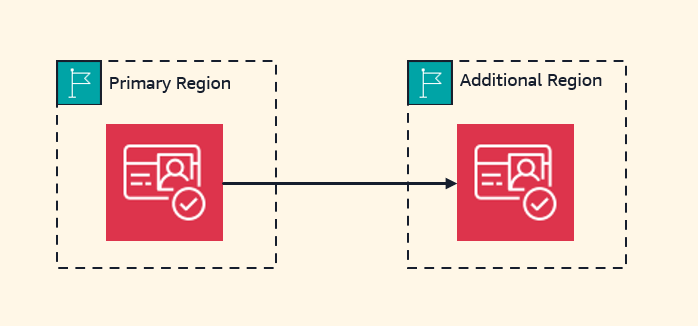
The introduction of multi-Region replication in Amazon Cognito marks a pivotal shift in how applications can achieve identity resilience. This feature enables automatic, continuous synchronization of user data and machine secrets from a designated primary AWS Region to a chosen secondary Region. This unidirectional replication encompasses critical components such as user profiles, credentials, and user pool configurations, ensuring that a consistent and up-to-date copy of identity data is always available.
The secondary Region operates in a read-only mode, primarily focused on maintaining authentication capabilities. A key benefit is the seamless continuation of existing user sessions during a failover scenario. When traffic is directed to the secondary Region—a process typically managed by DNS updates in response to health checks—existing users can continue signing in with their current credentials without disruption. Crucially, currently signed-in users remain authenticated because both primary and secondary regions recognize access tokens issued by either region. This token recognition ensures a smooth transition, minimizing user impact.

Multi-Region replication supports a comprehensive array of authentication methods, including federated sign-in through popular social providers like Amazon, Google, Apple, and Facebook, as well as enterprise integrations via Security Assertion Markup Language (SAML) and OpenID Connect (OIDC). It also extends its benefits to API authorization flows, ensuring availability for both customer-facing applications and the intricate M2M communications vital to backend services. While authentication continues uninterrupted, it is important to note that operations like new user registrations or profile updates are not available in the read-only secondary region during a failover event. These operations would typically resume once the primary region is restored or a new primary is established.
Enhanced Control with Customer Managed Keys
Complementing multi-Region replication is the new support for customer managed keys (CMKs) within Amazon Cognito. This feature provides organizations with an additional layer of control over the encryption of their user data at rest. Before configuring multi-Region replication, customers are required to configure a multi-Region CMK stored in AWS Key Management Service (AWS KMS). These CMKs ensure consistent encryption across all replicated regions while empowering customers to define and manage their encryption strategy in line with their specific security policies and compliance mandates.
The ability to use CMKs is particularly significant for customers in highly regulated industries, such as healthcare, financial services, and government, where strict data governance and compliance requirements are paramount. By leveraging CMKs, organizations can demonstrate greater control over their cryptographic keys, which is often a prerequisite for regulatory adherence (e.g., GDPR, HIPAA, PCI DSS). This capability not only strengthens the overall security posture of applications utilizing Cognito but also streamlines audit processes by providing a clear chain of custody for encryption keys.

Implementation and Operational Workflow: A Step-by-Step Guide
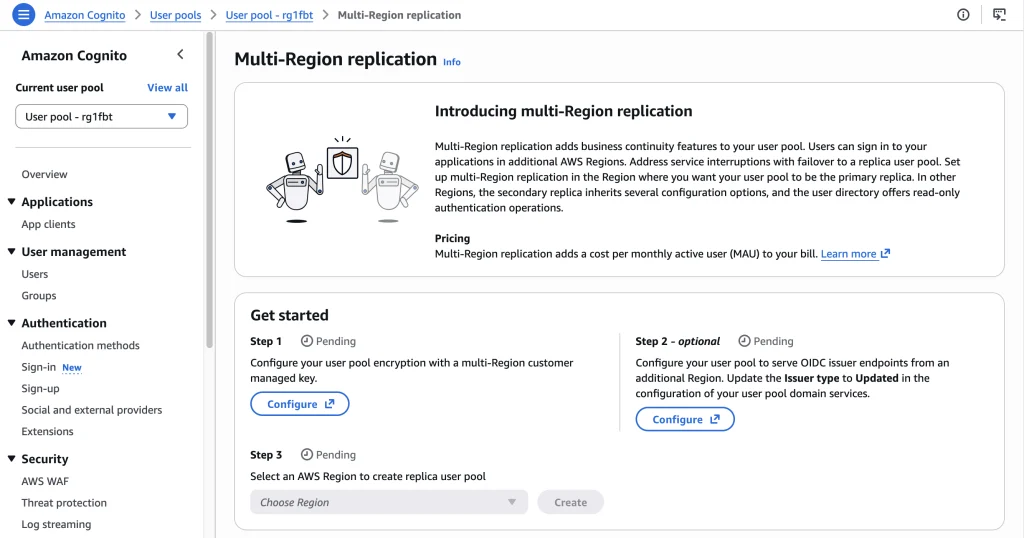
The configuration process for multi-Region replication is designed to be intuitive, guided by the AWS Management Console. An existing Cognito user pool in a primary Region (e.g., us-west-2 Oregon) can be set up for replication to a secondary Region (e.g., us-east-1 Northern Virginia) in three primary steps, assuming a multi-Region CMK is already established across these regions.
-
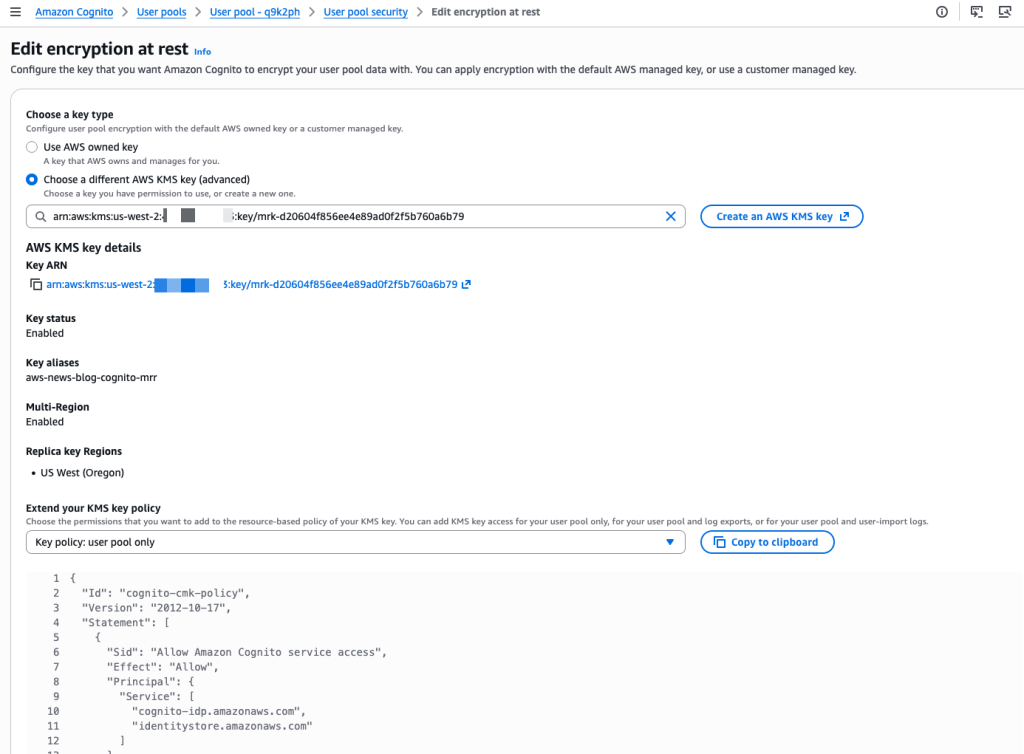
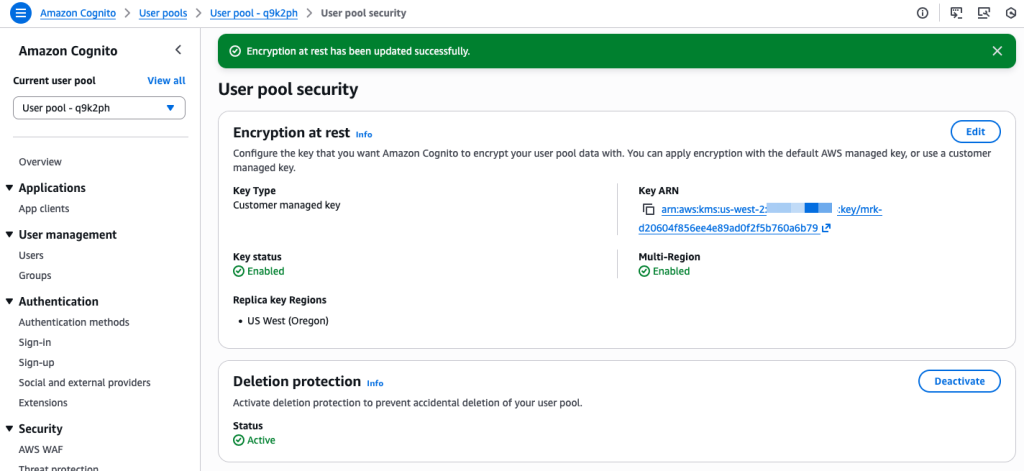
Custom Key Setup for Encryption: The initial step involves associating a custom AWS KMS key with the Cognito user pool. The console provides clear instructions and the necessary IAM policy statements to grant Amazon Cognito appropriate access to use the key for data encryption at rest. This ensures that all user data, both in the primary and replicated regions, is encrypted using the customer’s chosen key.
-
Multi-Region OIDC Endpoints Configuration: A crucial step involves configuring multi-region OIDC issuer endpoints. This requires an update to client applications to point to these new, globally consistent endpoints. This change is mandatory and necessitates a redeployment for server-side applications and an update submission for mobile applications on app stores. Failure to update these endpoints would lead to service disruptions as requests to old endpoints would no longer be routed correctly during a failover. The console confirms the updated URLs and facilitates the change of issuer type.
-
Replication Configuration: The final step involves selecting the target secondary Region for replication. The console intelligently displays only those regions where the custom encryption key has been successfully replicated, ensuring cryptographic consistency. Once the target Region is selected, the replication process is initiated. The time required for initial replication depends on the volume of data within the user pool. Upon completion of the replication preparation, the user must manually activate the replicated user pool, transitioning its status to "Active" and making it ready to receive traffic.
Beyond the core replication setup, developers must account for additional configurations. Any AWS Lambda functions used for custom authentication flows, SMS, or email notifications, as well as logging streams or AWS WAF configurations, must be manually deployed and configured in the secondary Region to ensure full functional parity during a failover. This comprehensive approach guarantees that all aspects of the identity and access management infrastructure are resilient.
Strategies for Seamless Failover and Business Continuity
While multi-Region replication provides the underlying data consistency, designing a robust failover strategy is crucial for truly uninterrupted operations. Both the primary and secondary regional endpoints remain active and ready to serve traffic. Organizations must implement sophisticated health checks to monitor the real-time status of authentication services in their primary Region. These checks can analyze error rates, latency patterns, or specific service alerts to define precise criteria for initiating a failover.
Upon detection of issues that meet the predefined failover criteria, traffic can be seamlessly redirected to the secondary Region through DNS updates. This approach grants organizations granular control over the failover process, allowing them to manage transitions securely and according to their specific operational policies. Regular testing of the failover strategy, particularly during off-peak hours, is highly recommended. This involves redirecting a small percentage of traffic to the secondary Region to verify that authentication continues without issues, thereby validating the disaster recovery plan. For applications utilizing managed login and federation with custom domains, Amazon Cognito integrates with Amazon Route 53 health checks, offering a built-in traffic routing feature to automate aspects of failover management.
Market Impact and Industry Implications
These Amazon Cognito updates are set to significantly impact the cloud identity landscape. For enterprises striving to meet stringent uptime SLAs and disaster recovery objectives, multi-Region replication dramatically simplifies the architecture required to achieve identity resilience. It abstracts away the complexities of data synchronization, allowing engineering teams to focus on core application development rather than custom replication logic. This reduction in operational overhead translates to cost savings and faster time-to-market for highly available applications.
The introduction of CMK support further solidifies Amazon Cognito’s position as a robust identity solution for regulated industries. Organizations handling sensitive personal identifiable information (PII) or financial data can now meet compliance mandates with greater ease and confidence, leveraging their own cryptographic keys to secure user data. This level of control is increasingly demanded by auditors and regulatory bodies worldwide.

From a broader perspective, these features align with the industry trend towards "zero-trust" security models, where continuous verification and robust authentication mechanisms are paramount regardless of network location. By providing highly available and securely encrypted identity services, AWS empowers developers to build applications that inherently incorporate these principles, contributing to a more secure and resilient digital infrastructure globally.
Pricing and Global Availability
Multi-Region replication is available as an add-on feature for Amazon Cognito customers utilizing the Essentials and Plus tiers. Pricing for user authentication is structured per monthly active user (MAU) per replica Region, with a charge of $0.0045 for Essentials tier customers and $0.006 for Plus tier customers. For machine-to-machine (M2M) authentication, the add-on incurs a 30% charge on top of the standard volume-based pricing for successfully issued tokens. Detailed pricing information is available on the Amazon Cognito pricing page.
The multi-Region replication feature is currently available in a wide array of AWS Regions, including US East (Ohio, N. Virginia), US West (N. California, Oregon), Asia Pacific (Mumbai, Seoul, Singapore, Sydney, Tokyo), Canada (Central), Europe (Frankfurt, Ireland, London, Paris, Stockholm), and South America (São Paulo). Any of these listed Regions can serve as either the source or destination for replication, offering extensive flexibility for global deployments.

Support for customer managed keys is also available for Essentials and Plus tiers across an even broader set of Regions, including US East (Ohio, N. Virginia), US West (N. California, Oregon), Africa (Cape Town), Asia Pacific (Hong Kong, Hyderabad, Jakarta, Malaysia, Melbourne, Mumbai, New Zealand, Osaka, Seoul, Singapore, Sydney, Thailand, Tokyo), Canada (Central), Canada West (Calgary), Europe (Frankfurt, Ireland, London, Milan, Paris, Spain, Stockholm, Zurich), Israel (Tel Aviv), Mexico (Central), South America (São Paulo), and AWS GovCloud (US-East, US-West).
These new capabilities represent a significant step forward for Amazon Cognito, addressing critical needs for resilience, security, and operational efficiency in modern application development. By simplifying the creation of highly available and compliant authentication systems, AWS continues to empower developers to build the next generation of robust and secure cloud-native applications. Developers and enterprises are encouraged to explore these features via the Amazon Cognito console or detailed documentation to strengthen their application architectures.
