

Amazon Web Services (AWS) has announced the immediate general availability of the next generation of Amazon OpenSearch Serverless, a significant advancement designed to revolutionize how developers build and deploy AI agents. This enhanced offering delivers a fully managed search and vector engine characterized by unparalleled scalability, efficiency, and deep integration into modern AI development workflows, positioning it as a pivotal tool in the rapidly evolving landscape of artificial intelligence.
At its core, the next generation of OpenSearch Serverless addresses the critical demands of AI-driven applications, which often experience highly fluctuating workloads. The service boasts the ability to scale seamlessly from zero to thousands of requests per second and, crucially, back to zero when idle. This elastic capacity management translates into substantial economic benefits, with AWS projecting up to 60% cost savings compared to the traditional model of provisioning OpenSearch Service clusters for peak capacity. Beyond cost, the new iteration dramatically improves performance, creating resources in mere seconds and scaling capacity up to 20 times faster than its predecessor. This combination of instant resource provisioning and rapid scaling is a game-changer for developers seeking to deploy production-ready search and vector backends for their AI agents in minutes, all without the complexities of managing underlying infrastructure.
The Genesis of OpenSearch and the Serverless Paradigm
To fully appreciate the significance of this announcement, it’s essential to understand the journey of OpenSearch and the broader trend towards serverless architectures. Amazon OpenSearch Service emerged from a fork of Elasticsearch and Kibana, following a licensing change by Elastic. AWS, along with a community of developers, created OpenSearch as a truly open-source, community-driven search and analytics suite. This move ensured continued innovation and accessibility for users who relied on the open-source model.
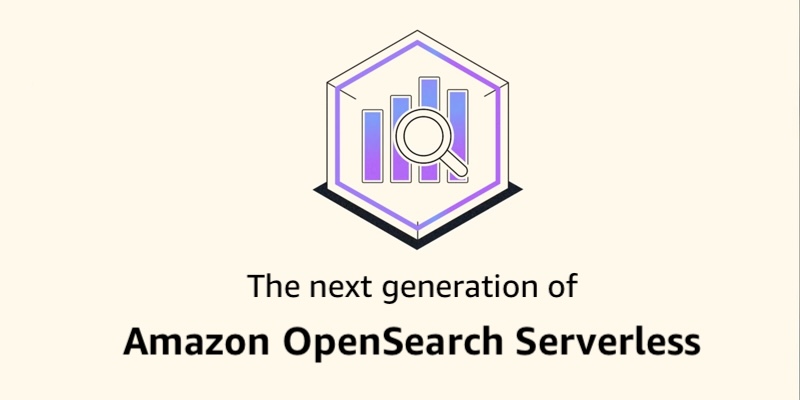
The introduction of OpenSearch Serverless represented a natural evolution, bringing the power of OpenSearch to a managed, serverless paradigm. The initial OpenSearch Serverless aimed to simplify operations by abstracting away server management, allowing users to focus purely on data and applications. However, as AI applications, particularly generative AI, began to proliferate, the need for even greater agility, more granular scaling, and optimized vector search capabilities became apparent. AI agents, which require swift, context-aware information retrieval to function effectively, demand infrastructure that can respond instantaneously to fluctuating query loads and complex semantic searches. This new generation of OpenSearch Serverless is AWS’s direct response to these burgeoning requirements.
Fueling the AI Agent Revolution with Advanced Vector Search
The burgeoning field of AI agents is fundamentally reshaping how businesses and individuals interact with technology. These agents, whether performing complex data analysis, powering sophisticated chatbots, or automating intricate workflows, rely heavily on their ability to quickly and accurately retrieve relevant information from vast datasets. This is where vector search, a core capability of the next-generation OpenSearch Serverless, becomes indispensable.
Traditional keyword search often falls short when dealing with the nuanced, contextual understanding required by AI. Vector search, by contrast, converts data (text, images, audio) into high-dimensional numerical representations called vectors. These vectors capture the semantic meaning of the data, allowing for similarity searches based on conceptual closeness rather than exact keyword matches. When an AI agent needs to retrieve information—for example, to answer a complex query using a Retrieval Augmented Generation (RAG) architecture—it can query a vector database, and OpenSearch Serverless can swiftly identify and return semantically similar data points, providing the agent with the precise context it needs to generate accurate and relevant responses.
The enhanced speed and efficiency of the new OpenSearch Serverless are particularly beneficial for RAG pipelines. In such systems, the agent first retrieves relevant documents or data snippets from a knowledge base (often a vector database) and then uses a large language model (LLM) to synthesize a response based on this retrieved context. Faster retrieval directly translates to lower latency in agent responses and more efficient utilization of LLMs, which are often costly to run. This service is poised to become a foundational component for developers building advanced AI agents that demand both speed and semantic accuracy.

Seamless Integration: Accelerating Development Workflows
Recognizing that modern AI development occurs within integrated ecosystems, AWS has ensured that the next generation of OpenSearch Serverless offers native integrations with popular AI development platforms. Two prominent examples highlighted are Vercel and Kiro, underscoring AWS’s commitment to developer experience and streamlined workflows.
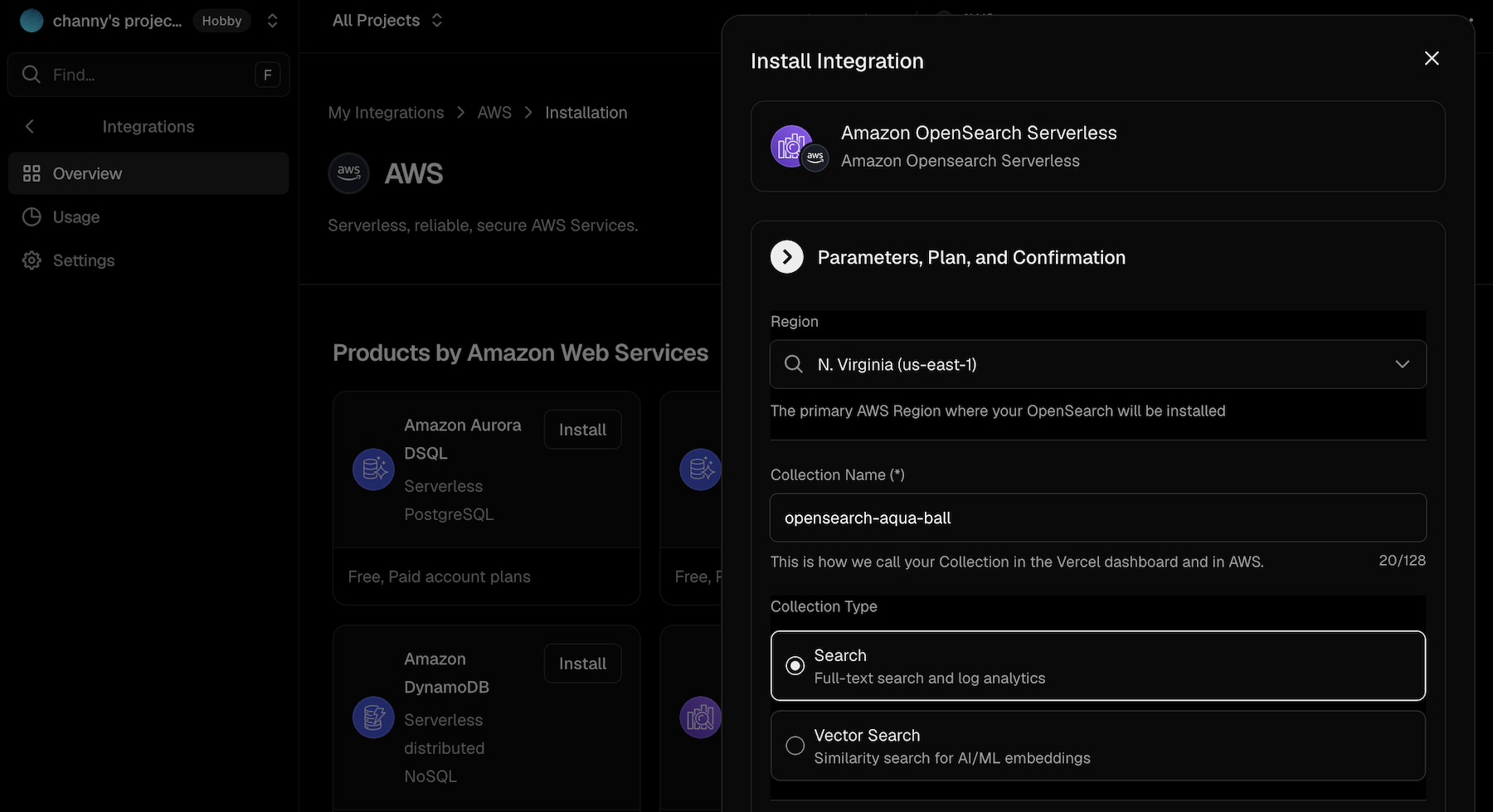
For developers utilizing Vercel, the platform known for its focus on front-end frameworks and serverless functions, the integration means they can now create a new OpenSearch collection or connect an existing OpenSearch Serverless collection directly within the Vercel console. This capability allows for the rapid deployment of search backends, enabling developers to incorporate powerful search and vector capabilities into their Vercel-hosted applications with unprecedented ease. This synergy empowers Vercel users to build and scale sophisticated AI applications without leaving their familiar development environment, drastically reducing time-to-market for new features and products. An AWS spokesperson, commenting on the collaboration, stated, "Our goal is to meet developers where they are, and by deeply integrating with platforms like Vercel, we’re making it simpler than ever to harness the power of OpenSearch Serverless for AI-driven experiences."
Similarly, the integration with Kiro (an AI development platform) further solidifies OpenSearch Serverless’s role in the AI ecosystem. Kiro, particularly through its "Kiro Powers" and the "OpenSearch Launchpad," offers guided, end-to-end architecture planning for accelerating search applications. The collaboration with Kiro extends to the OpenSearch Agent Skills repository, a collection of pre-built skills that embed OpenSearch intelligence directly into AI agents. These skills encapsulate domain knowledge, best practices, and multi-step execution logic, enabling agents not just to retrieve results but to understand how those results were achieved. This contextual understanding is vital for creating truly intelligent and reliable AI agents. A representative from Kiro emphasized, "Our partnership with AWS and the new OpenSearch Serverless empowers developers to move from concept to working prototype in minutes, leveraging tools like Claude Code and Cursor to build highly capable AI agents that truly understand and act upon information."
Operationalizing the Next Generation: Getting Started
AWS has made the process of adopting the next generation of OpenSearch Serverless straightforward, catering to both console-driven and programmatic approaches.
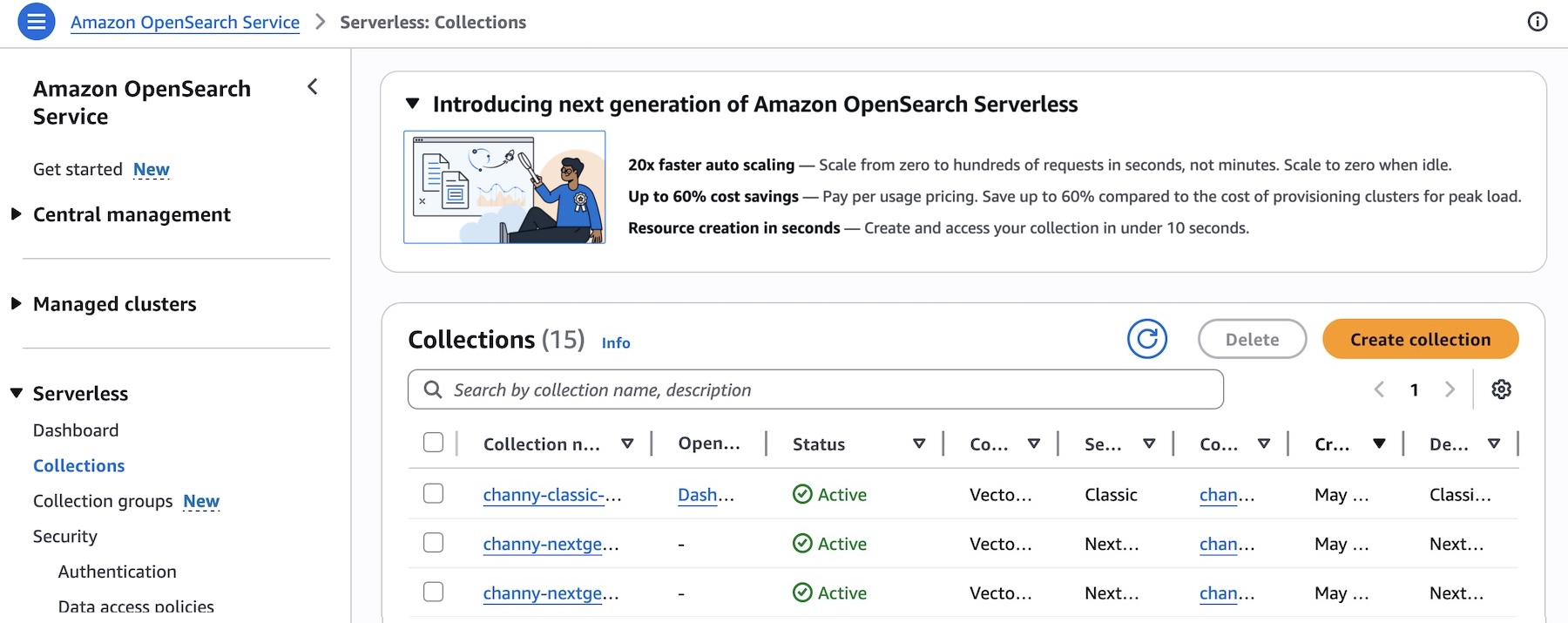
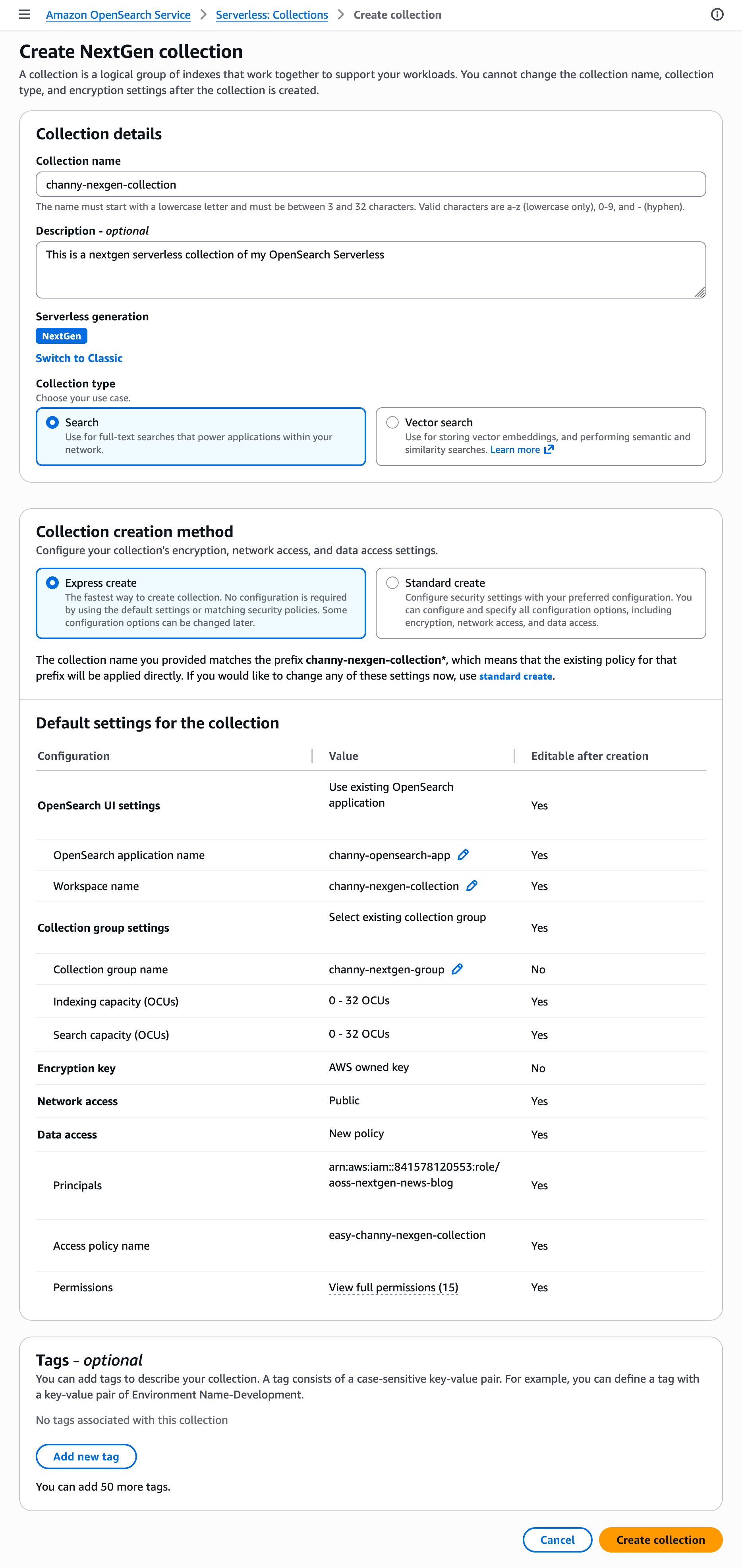
For users preferring the AWS Management Console, the journey begins by navigating to the Amazon OpenSearch Service console. Within the "Serverless" menu, selecting "Create collection" initiates the process. Users are presented with the option to create a "NextGen collection," which inherently includes instant auto-scaling and scale-to-zero capabilities for optimal cost efficiency. At launch, the NextGen collection supports full-text search and vector search types. For those who wish to continue using the previous infrastructure, a "Switch to Classic" option remains available. The "Express create" option further simplifies the setup, applying default settings and matching security policies automatically, requiring no immediate configuration from the user and allowing for later adjustments. Upon choosing "Create collection," OpenSearch Serverless provisions the necessary resources within seconds, a testament to its enhanced performance.
For developers who favor programmatic control, the next generation of OpenSearch Serverless is fully accessible via the AWS Command Line Interface (AWS CLI) and AWS SDKs. A sample CLI command for creating a collection group demonstrates the flexibility:
aws opensearchserverless create-collection-group
    --name channy-nextgen-group
    --standby-replicas ENABLED
    --generation NEXTGEN
    --description "My NextGen collection group"
    --capacity-limits '
        "maxIndexingCapacityInOCU": 96,
        "maxSearchCapacityInOCU": 96,
        "minIndexCapacityInOCU": 0,
        "minSearchCapacityInOCU": 0
    '
    --region "us-east-1"
Once a collection group is established, individual collections can be created within it, inheriting the specified generation. The CLI command for creating a collection illustrates this:
aws opensearchserverless create-collection
    --name channy-nextgen-collection
    --type SEARCH
    --collection-group-name channy-nextgen-group
    --standby-replicas ENABLED
    --description "My collection in NextGen group"
    --region "us-east-1"
These commands highlight the emphasis on declarative infrastructure, allowing developers to define their search and vector backends as code, which is crucial for modern DevOps practices and continuous integration/continuous delivery (CI/CD) pipelines. Comprehensive documentation for managing the next generation of OpenSearch Serverless is available in the Amazon OpenSearch Serverless developer guide.
Pricing Structure and Widespread Availability
The next generation of Amazon OpenSearch Serverless adopts a consumption-based pricing model, aligning with the serverless philosophy of paying only for what you use. Charges are primarily based on the compute consumed, measured in OpenSearch Compute Units (OCUs) for indexing, search, and GPU acceleration. GPU acceleration is a notable feature, indicating support for computationally intensive vector operations, which are increasingly critical for high-performance AI applications. Storage is billed separately on a GB-month basis. This transparent pricing model, where costs directly correlate with actual usage, reinforces the projected cost savings, particularly for workloads with variable demand. Detailed pricing information is available on the Amazon OpenSearch Service pricing page.
AWS has ensured broad accessibility for this new service. The next generation of Amazon OpenSearch Serverless is generally available today across all AWS commercial Regions where the existing Amazon OpenSearch Serverless is currently offered. This widespread availability means that developers and enterprises globally can immediately leverage these advanced capabilities to power their AI agents and intelligent applications, ensuring low latency and data residency compliance for diverse operational requirements.
Broader Implications and Future Outlook
The launch of the next generation of Amazon OpenSearch Serverless is more than just a product update; it represents a strategic move by AWS to solidify its position as a leading provider of infrastructure for the AI era. By offering a fully managed, highly scalable, and cost-effective solution for vector search and full-text search, AWS is directly enabling the next wave of AI innovation.
For startups and small to medium-sized businesses, the "scale-to-zero" capability significantly lowers the barrier to entry for building sophisticated AI agents. They can experiment and launch without the upfront investment and ongoing operational burden of managing complex search clusters. For large enterprises, the rapid scaling and performance enhancements mean they can confidently deploy mission-critical AI applications that can handle unpredictable traffic spikes and vast data volumes without performance degradation.
Industry analysts suggest that this release will intensify competition in the vector database market, where specialized solutions have seen significant growth. AWS’s integrated approach, combining search, vector capabilities, and deep ties to its broader cloud ecosystem, presents a compelling alternative for customers looking for a unified platform. The emphasis on developer experience through integrations with Vercel and Kiro also highlights a growing trend in cloud services: moving beyond raw infrastructure to provide complete, opinionated developer workflows.
Looking ahead, the evolution of OpenSearch Serverless will likely continue to track the advancements in AI. Future enhancements could include deeper integrations with other AWS AI/ML services, more specialized vector indexing algorithms, and further optimizations for real-time inference. As AI agents become more sophisticated and ubiquitous, the underlying search and retrieval infrastructure will remain a critical differentiator, and AWS appears well-positioned to lead in this space.
Developers are encouraged to explore the new capabilities and provide feedback via the AWS re:Post for Amazon OpenSearch Service or through their standard AWS Support channels, ensuring continuous improvement and adaptation to real-world use cases.
Update on May 29, 2026: The default value (96) of maximum indexing/search capacity in the provided CLI command has been fixed. Users should ensure they use the appropriate binary sequence number when setting these values for optimal configuration.
