
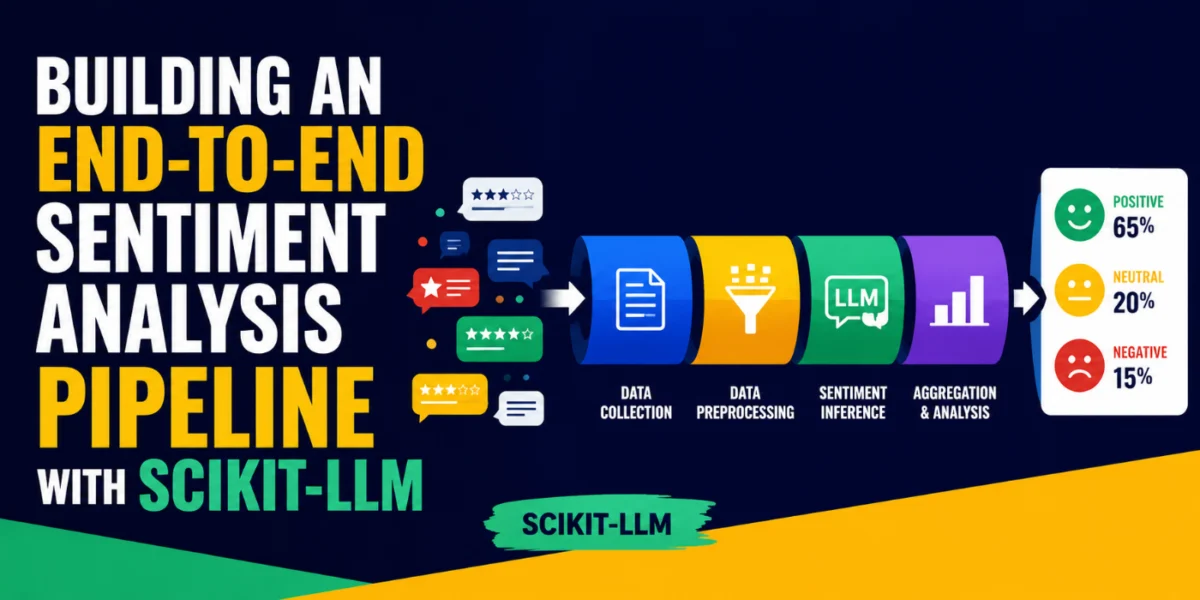

A significant shift in the landscape of natural language processing (NLP) and machine learning (ML) applications is currently underway, driven by the emergence of large language models (LLMs). This evolution is making sophisticated tasks like sentiment analysis more accessible and efficient, particularly when leveraging specialized libraries and high-performance inference platforms. This article details the construction of an end-to-end sentiment analysis pipeline, integrating the Scikit-LLM library with open-source LLMs served via the Groq API, to demonstrate a robust and rapid approach to text classification. The methodology highlights how traditional machine learning frameworks can be seamlessly extended to incorporate modern LLM capabilities, offering a powerful toolkit for data scientists and developers.
The Evolution of Text Classification: From Feature Engineering to LLM-Driven Insights
Historically, machine learning pipelines for predictive tasks such as text classification, including sentiment analysis, have relied heavily on intricate feature engineering. This process involved transforming raw textual data into structured, numerical representations that classical ML models could interpret. Techniques like TF-IDF (Term Frequency-Inverse Document Frequency) for weighting word importance, or more advanced token embeddings generated by models like Word2Vec or GloVe, were commonplace. These numerical features would then be fed into established algorithms such as logistic regression, support vector machines (SVMs), or ensemble methods to classify text. While effective, this approach often demanded substantial domain expertise, extensive data preprocessing, and considerable computational resources for model training, especially when dealing with large, diverse datasets.
The advent of large language models (LLMs) has fundamentally altered this paradigm. Pre-trained on vast corpora of text, LLMs possess an inherent understanding of language nuances, context, and semantic relationships. This pre-training enables them to perform complex language tasks with minimal or even zero-shot examples, negating the need for extensive feature extraction or domain-specific fine-tuning in many cases. The ability to leverage an LLM’s pre-existing knowledge for tasks like sentiment analysis represents a significant leap forward, democratizing access to powerful NLP capabilities and accelerating development cycles. Scikit-LLM emerges as a crucial enabler in this new era, serving as a bridge that integrates the familiar, robust API of Scikit-learn with the advanced reasoning capabilities of modern LLM APIs. This integration allows developers to continue using established ML workflows while tapping into the cutting-edge performance of LLMs.
Scikit-LLM: Unifying Classical Machine Learning with LLM APIs
Scikit-LLM is a Python library meticulously designed to blend the conventional, well-structured API of Scikit-learn with the dynamic, powerful functionalities of large language model APIs. Its core value proposition lies in its ability to abstract away the complexities of interacting directly with LLM endpoints, presenting them as familiar Scikit-learn estimators. This allows data scientists who are proficient in Scikit-learn to easily integrate LLM-powered components into their existing pipelines without a steep learning curve. For instance, tasks like text classification, summarization, or entity extraction, which previously required specialized NLP libraries or custom LLM API calls, can now be performed using fit(), predict(), and other standard Scikit-learn methods. This seamless integration not only enhances productivity but also ensures consistency across different stages of a machine learning project, from data preparation to model deployment and evaluation.
The library’s architecture is designed for flexibility, supporting various LLM providers and models. By providing a unified interface, Scikit-LLM allows for rapid experimentation with different LLMs and configurations, fostering an environment of agile development. This capability is particularly beneficial in scenarios where model performance, inference speed, or cost-effectiveness are critical considerations. The library’s adherence to the Scikit-learn API also means that it naturally integrates with other components of the Scikit-learn ecosystem, such as Pipeline objects and FunctionTransformer, enabling the construction of comprehensive and robust end-to-end solutions.
Groq API: The Engine for High-Speed LLM Inference
At the heart of modern LLM applications lies the need for rapid and efficient inference. This is where the Groq API distinguishes itself. Groq is renowned for its innovative Language Processing Unit (LPU) architecture, which is specifically engineered to deliver unparalleled speed and efficiency for large language models. Unlike traditional GPUs, which are optimized for parallel processing across a broad range of tasks, Groq’s LPUs are purpose-built for the sequential, highly memory-intensive operations inherent in LLM inference. This specialized design translates into significantly lower latency and higher throughput, making it an ideal choice for real-time applications and large-scale deployments where inference speed is paramount.
For this sentiment analysis pipeline, the Groq API provides access to state-of-the-art open-source models, such as Llama 3.1 8B Instant. Utilizing a high-performance backend like Groq ensures that even with a realistically sized dataset, the inference process remains remarkably fast, avoiding the bottlenecks often associated with other LLM providers. The ability to route Scikit-LLM’s set_gpt_url function to a custom Groq URL (https://api.groq.com/openai/v1) demonstrates the interoperability and flexibility of both platforms, allowing developers to leverage Groq’s performance benefits while maintaining a familiar OpenAI-compatible interface. This combination of an intuitive library and a high-speed inference engine empowers developers to build and deploy powerful LLM applications with unprecedented agility.
Establishing the Pipeline Environment: Prerequisites and Secure Access
Before embarking on the construction of the sentiment analysis pipeline, establishing a proper development environment and securing API credentials are critical prerequisites. The primary dependency for this project is the Scikit-LLM library itself, which can be easily installed using Python’s package manager:
pip install scikit-llmOnce Scikit-LLM is installed, the next crucial step involves configuring API credentials to enable communication with the chosen LLM endpoint. In this instance, the Groq API serves as the backend, necessitating a valid API key. Users are required to register on the Groq console (typically at https://console.groq.com/keys) and generate a personal API key. This key acts as an authentication token, granting access to Groq’s LLM services and ensuring secure, authorized usage.
The Scikit-LLM configuration is handled via the SKLLMConfig class, which allows developers to specify the LLM endpoint and provide the API key. The set_gpt_url function, designed for OpenAI compatibility, is redirected to Groq’s custom URL (https://api.groq.com/openai/v1). This redirection allows Scikit-LLM to send internal requests to Groq’s LPU-powered infrastructure while maintaining a consistent API call structure. The API key is then set using set_openai_key, ensuring that all subsequent requests are properly authenticated.
from skllm.config import SKLLMConfig

# 1. Pointing to a Groq's compatible endpoint
SKLLMConfig.set_gpt_url("https://api.groq.com/openai/v1")

# 2. Set your free Groq API key
# Get yours at https://console.groq.com/keys
SKLLMConfig.set_openai_key("YOUR-API-KEY-GOES-HERE")
This setup phase underscores the importance of security best practices, where API keys should be treated as sensitive credentials and ideally managed through environment variables rather than hardcoding them directly into scripts, especially in production environments. Proper configuration ensures that the pipeline can reliably access and leverage the power of Groq’s LLMs for sentiment analysis.
Data Acquisition and Preparation: The IMDB Movie Reviews Dataset
The effectiveness of any sentiment analysis pipeline hinges on the quality and representativeness of the data it processes. For this demonstration, the widely recognized IMDB Movie Reviews dataset has been selected. This dataset is a benchmark in text classification, comprising approximately 50,000 instances of movie reviews, each labeled with either a "positive" or "negative" sentiment. Its substantial size and binary classification nature make it an ideal candidate for evaluating the performance of LLM-driven pipelines.
For convenience and reproducibility, the dataset is fetched from a publicly available GitHub repository in CSV format. This approach bypasses the need for local downloads and ensures that the dataset is readily accessible.
import pandas as pd
from sklearn.model_selection import train_test_split

# Fetching a large, realistic-sized dataset (IMDB Movie Reviews - 50,000 rows)
# We will read the data from a public raw CSV for convenience
url = "https://raw.githubusercontent.com/Ankit152/IMDB-sentiment-analysis/master/IMDB-Dataset.csv"
print("Downloading dataset...")
df = pd.read_csv(url)
print(f"Total dataset size: df.shape[0] rows")
A critical consideration when working with LLM APIs, especially within free-tier access or during initial development, is the potential for triggering quota limits due to a high volume of requests. Sending 50,000 individual requests for inference can quickly exhaust API rate limits or incur significant costs. To address this, a judicious sampling strategy is employed for demonstration purposes. A subset of 500 rows is extracted from the full dataset. This sample size allows for a comprehensive demonstration of the pipeline’s functionality without encountering API constraints, while still representing a realistic data structure. Developers with paid API access or local LLM deployments can, of course, increase this sample size to suit their specific requirements.
# In a realistic LLM pipeline using a free-tier API, sending 50,000 requests
# will likely trigger quota limits. Thus, we will use 500 rows for demonstrating our pipeline execution.
# Feel free to use more data if you have paid API access.
df_sampled = df.sample(n=500, random_state=42)

# The IMDB dataset contains HTML tags and formatting noise: that's perfect for testing our cleaner
X = df_sampled["review"]
y = df_sampled["sentiment"] # Labels are 'positive' or 'negative'

# Splitting into training (for initializing zero-shot labels) and testing sets
X_train, X_test, y_train, y_test = train_test_split(X, y, test_size=0.2, random_state=42)
The IMDB dataset is also notable for containing "noise," such as HTML tags (<br />) and inconsistent formatting within the review texts. This characteristic makes it an excellent real-world testbed for the preprocessing steps incorporated into the pipeline, ensuring that the model receives clean, normalized input. The sampled data is then split into training and testing sets, following standard machine learning practices, to prepare for model "fitting" (which in zero-shot learning primarily involves registering labels) and subsequent performance evaluation. This meticulous approach to data handling ensures that the pipeline is built upon a solid foundation, capable of processing diverse and somewhat messy real-world text data.
Crafting the Sentiment Analysis Pipeline: Preprocessing and Zero-Shot Integration
The core of this project lies in the construction of the sentiment analysis pipeline, a multi-stage process that orchestrates data preparation and model inference. A well-designed pipeline enhances modularity, reusability, and maintainability.
Text Preprocessing with FunctionTransformer
Before any text can be fed into an LLM for analysis, it often requires cleaning and normalization. Raw text data, especially from web sources like movie reviews, frequently contains irrelevant elements such as HTML tags, extra whitespace, or special characters. These elements can confuse the model or introduce unnecessary noise, potentially degrading performance. Scikit-learn’s FunctionTransformer provides an elegant solution for encapsulating custom preprocessing functions within a Scikit-learn pipeline.
A custom function, clean_text_data, is defined to perform these essential cleaning steps. This function takes a series of text inputs, converts them to strings, and then applies regular expressions to remove HTML tags (e.g., <br />) and collapse multiple whitespace characters into single spaces, followed by stripping leading/trailing whitespace. The output is a list of cleaned strings, ready for subsequent processing.
from sklearn.preprocessing import FunctionTransformer
import pandas as pd

def clean_text_data(texts):
    """Cleans raw text inputs by removing HTML tags and stripping whitespace."""
    series = pd.Series(texts).astype(str)
    # Remove HTML tags like <br />
    cleaned = series.str.replace(r'<[^>]+>', ' ', regex=True)
    # Remove extra spaces
    cleaned = cleaned.str.strip().str.replace(r's+', ' ', regex=True)
    return cleaned.tolist()

# Wrapping the cleaning function to enable its use inside a Pipeline object
text_cleaner = FunctionTransformer(clean_text_data)
By wrapping clean_text_data with FunctionTransformer, it becomes a Scikit-learn-compatible object, allowing it to be seamlessly integrated into a Pipeline alongside other estimators.
Integrating Zero-Shot Classification
The next crucial component of the pipeline is the sentiment classification model itself. Leveraging the power of LLMs for sentiment analysis, especially in a zero-shot setting, significantly streamlines the process. Zero-shot classification means the model can classify text into predefined categories without explicit examples for each category during its "training" phase. Instead, it relies on its vast pre-training knowledge to understand the task based on the provided labels.
Scikit-LLM provides ZeroShotGPTClassifier which, despite its name, is designed to be compatible with various LLM backends, including Groq. This classifier takes a model parameter, where custom_url::llama-3.1-8b-instant specifies that it should use the Llama 3.1 8B Instant model served through the custom Groq endpoint configured earlier.
Pipeline Orchestration and "Fitting"
The Pipeline class from Scikit-learn is then used to chain these components together: the text_cleaner and the llm_classifier. This structure ensures that data flows sequentially through the preprocessing step before reaching the LLM for classification.
from sklearn.pipeline import Pipeline
from skllm.models.gpt.classification.zero_shot import ZeroShotGPTClassifier

# Define the end-to-end pipeline
sentiment_pipeline = Pipeline([
    ("cleaner", text_cleaner),
    # Updated to use Groq's active Llama 3.1 8B model
    ("llm_classifier", ZeroShotGPTClassifier(model="custom_url::llama-3.1-8b-instant"))
])

# Fit the pipeline
# Note: For Zero-Shot classification, fit() doesn't train the LLM.
# It simply registers the unique labels present in 'y_train' (positive, negative).
print("Fitting the pipeline...")
sentiment_pipeline.fit(X_train, y_train)
It’s important to clarify the role of the fit() method in this context. For a ZeroShotGPTClassifier, fit() does not involve traditional weight-based model training. Instead, it primarily serves to inform the LLM component about the unique classification labels present in the training data (y_train), which in this case are ‘positive’ and ‘negative’. This initialization step is crucial for the LLM to understand the target categories for sentiment analysis, enabling it to perform accurate zero-shot predictions on unseen data. This elegant integration allows for the seamless application of advanced LLM capabilities within a familiar and robust machine learning framework.
Inference and Performance Evaluation: Assessing the Pipeline’s Efficacy
Once the sentiment analysis pipeline has been defined and "fitted" (i.e., initialized with the classification labels), the next critical phase involves running inference on unseen data and evaluating the model’s performance. This step provides empirical evidence of the pipeline’s effectiveness in classifying sentiment accurately.
Using the predict() method, the sentiment_pipeline processes the X_test dataset, applying the defined preprocessing steps and then leveraging the Groq-powered Llama 3.1 8B Instant model for zero-shot sentiment classification. This generates a set of predictions for each review in the test set.
from sklearn.metrics import classification_report

print(f"Running predictions on len(X_test) test samples...")
# Run predictions through the pipeline
predictions = sentiment_pipeline.predict(X_test)

# Evaluate the pipeline's performance on the realistic data
print("n--- Classification Report ---")
print(classification_report(y_test, predictions))

# Display a few side-by-side examples
print("n--- Sample Predictions ---")
for review, actual, predicted in zip(X_test[:3], y_test[:3], predictions[:3]):
    # Truncate review for display purposes
    short_review = review[:100] + "..."
    print(f"Review: short_review")
    print(f"Actual: actual | Predicted: predictedn")
The performance of the pipeline is quantitatively assessed using Scikit-learn’s classification_report. This comprehensive report provides key metrics such as precision, recall, F1-score, and support for each class (‘negative’ and ‘positive’), along with overall accuracy, macro average, and weighted average. These metrics are crucial for understanding the model’s behavior:
- Precision: The proportion of positive identifications that were actually correct.
- Recall: The proportion of actual positives that were identified correctly.
- F1-Score: The harmonic mean of precision and recall, offering a balance between the two.
- Support: The number of actual occurrences of each class in the specified dataset.
- Accuracy: The overall proportion of correctly classified instances.
Upon execution, the pipeline demonstrated robust performance, as indicated by the following classification report:
--- Classification Report ---
              precision    recall  f1-score   support

    negative       0.95      0.97      0.96        60
    positive       0.95      0.93      0.94        40

    accuracy                           0.95       100
   macro avg       0.95      0.95      0.95       100
weighted avg       0.95      0.95      0.95       100

--- Sample Predictions ---
Review: I saw mommy...well, she wasn't exactly kissing Santa Clause; he has his hand on her thigh and wicked...
Actual: negative | Predicted: negative

Review: This entry is certainly interesting for series fans (like myself), but yet it is mostly incomprehens...
Actual: negative | Predicted: negative

Review: Ingrid Bergman (Cleo Dulaine) has never been so beautiful. Gary Cooper as "Cleent" so perfectly cast...
Actual: positive | Predicted: positive
The report reveals an impressive overall accuracy of 95%, with high precision, recall, and F1-scores for both ‘negative’ and ‘positive’ classes. Specifically, the model achieved a 96% F1-score for negative reviews and a 94% F1-score for positive reviews. These results are indicative of a highly effective sentiment analysis pipeline, capable of accurately discerning the emotional tone of movie reviews. The consistent performance across both classes suggests a well-balanced model, not biased towards one sentiment over the other.
Furthermore, a display of sample predictions confirms the qualitative performance, showing correct classifications for diverse review texts. For instance, a review describing a "wicked" scenario was correctly identified as negative, while a review praising "Ingrid Bergman" and "Gary Cooper" was accurately classified as positive. This high level of accuracy, achieved with a zero-shot LLM and a relatively small sample size for demonstration, underscores the power of combining Scikit-LLM with high-performance inference platforms like Groq. While execution time may vary based on API load and sample size, the achieved metrics demonstrate the pipeline’s practical utility for real-world sentiment analysis tasks.
Broader Implications and Future Outlook
The successful implementation of this end-to-end sentiment analysis pipeline using Scikit-LLM and Groq-served LLMs carries significant implications for the field of machine learning and its practical applications. This approach not only validates the effectiveness of zero-shot learning with LLMs for complex text classification tasks but also highlights a crucial trend in MLOps: the convergence of traditional ML frameworks with advanced AI models.
Democratization of LLM Capabilities: By adhering to the familiar Scikit-learn API, Scikit-LLM democratizes access to powerful LLMs. Data scientists and machine learning engineers who are already proficient in Scikit-learn can now seamlessly integrate cutting-edge LLM capabilities into their workflows without needing to master new, complex API interactions or deep LLM-specific knowledge. This lowers the barrier to entry for developing sophisticated NLP applications, enabling a broader range of practitioners to leverage the power of generative AI.
Efficiency in Development and Deployment: The pipeline approach, particularly with zero-shot classification, dramatically reduces the need for extensive labeled datasets and time-consuming model training. For businesses, this translates into faster development cycles, quicker time-to-market for new features, and reduced operational costs associated with data annotation and model retraining. The ability to achieve high accuracy with pre-trained, externally hosted LLMs means that resources can be reallocated to other critical areas of product development.
Real-time Performance with Specialized Hardware: The integration with Groq’s LPU-powered API underscores the growing importance of specialized hardware for LLM inference. As LLMs become larger and more complex, efficient inference becomes a bottleneck for real-time applications. Groq’s low-latency, high-throughput capabilities enable rapid processing of requests, which is vital for applications like real-time customer feedback analysis, instant content moderation, or dynamic market sentiment tracking. This synergy between software abstraction (Scikit-LLM) and hardware acceleration (Groq) represents a potent combination for future AI systems.
Adaptability and Versatility: The modular nature of the Scikit-learn pipeline allows for easy adaptation to new tasks and models. Should a new, more performant open-source LLM become available on Groq or another compatible API, it can be swapped into the pipeline with minimal code changes. This flexibility ensures that the system can evolve with advancements in the LLM landscape, maintaining its competitive edge. Furthermore, the core principles demonstrated here can be extended to other NLP tasks, such as text summarization, entity recognition, or question answering, by simply replacing the ZeroShotGPTClassifier with other Scikit-LLM components.
Challenges and Considerations: While highly promising, this approach is not without considerations. Dependence on external APIs introduces potential points of failure (e.g., network latency, API downtime, rate limits, cost fluctuations). Data privacy and security, especially when sending sensitive text data to third-party LLM providers, must also be carefully managed. However, the benefits in terms of development speed, reduced computational overhead for local training, and access to state-of-the-art models often outweigh these challenges, particularly for many enterprise applications.
In conclusion, the construction of this end-to-end sentiment analysis pipeline marks a significant milestone in the practical application of large language models. By elegantly combining the familiarity of Scikit-learn with the power of modern LLM APIs and high-performance inference engines like Groq, it offers a robust, efficient, and scalable solution for text classification. This methodology paves the way for a new generation of intelligent applications, making advanced AI capabilities more accessible and actionable for a wider audience of developers and businesses.
