
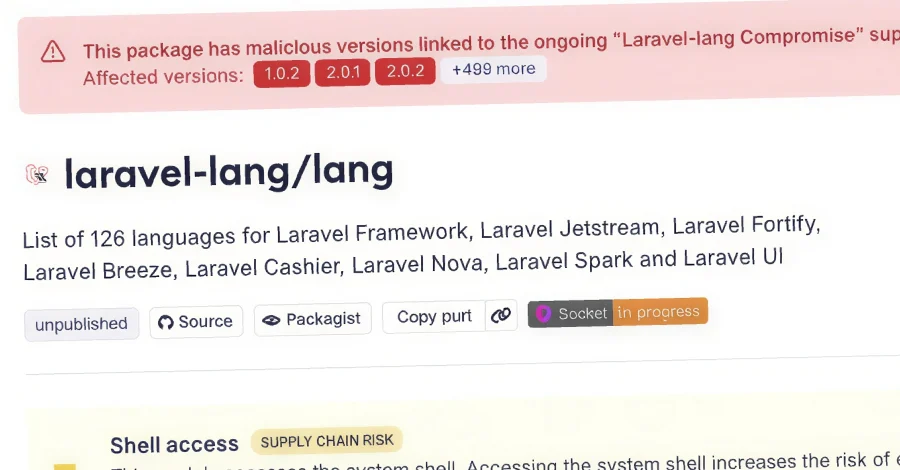

Cybersecurity researchers have recently identified and flagged a sophisticated software supply chain attack campaign that has extensively targeted multiple PHP packages associated with Laravel-Lang, a prominent localization library within the Laravel ecosystem. This widespread compromise has been designed to deploy a multi-faceted credential-stealing framework, posing a significant threat to developers and organizations utilizing these affected packages. The discovery underscores the escalating risks inherent in modern software supply chains, where a single point of compromise can cascade into widespread data theft and system infiltration across numerous downstream users.
The Anatomy of a Supply Chain Breach
A supply chain attack, in the context of software, occurs when malicious code is injected into legitimate software or components before they reach the end-user. This method is particularly insidious because it exploits the trust inherent in the development process, allowing attackers to distribute malware through trusted channels, often without immediate detection. For developers, this means that merely downloading or updating a seemingly legitimate library could introduce a critical vulnerability or malware into their projects, and subsequently, into their production environments.
Laravel-Lang provides language files for the Laravel framework, a highly popular PHP web application framework known for its elegant syntax and robust features. Given Laravel’s extensive adoption by millions of developers worldwide, any compromise of its associated libraries, even those for localization, represents a broad attack surface. The malicious intervention into Laravel-Lang packages suggests a calculated move by attackers to leverage this wide reach, turning a seemingly innocuous component into a distribution vector for their nefarious payload.
Chronology of Compromise: Rapid Tagging and Widespread Distribution
The timeline of the attack, as documented by cybersecurity firm Socket, points to a highly automated and aggressive campaign. "The timing and pattern of the newly published tags point to a broader compromise of the Laravel Lang organization’s release process, rather than a single malicious package version," Socket reported. This observation is critical, indicating that the attackers did not merely target one specific version but rather gained control over a significant portion of the release mechanism itself.
The malicious activity unfolded rapidly between May 22 and May 23, 2026. During this brief window, an alarming number of versions — more than 700 associated with various Laravel-Lang packages — were identified as compromised. These versions appeared in rapid succession, often mere seconds apart, strongly suggesting automated mass tagging or republishing by the attackers. This unprecedented speed and scale of modification indicate that the perpetrators likely obtained high-level access to Laravel-Lang’s core infrastructure. Researchers suspect this could involve organization-level credentials, control over repository automation tools, or direct access to their release infrastructure, allowing them to inject their malicious code across a vast array of package iterations.
The Malicious Payload: A Cross-Platform Threat
The core of the malicious functionality was meticulously embedded within a file named "src/helpers.php" across the compromised version tags. This file, strategically placed, is designed to be automatically loaded and executed whenever a PHP request is handled by an application that uses the compromised package. Socket elaborated on this mechanism: "Because this file [‘src/helpers.php’] is registered in the composer.json under autoload.files, the backdoor is executed automatically on every PHP request handled by the compromised application." This ensures persistent execution and broad reach within the infected environment.
Upon execution, the "helpers.php" script initiates a multi-stage attack. Its primary function is to fingerprint the infected host, gathering crucial information about the operating system and system architecture. Following this initial reconnaissance, it establishes contact with an external command-and-control (C2) server, identified as "flipboxstudio[.]info". This server then delivers a secondary, more potent PHP-based cross-platform payload. The choice of a PHP-based payload is particularly effective, as it allows the malware to operate seamlessly across different operating systems—Windows, Linux, and macOS—without requiring distinct binaries for each platform, maximizing the attacker’s reach and impact.
Execution Across Operating Systems
The dropper mechanism employed by the attackers demonstrates a sophisticated understanding of different operating system environments:

- Windows Systems: According to analysis by Aikido Security, the dropper delivers a Visual Basic Script (VBS) launcher. This VBS script is then executed via
cscript, a command-line scripting host for Microsoft Windows. The use of VBS allows the attackers to leverage built-in Windows functionalities, often bypassing traditional antivirus detections that might focus on executable files. - Linux and macOS Systems: For Unix-like operating systems, the payload leverages the
exec()function in PHP. This function allows PHP to execute external programs, enabling the stealer payload to run directly on the system. This method is straightforward and effective, exploiting the inherent capabilities of PHP to interact with the underlying operating system.
A key feature designed for stealth and persistence is the malware’s ability to generate a unique per-host marker. "The script generates a unique per-host marker (an MD5 hash combining the directory path, system architecture, and inode) to ensure the payload only triggers once per machine," Socket explained. "This prevents redundant executions and helps the malware remain undetected after the initial run." This mechanism ensures that the payload is not constantly active, reducing its footprint and making it harder for system administrators or security tools to detect its presence after the initial compromise.
The Comprehensive Credential-Stealing Framework
Once executed, the fetched payload transforms into a highly effective credential stealer. Aikido researcher Ilyas Makari provided a detailed insight into its capabilities: "The fetched payload is a ~5,900 line PHP credential stealer, organised into fifteen specialist collector modules." This modular design allows the stealer to target and harvest an extensive array of sensitive data from compromised systems.
The range of data specifically targeted by this sophisticated framework is alarming and includes:
- Credentials: Usernames, passwords, API keys, and other authentication tokens from various applications and services.
- Environment Variables: System-wide and user-specific environment variables that may contain sensitive configuration data, API keys, or paths.
- SSH Keys: Private and public SSH keys, which are critical for secure remote access and could grant attackers unfettered access to servers and other infrastructure.
- Cloud Provider Credentials: Access keys and secret keys for major cloud platforms like AWS, Google Cloud, and Azure, enabling potential takeover of cloud resources.
- Cryptocurrency Data: Wallet information, private keys, and other data related to cryptocurrency holdings, potentially leading to significant financial losses.
- Browser Data: Stored credentials, cookies, browsing history, and autofill data from web browsers, providing access to online accounts.
- System Information: Detailed information about the operating system, hardware, installed software, and running processes, aiding in further exploitation.
- Network Configurations: Network settings, IP addresses, open ports, and other connectivity data that could be used for lateral movement within a network.
- Configuration Files: Sensitive configuration files from various applications that might contain database credentials, API endpoints, or other critical secrets.
After meticulously collecting all available sensitive information, the malware encrypts the results using AES-256, a strong encryption standard, before exfiltrating the data to "flipboxstudio[.]info/exfil". To further evade detection and hinder forensic analysis, the stealer then promptly deletes itself from the disk, minimizing any tangible evidence of its presence.
Broader Implications for the Open-Source Ecosystem
This Laravel-Lang supply chain attack serves as a stark reminder of the pervasive and evolving threat landscape facing modern software development, particularly within the open-source community. The reliance on third-party libraries and packages, while accelerating development, simultaneously introduces potential vulnerabilities that are often beyond the direct control of individual developers or organizations.
The compromise of a widely used localization package like Laravel-Lang highlights several critical implications:
- Trust Erosion: Such attacks undermine the fundamental trust that developers place in open-source projects and their maintainers. When core components are compromised, it casts a shadow over the entire ecosystem.
- Widespread Impact: Due to the interconnected nature of software dependencies, a single compromised package can affect thousands, if not millions, of applications globally. Organizations using Laravel, from small startups to large enterprises, could inadvertently integrate this malicious code into their systems.
- Sophistication of Attackers: The cross-platform nature of the payload, the rapid and automated tagging, the stealth mechanisms (unique per-host marker, self-deletion), and the comprehensive data collection capabilities demonstrate a high level of sophistication from the threat actors involved.
- Difficulty of Detection: Supply chain attacks are notoriously difficult to detect. The malicious code is often embedded within legitimate updates, making it appear as normal activity. Traditional security measures often struggle to differentiate between benign and malicious changes in legitimate packages.
Mitigation and Best Practices for Developers and Organizations
In light of this significant attack, it is imperative for developers and organizations to re-evaluate and strengthen their software supply chain security practices. Immediate and long-term strategies include:
- Auditing Dependencies: Regularly audit all third-party dependencies for known vulnerabilities and suspicious activity. Tools for Software Composition Analysis (SCA) can help automate this process.
- Pinning Versions: Avoid using broad version ranges (e.g.,
^1.0or*) for dependencies. Instead, pin to specific, known-good versions (e.g.,1.2.3). This prevents automatic updates to potentially compromised versions without explicit approval. - Strict Access Controls: Maintain stringent access controls, including multi-factor authentication (MFA), for all repository, package manager, and release infrastructure accounts. Regular review of these permissions is crucial.
- Code Signing: Where possible, utilize code signing for packages and releases. This provides a cryptographic assurance of the origin and integrity of the software.
- Dependency Scanning: Implement continuous scanning of dependencies throughout the development lifecycle, from development to production.
- Software Bill of Materials (SBOMs): Generate and maintain SBOMs for all applications. An SBOM provides a comprehensive list of all components, libraries, and modules used in a piece of software, making it easier to identify affected applications in case of a supply chain compromise.
- Network Segmentation: Implement network segmentation to limit the potential lateral movement of malware if a system becomes compromised.
- Endpoint Detection and Response (EDR): Deploy EDR solutions to monitor for suspicious activities on endpoints, including unexpected process executions, network connections, and file modifications.
- Regular Backups: Maintain robust backup and recovery strategies to minimize the impact of data exfiltration or system compromise.
- Stay Informed: Keep abreast of the latest cybersecurity threats and vulnerabilities, especially those related to commonly used frameworks and libraries. Follow security researchers and official advisories.
While Laravel-Lang maintainers are undoubtedly working diligently to revoke compromised credentials, audit their release pipelines, and issue clean, verified versions of their packages, the responsibility also falls on the users of these packages to verify the integrity of their own deployments. This incident serves as a critical wake-up call, emphasizing that even the most trusted components of the software ecosystem are not immune to sophisticated attacks. The collective security posture of the entire software community hinges on vigilance, robust security practices, and rapid response to emerging threats.
