

OpenAI announced a significant overhaul of its Agents Software Development Kit (SDK) on Wednesday, transforming it from a nascent tool for building AI agents into a robust platform designed to facilitate their deployment into production environments. This latest iteration introduces sophisticated sandboxing capabilities and enhanced durability, addressing key challenges for developers aiming to operationalize AI agents at scale. The update signifies a strategic pivot for OpenAI, acknowledging the rapid evolution of AI models and their increasing capacity for complex, long-duration tasks.
The original Agents SDK, launched just over a year ago, was predicated on the growing ability of AI models to maintain a coherent trajectory, plan multi-step actions, and sustain focus on a task for extended periods. At its inception, the SDK was largely geared towards simpler chatbot interactions, as Steve Coffey, Tech Lead for OpenAI’s Responses API, explained to The New Stack. "The models that were out at the time, you could expect them to take five, six, seven steps maybe in a workflow, but not really go beyond that," Coffey stated. "And now we have models that can kind of work for hours at a time or days or weeks."
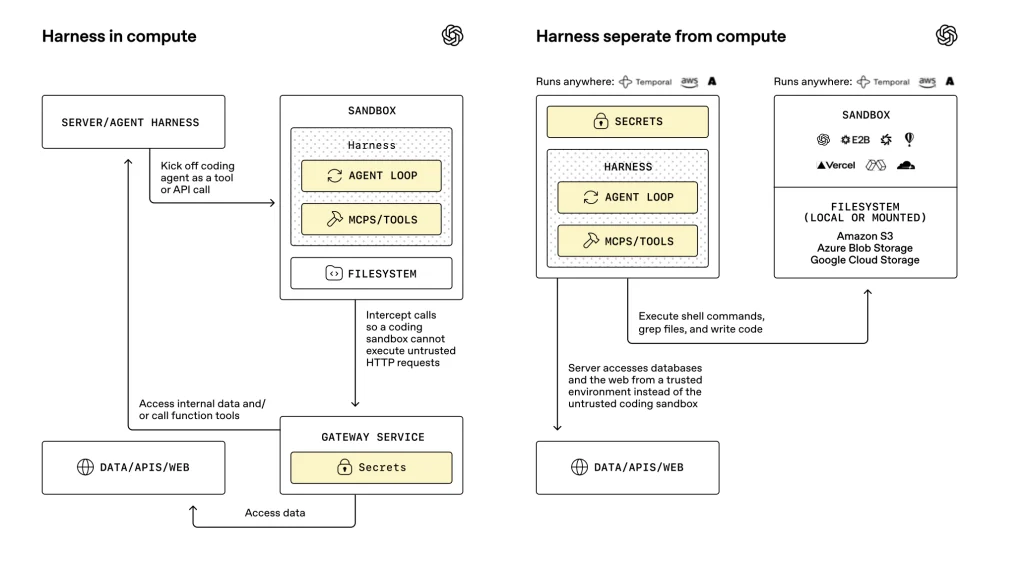
This dramatic increase in model endurance necessitated a more sophisticated infrastructure. While OpenAI had incrementally added features over the past year, including support for Temporal’s tools for durable execution (MCP) and various third-party integrations, the SDK remained in a pre-1.0 state, a status that continues as OpenAI signals further evolution. The core innovation of this release lies in the introduction of controlled workspaces, or "sandboxes," for agents. This feature is designed to decouple the agent’s execution environment from its core logic, a move aimed at bolstering security, ensuring operational durability, and enabling seamless scaling.
The Advent of Agent Sandboxes: A New Paradigm for AI Deployment
The most prominent feature of this update is the ability for developers to provision secure, isolated environments for their AI agents. This architectural shift is crucial for moving AI agents from experimental stages to production-ready systems, particularly within enterprise settings where security and reliability are paramount. The sandboxes can be configured as virtually any type of container or virtual machine, offering developers substantial flexibility. They can leverage their existing container infrastructure or integrate with a range of specialized tools and platforms, including Blaxel, Cloudflare, Daytona, E2B, Modal, Runloop, and Vercel.
This flexibility extends to agent management. An agent can operate within a single sandbox, dynamically provision additional sandboxes as computational demands increase, or even spawn sub-agents that execute within their own distinct, sandboxed environments. This granular control over execution contexts is particularly beneficial for complex workflows. As Coffey elaborated, the SDK can now be orchestrated as a Temporal job, with the agent subsequently running within a model-specific sandbox or a Docker container. "And then these things are very separated from each other," Coffey noted. "So tool calls run in an unprivileged environment, and all the code that Modal writes runs in a privileged environment." This separation ensures that potentially risky operations or tool executions do not compromise the core agent or the underlying infrastructure.
Deconstructing the Harness: Separating Logic from Compute for Enhanced Security
The strategic decision to separate the agent’s "harness" – the core logic and orchestration layer – from its computational "compute" environment is a direct response to the evolving needs of businesses integrating AI. For individual developers working on limited-scope projects, security concerns might be less pressing. However, for large enterprises, the implications are profound. "On the other end of the spectrum are these big enterprise deployments, where you care a ton about the agent running in a totally de-approved environment," Coffey emphasized.

This heightened security posture means that sandboxed agents will operate without direct access to sensitive credentials. "So no API keys, no secrets in that sandbox," Coffey explained. "You want it to be totally isolated – probably isolated from the network in a lot of cases and not able to do any sort of egress." This level of isolation significantly mitigates the risk of data breaches or unauthorized access, making the Agents SDK a more viable option for regulated industries and security-conscious organizations.
Within these secure sandboxes, the agents, now more opinionated than their predecessors, gain access to a controlled set of tools. This includes the ability to interact with the shell and file system, enabling them to process various data formats such as text files, images, and PDFs. Developers retain the authority to define the specific tools and functionalities available to each agent, ensuring that their capabilities align precisely with the task at hand.
Empowering Agents with Data Access and State Management
Beyond computational isolation, the updated SDK also addresses the critical need for agents to access and process data. Developers can now mount various data sources directly into the agent’s sandbox. These include local file systems, cloud storage solutions like Amazon S3 buckets, Google Cloud Storage, Azure Blob Storage, and object storage services such as Cloudflare R2. This seamless integration facilitates data-intensive workflows and allows agents to operate on diverse datasets without requiring complex data transfer pipelines.
Furthermore, this enhanced data connectivity contributes to the statefulness of the sandbox environments. "If you want to be able to snapshot a container and spin down that container and then spin it back up later with the same file system, we’re adding support for that," Coffey revealed. This capability is invaluable for long-running processes or scenarios where an agent needs to resume its work from a specific point, preserving progress and context.
Even for agents not deployed within these dedicated sandboxes, the Agents SDK has been augmented with configurable memory and improved support for file and document handling. However, OpenAI clearly anticipates that the sandboxed approach will become the de facto standard for production deployments due to its inherent security and scalability advantages.
Pricing and Accessibility: Continued Commitment to Developer Access
In line with its previous offerings, OpenAI has maintained its commitment to developer accessibility by not introducing any additional pricing for the Agents SDK itself. Users will continue to be billed based on their consumption of API tokens and tool usage, adhering to OpenAI’s standard pricing structure. This approach democratizes access to advanced AI agent development, allowing businesses of all sizes to experiment and deploy sophisticated AI solutions without prohibitive upfront costs.
The evolution of the Agents SDK reflects a broader trend in the AI landscape: the maturation of AI models from research curiosities to integral components of business operations. By providing developers with the tools to build, secure, and deploy AI agents with confidence, OpenAI is positioning itself as a key enabler of this transformative shift, paving the way for more autonomous, intelligent, and integrated AI systems across industries. The move towards production-readiness signals OpenAI’s strategic focus on empowering enterprises to leverage the full potential of advanced AI models in real-world applications.
