

Containers represent a paradigm shift in how software is packaged, deployed, and managed. At their core, containers are lightweight, standalone, executable software packages that bundle everything a piece of software needs to run: its code, runtime environment, system tools, necessary libraries, and configurations. This innovation is a cornerstone of containerization, a methodology that isolates software and its dependencies from other processes, ensuring consistent and predictable execution across diverse environments. This article delves into the intricacies of containerization, exploring its fundamental components, contrasting it with virtual machines, and examining its benefits, widespread use cases, and the leading technologies driving its adoption. We will also address the inherent challenges and anticipate the future trajectory of this transformative technology.
Understanding the Power of Containers
Containerization empowers developers to package and execute applications within isolated environments. This process guarantees a uniform and efficient method for deploying software, whether on a developer’s local machine or on robust production servers, effectively eliminating concerns about OS configurations or underlying infrastructure discrepancies. Unlike conventional deployment approaches, containers encapsulate an application and its dependencies into a cohesive "container image." This image is a self-contained unit, containing all the prerequisites for the application’s operation: code, runtime, libraries, and system utilities. A key characteristic of containers is their ability to share the host system’s kernel while maintaining their own distinct filesystem, CPU, memory, and process space. This shared kernel architecture renders them significantly more lightweight and resource-efficient compared to virtual machines.
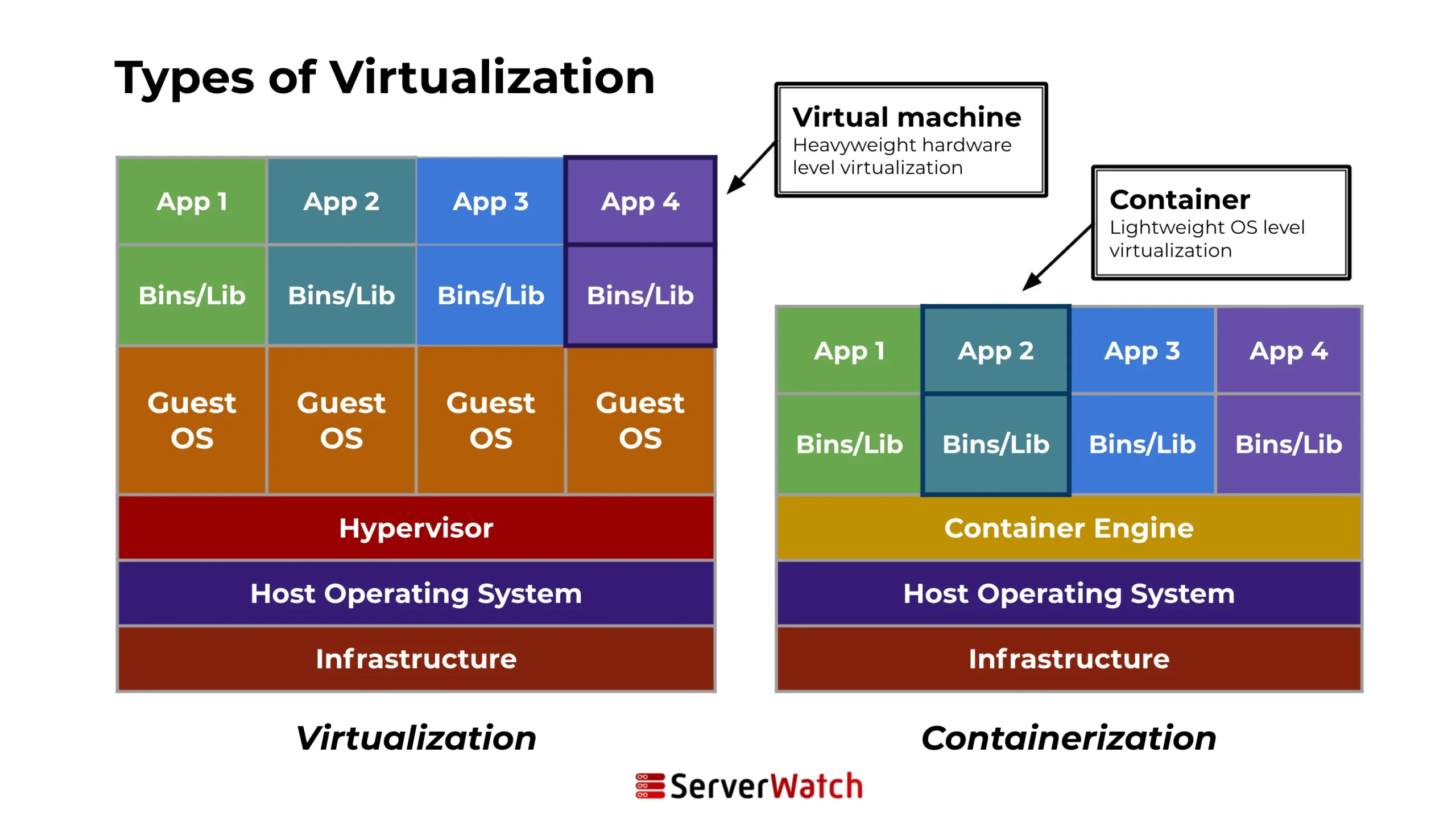
The fundamental distinction between containerization and virtualization lies in their architectural approach. Virtual machines (VMs) operate by creating a full hardware virtualization layer, known as a hypervisor, which then hosts an entire guest operating system for each virtual machine. This guest OS, along with the application and its dependencies, resides within the VM. In contrast, containers leverage the host operating system’s kernel. They virtualize the operating system environment rather than the hardware. This distinction has profound implications for performance, resource utilization, and deployment speed.
Containers vs. Virtual Machines: A Comparative Analysis
While both containers and VMs serve the purpose of creating isolated environments for running applications, their underlying mechanisms differ significantly.
| Feature | Containers | Virtual Machines |
|---|---|---|
| Architecture | Containers share the host system’s kernel, isolating application processes from the core OS. They do not require a full operating system for each instance, making them considerably lighter and faster to initiate than VMs. | A virtual machine encompasses not only the application and its dependencies but also a complete guest operating system. This OS operates on virtual hardware managed by a hypervisor, which is itself positioned above the host’s physical hardware. VMs are isolated from each other and from the host system, offering a high degree of security and control. |
| Resource Management | Containers are inherently more efficient and consume fewer resources than VMs. This efficiency stems from their shared utilization of the host system’s kernel and their need to package only the application and its runtime environment, rather than an entire OS. | The necessity of running a full operating system within each VM leads to increased consumption of system resources. This can result in less efficient utilization of the underlying hardware infrastructure. |
The operational efficiency and reduced overhead of containers have made them a preferred choice for many modern applications, particularly those requiring rapid scaling and frequent updates.
How Containerization Works: A Behind-the-Scenes Look
The process of containerization involves encapsulating an application and its operating environment into a self-contained unit. This intricate process typically unfolds through several key stages:
- Image Creation: Developers define the application’s environment, dependencies, and configurations within a Dockerfile or a similar declarative format. This file acts as a blueprint for building the container image.
- Image Building: A containerization platform, such as Docker, interprets the Dockerfile and constructs the container image. This image is a layered, immutable artifact containing all the necessary components.
- Image Registry: The built image is then stored in a container registry (e.g., Docker Hub, Amazon ECR, Google Container Registry). This registry serves as a centralized repository for managing and sharing container images.
- Container Runtime: When an application needs to be deployed, a container runtime engine (like Docker Engine or containerd) pulls the image from the registry.
- Container Instantiation: The runtime engine then creates and runs an instance of the container based on the image. This involves setting up the isolated process, filesystem, and network environment for the application.
- Orchestration: For managing multiple containers, orchestration platforms like Kubernetes come into play. They automate deployment, scaling, networking, and availability of containerized applications across clusters of machines.
Key Components of a Container
A container, though lightweight, comprises several critical components that enable its isolated operation:
- Container Image: This is the static, read-only template containing the application code, runtime, libraries, environment variables, and configuration files. It’s akin to a blueprint from which containers are created.
- Container Runtime: This is the software responsible for running containers. It manages the lifecycle of containers, including starting, stopping, and monitoring them. Examples include Docker Engine, containerd, and CRI-O.
- Namespaces: These provide process isolation, ensuring that a process within a container cannot see or interact with processes outside its designated namespace. This includes process ID (PID) isolation, network isolation, and mount isolation.
- Control Groups (cgroups): These limit and account for the resource usage of processes, such as CPU, memory, I/O, and network bandwidth. Cgroups prevent a single container from consuming all system resources, thereby ensuring fair resource allocation.
- Union File Systems (UnionFS): These allow for the creation of layered filesystems. Container images are built in layers, and when a container is run, a writable layer is added on top of the read-only image layers, allowing for modifications within the container without affecting the underlying image.
- Networking Interface: Each container is typically provided with its own network namespace, enabling it to have its own IP address, routing table, and network interfaces, thus ensuring network isolation.
Container Use Cases: Driving Modern Software Development
The versatility and efficiency of containers have made them indispensable across a wide spectrum of applications in the contemporary software landscape, addressing diverse needs in development, deployment, and management.
Microservices and Cloud-Native Applications
Containers are a natural fit for microservices architectures, where applications are decomposed into small, independent, and loosely coupled services. Each microservice can be encapsulated in its own container, fostering isolated environments, minimizing conflicts, and simplifying independent updates and scaling. In the realm of cloud-native development, containers are instrumental in building highly scalable and resilient applications. They can be easily replicated, managed, and monitored, facilitating efficient load balancing and ensuring high availability. Orchestration tools like Kubernetes further enhance this by enabling dynamic management of containers, optimizing resource utilization, automating recovery, and streamlining scaling in response to fluctuating demand. The adoption of microservices, facilitated by containers, has become a key strategy for organizations aiming for agility and faster innovation cycles.
Continuous Integration/Continuous Deployment (CI/CD) Pipelines
Containerization seamlessly integrates with CI/CD pipelines, providing consistent environments from the development stage all the way to production. This uniformity is crucial for early detection and remediation of issues within the development lifecycle. Containers also enable the automation of testing environments, ensuring that every code commit is rigorously tested in a production-like setting, leading to more dependable deployments and accelerated release cycles. The inherent encapsulation of applications and their environments within containers guarantees predictable behavior across development, testing, staging, and production environments, significantly reducing deployment failures attributed to environmental inconsistencies. Many organizations now mandate containerized testing as a prerequisite for code merging.
Application Packaging and Distribution
Containers simplify the packaging and distribution of software by bundling an application with all its dependencies. This inherent portability allows applications to run across a multitude of platforms and cloud environments without requiring any modifications. Furthermore, container registries provide robust version control for container images, enabling straightforward rollbacks to previous stable versions if issues arise. This capability significantly bolsters the reliability and stability of application deployments. Companies are increasingly leveraging container registries to manage their software supply chains more effectively.
13 Benefits of Containerization
The widespread adoption of containerization is a testament to its numerous advantages, fundamentally reshaping software development and deployment strategies.
- Portability: Containerized applications can run consistently across any environment – developer laptops, on-premises servers, or public clouds – without modification.
- Consistency: Eliminates the "it works on my machine" problem by ensuring the application environment is identical everywhere.
- Efficiency: Containers share the host OS kernel, requiring fewer resources than VMs, leading to higher density and lower infrastructure costs.
- Speed: Containers start up in seconds, drastically reducing deployment and scaling times compared to VMs.
- Isolation: Applications and their dependencies are isolated, preventing conflicts and enhancing security.
- Scalability: Easily scale applications up or down by launching or terminating container instances, often automated by orchestrators.
- Agility: Faster development cycles and quicker time-to-market due to streamlined build, test, and deployment processes.
- Resource Optimization: Better utilization of hardware resources by packing more applications onto a single server.
- Simplified Management: Container orchestration platforms simplify the management of complex applications and large fleets of containers.
- Modularity: Supports microservices architectures, enabling independent development, deployment, and scaling of application components.
- Cost Savings: Reduced infrastructure costs due to higher density and efficient resource utilization.
- Developer Productivity: Developers can focus on writing code rather than managing infrastructure complexities.
- Faster Innovation: Enables organizations to experiment and iterate rapidly, fostering a culture of innovation.
Challenges and Considerations in Containerization
Despite its compelling advantages, containerization presents its own set of hurdles and considerations that organizations must navigate for successful implementation.

Security Issues
While containers offer isolation, they are not inherently immune to security threats. Several security concerns can arise:
- Image Vulnerabilities: Container images can contain vulnerabilities in their base OS, libraries, or application code. Rigorous scanning and patching are essential.
- Container Escapes: Malicious actors may attempt to exploit vulnerabilities to break out of a container’s isolation and gain access to the host system or other containers.
- Runtime Security: Protecting containers while they are running is critical, involving secure configurations, access controls, and network segmentation.
- Secrets Management: Securely managing sensitive information like API keys, passwords, and certificates used by containers is a significant challenge.
- Shared Kernel Risks: While a strength, the shared kernel means a compromise of the host kernel could potentially impact all containers running on it.
Complexity in Management
While containerization streamlines many operational aspects, it introduces new layers of complexity, particularly in large-scale deployments:
- Orchestration Overhead: Managing hundreds or thousands of containers requires sophisticated orchestration tools like Kubernetes, which have a steep learning curve.
- Networking Complexity: Designing, implementing, and managing container networking can become intricate, especially in distributed environments.
- Storage Management: Persistent storage for stateful applications in containers requires careful planning and integration with external storage solutions.
- Monitoring and Logging: Aggregating logs and monitoring the health and performance of numerous distributed containers demands robust observability tools.
- Skill Gap: Organizations often face a shortage of skilled professionals experienced in container technologies and DevOps practices.
Integration with Existing Systems
Adopting containerization often necessitates integrating this modern paradigm with existing legacy systems, presenting unique challenges:
- Legacy Application Compatibility: Older applications may not be designed for containerization and might require significant refactoring or re-architecting.
- Data Migration: Migrating data from traditional databases or storage systems to containerized environments can be complex and time-consuming.
- Hybrid Cloud Strategies: Integrating on-premises container deployments with cloud-based container services requires careful architectural planning and tooling.
- Security Policy Alignment: Ensuring that container security policies align with existing enterprise security frameworks and compliance requirements is crucial.
- Cultural Shift: Embracing containerization often requires a shift in organizational culture towards DevOps practices, collaboration, and continuous learning.
Popular Container Technologies
The container ecosystem has matured significantly, with several powerful technologies dominating the landscape.
Docker
Docker is widely recognized as the pioneer and most popular container platform, democratizing containerization and making it accessible to a broader audience. It provides a comprehensive suite of tools for developing, shipping, and running containerized applications.
- Key Features:
- Docker Engine: The core runtime for building and running Docker containers.
- Dockerfile: A script containing instructions to build a Docker image.
- Docker Hub: A cloud-based registry for sharing and storing Docker images.
- Docker Compose: A tool for defining and running multi-container Docker applications.
- Container Isolation: Utilizes Linux namespaces and cgroups for process and resource isolation.
- Benefits:
- Ease of use and rapid adoption.
- Extensive community support and a vast ecosystem of tools.
- Standardized image format simplifying portability.
- Accelerated development and deployment workflows.
Kubernetes
Kubernetes (often abbreviated as K8s) is the de facto standard for container orchestration, designed to automate the deployment, scaling, and management of containerized applications. It’s an open-source system developed by Google and now maintained by the Cloud Native Computing Foundation (CNCF).
- Key Features:
- Automated Rollouts and Rollbacks: Manages application updates and can revert to previous versions if issues arise.
- Service Discovery and Load Balancing: Automatically assigns DNS names to containers and distributes network traffic.
- Storage Orchestration: Allows automatic mounting of storage systems, local storage, or cloud provider storage.
- Self-Healing: Restarts containers that fail, replaces and reschedules containers when nodes die, and kills containers that don’t respond to health checks.
- Secret and Configuration Management: Manages sensitive information and application configurations.
- Benefits:
- Handles complex, large-scale container deployments efficiently.
- Provides high availability and resilience for applications.
- Enables sophisticated scaling and auto-scaling capabilities.
- Offers a rich ecosystem of add-ons and integrations.
Other Notable Containers
Beyond Docker and Kubernetes, several other technologies contribute to the containerization landscape:
- containerd: A core container runtime that emphasizes simplicity, robustness, and portability, often used as a foundational component by higher-level tools.
- CRI-O: A lightweight container runtime specifically designed for Kubernetes, adhering strictly to the Kubernetes Container Runtime Interface (CRI).
- Podman: A daemonless container engine for developing, managing, and running OCI (Open Container Initiative) containers on Linux systems, often seen as a direct alternative to Docker for certain use cases.
- LXC (Linux Containers): A foundational technology that provides OS-level virtualization for managing multiple isolated Linux systems on a single control host.
Future Trends in Containerization
The evolution of containerization is inextricably linked to emerging technologies and evolving industry standards, promising further innovation and integration.
Integration with Emerging Technologies
Containerization is not a static field; it’s rapidly evolving and increasingly intersecting with cutting-edge technologies:
- Artificial Intelligence (AI) and Machine Learning (ML): Containers are ideal for packaging and deploying complex AI/ML models, ensuring consistent environments for training and inference across diverse hardware, including GPUs. This facilitates MLOps (Machine Learning Operations).
- Edge Computing: As computing moves closer to data sources, containers offer a lightweight and efficient way to deploy and manage applications on resource-constrained edge devices.
- Serverless Computing: While seemingly distinct, serverless platforms often leverage containers under the hood to manage and scale functions, blurring the lines between serverless and containerized architectures.
- WebAssembly (Wasm): Wasm is emerging as a portable, secure, and performant runtime for client and server applications, and its integration with container technologies is a significant area of development.
- Blockchain and Distributed Ledgers: Containerization can simplify the deployment and management of blockchain nodes and decentralized applications, ensuring consistent network participation.
Evolution of Container Standards and Regulations
As containerization solidifies its position in enterprise IT, the development of robust standards and adherence to regulations become paramount:
- Open Container Initiative (OCI): The OCI defines specifications for container image formats and runtimes, ensuring interoperability between different container tools and platforms. Adherence to OCI standards promotes a more open and fragmented ecosystem.
- Security Compliance: As containers are increasingly used in regulated industries (e.g., finance, healthcare), ensuring container security meets stringent compliance mandates (e.g., GDPR, HIPAA) is becoming a critical focus. This includes vulnerability management, access control, and auditing.
- Supply Chain Security: With the rise of software supply chain attacks, there is a growing emphasis on securing the entire lifecycle of container images, from their creation to their deployment, including signing and verification.
- Standardization of Orchestration APIs: While Kubernetes is dominant, efforts are underway to standardize APIs for managing containerized workloads across different environments, potentially leading to greater flexibility and reduced vendor lock-in.
- Sustainability and Efficiency: As the adoption of containerization scales globally, there’s an increasing focus on optimizing resource utilization for energy efficiency and environmental sustainability.
Bottom Line: The Role of Containers Will Continue to Grow
Containers have irrevocably altered the landscape of software development and deployment, delivering unparalleled efficiency, scalability, and consistency. As these technologies continue their rapid evolution, containers are poised to become even more deeply embedded in IT infrastructure, acting as a catalyst for innovation and efficiency across a multitude of sectors.
Looking ahead, the potential of containerization is immense. Its inherent ability to seamlessly integrate with burgeoning technological advancements and adapt to evolving regulatory frameworks positions it as a fundamental pillar of digital transformation strategies. Organizations that effectively harness the power of container technologies will find themselves at the vanguard of innovation, equipped to confront the challenges of an ever-changing digital world. The ongoing maturation of container orchestration, security practices, and interoperability standards will further solidify their indispensable role in the future of computing.
For those seeking to understand the broader context of virtualization, exploring virtual machines provides valuable insight into complementary technologies. Additionally, identifying the best virtualization companies can help organizations select partners that align with their strategic infrastructure needs.
