

Containers have fundamentally reshaped the landscape of software development and deployment, offering an unprecedented level of efficiency, scalability, and consistency. This transformative technology, part of a broader trend known as containerization, provides a method of packaging software with its dependencies, isolating it from other processes. At its core, a container is a lightweight, standalone, executable package of software that bundles all necessary components: code, runtime, system tools, libraries, and settings. This article delves into the intricacies of containerization, exploring its fundamental components, its crucial differences from virtual machines, and its burgeoning role in modern IT infrastructure. We will also examine the manifold benefits, diverse use cases, prominent container technologies, and the potential challenges and future trajectories of this pivotal technology.
Understanding the Power of Containers
Containerization empowers developers to package and execute applications within self-contained, isolated environments. This process ensures a consistent and reliable deployment experience, transcending the traditional hurdles of varying operating system configurations and underlying infrastructure differences. Whether deploying on a developer’s local workstation or to vast production servers, containers maintain their integrity.
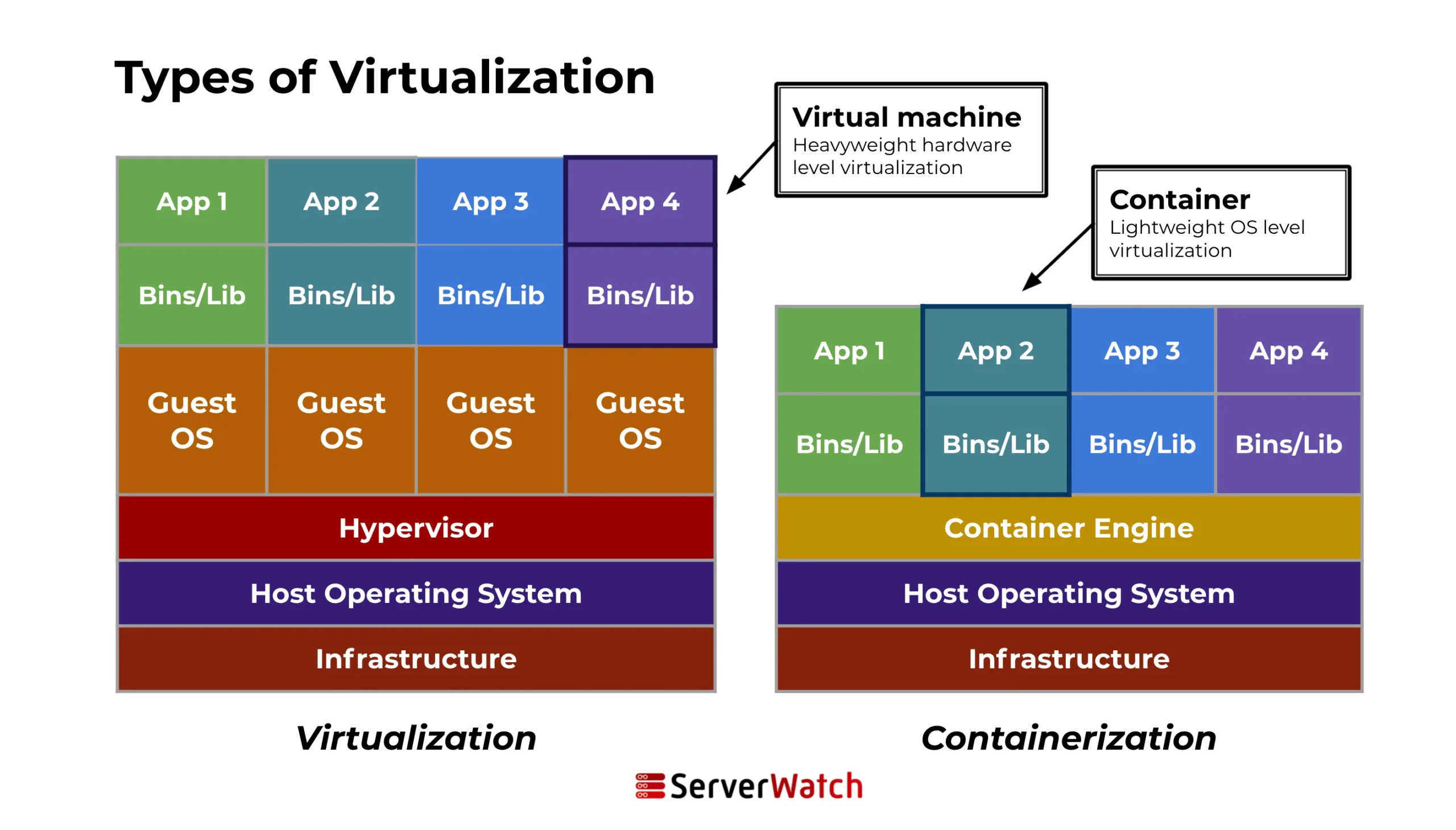
Unlike conventional deployment paradigms, containers encapsulate an application and its entire ecosystem of dependencies into a single container image. This image acts as a blueprint, containing everything required for the application to function. A key architectural distinction is that containers share the host system’s kernel. However, they maintain their own distinct filesystem, CPU allocation, memory space, and process isolation. This shared kernel architecture renders containers significantly more lightweight and resource-efficient compared to virtual machines (VMs).
The stark contrast between virtualization and containerization can be visualized through their architectural approaches. Virtualization relies on a hypervisor to create virtual hardware, upon which a full guest operating system is installed for each virtual machine. This leads to significant overhead in terms of resources and boot times. Containerization, conversely, leverages a container engine that utilizes the host OS kernel, allowing for multiple isolated application environments to run concurrently with minimal overhead.
Containers vs. Virtual Machines: A Fundamental Divide
While both containers and virtual machines serve the purpose of creating isolated environments for software execution, their underlying mechanisms and resource utilization differ dramatically.
| Feature | Containers | Virtual Machines |
|---|---|---|
| Architecture | Containers share the host system’s kernel, isolating application processes from the system. They do not require a full operating system for each instance, making them more lightweight and faster to initiate than VMs. | A VM encompasses not only the application and its dependencies but also an entire guest operating system. This OS runs on virtualized hardware managed by a hypervisor, which interfaces with the host’s physical hardware. VMs are isolated from each other and the host. |
| Resource Management | Containers are highly efficient, consuming fewer resources as they share the host system’s kernel and only necessitate the application and its runtime environment. This leads to denser deployments and better hardware utilization. | The necessity of running a full operating system within each VM results in substantial resource consumption. This can lead to less efficient utilization of underlying hardware and higher operational costs, especially at scale. |
| Portability | Highly portable, running consistently across different environments due to the self-contained nature of the image. | Portability can be more challenging due to OS dependencies and potential compatibility issues between different hypervisors and host environments. |
| Startup Time | Near-instantaneous startup times, measured in seconds or milliseconds, due to the absence of an operating system boot process. | Startup times can range from minutes to several minutes, as the entire guest operating system needs to boot. |
| Isolation | Process-level isolation provides strong isolation for applications but shares the host kernel. A kernel vulnerability could potentially impact all containers. | Hardware-level isolation provides a more robust security boundary, as each VM has its own kernel and operating system, completely detached from the host and other VMs. |
How Containerization Works
The process of containerization involves packaging an application along with its entire operating environment into a self-sufficient container. This intricate process typically involves several key steps:
- Defining the Container Image: Developers create a
Dockerfileor similar configuration file that specifies the base operating system, necessary libraries, application code, and runtime configurations. - Building the Image: A containerization engine, such as Docker, reads the
Dockerfileand builds a layered image. Each instruction in theDockerfilecreates a new layer, ensuring efficient storage and faster image builds. - Running the Container: Once the image is built, the containerization engine can instantiate one or more containers from it. These containers are isolated instances that run the application defined in the image.
- Orchestration (at scale): For managing multiple containers across a cluster of machines, container orchestration platforms like Kubernetes become essential. They automate deployment, scaling, and management of containerized applications.
Key Components of a Container
A container is comprised of several fundamental components that enable its isolated and portable operation:
- Application Code: The actual software program or service intended to be run.
- Runtime: The environment necessary to execute the application code (e.g., Java Runtime Environment for Java applications, Python interpreter for Python applications).
- System Tools and Libraries: Essential utilities and shared libraries that the application relies on to function, independent of the host system’s specific versions.
- Filesystem: Each container possesses its own isolated filesystem, preventing interference with the host or other containers. This includes configuration files, application binaries, and any data the application needs to access locally.
- Process Space: Containers operate within their own isolated process space, meaning processes running inside a container cannot directly see or interact with processes outside of it, or in other containers, unless explicitly configured.
- Network Interface: Each container typically gets its own virtual network interface, allowing it to communicate with other containers, the host, or external networks as defined by the networking configuration.
Container Use Cases: Powering Modern Applications
The adoption of containers has surged across various sectors due to their inherent flexibility and efficiency, revolutionizing how applications are developed, deployed, and managed.
Microservices and Cloud-Native Applications
Containers are intrinsically aligned with the microservices architectural style, where applications are decomposed into small, independent, and loosely coupled services. Each microservice can be packaged and deployed within its own container, ensuring isolation, minimizing conflicts, and facilitating independent updates and scaling. This granular approach is a cornerstone of cloud-native development, enabling applications to be highly scalable, resilient, and adaptable. Orchestration platforms like Kubernetes further enhance this by providing automated management, scaling, and healing capabilities, ensuring optimal resource utilization and high availability in dynamic cloud environments.
Continuous Integration/Continuous Deployment (CI/CD) Pipelines
The integration of containers into CI/CD pipelines has been a game-changer. Containers provide consistent environments that span development, testing, staging, and production. This uniformity drastically reduces the "it worked on my machine" problem, leading to earlier bug detection and resolution. Automated testing environments, built using containers, ensure that every code commit is rigorously tested in a production-like setting, significantly boosting deployment reliability and accelerating release cycles. The self-contained nature of containers guarantees that software behaves identically across all stages of the pipeline, minimizing unforeseen deployment failures.
Application Packaging and Distribution
Containers excel at encapsulating applications and all their dependencies, simplifying the process of packaging and distributing software. The inherent portability of container images means applications can be deployed across diverse platforms and cloud environments without requiring modifications. Container registries serve as central repositories for storing and managing multiple versions of container images, enabling seamless rollbacks to previous stable versions if issues arise. This capability significantly enhances the robustness and stability of application deployments, providing a safety net for complex release processes.
Benefits of Containerization: A Comprehensive Overview
The advantages offered by containerization are multifaceted, making it an indispensable tool in the modern IT arsenal.
- Portability and Consistency: Applications packaged in containers run the same way regardless of the underlying infrastructure, from a developer’s laptop to a public cloud or an on-premises data center.
- Resource Efficiency: By sharing the host OS kernel, containers consume significantly fewer resources (CPU, RAM, storage) compared to VMs, enabling higher application density on the same hardware.
- Faster Deployment and Scalability: Containers can be started, stopped, and scaled in seconds, enabling rapid application deployment and dynamic scaling to meet fluctuating demand.
- Isolation and Security: Containers provide process-level isolation, preventing applications from interfering with each other or the host system. While not as robust as VM hardware isolation, it offers significant security benefits for application deployment.
- Agility and Developer Productivity: Developers can work in consistent, predictable environments, speeding up the development cycle and reducing time spent on environment setup and troubleshooting.
- Simplified Management: Container orchestration platforms automate many complex management tasks, including deployment, scaling, load balancing, and self-healing.
- Cost Savings: Increased resource efficiency and faster deployment cycles can translate into reduced infrastructure costs and operational overhead.
- Microservices Enablement: Containers are the ideal deployment unit for microservices, facilitating modular application architectures.
- Disaster Recovery: Container images can be easily replicated and deployed across different regions, enhancing disaster recovery capabilities.
- Version Control and Rollbacks: Container registries facilitate version management of applications, allowing for quick rollbacks to previous stable versions.
- Improved CI/CD: Consistent environments streamline CI/CD pipelines, leading to faster and more reliable software releases.
- Environmental Standardization: Ensures that applications run identically across development, testing, staging, and production environments.
- Reduced Vendor Lock-in: Containerization promotes portability across different cloud providers and infrastructure, reducing reliance on specific vendor technologies.
Challenges and Considerations in Containerization
Despite its numerous advantages, the widespread adoption of containerization also introduces specific challenges that organizations must address for successful implementation.
Security Issues
While containers offer isolation, they are not without security vulnerabilities. Potential concerns include:
- Shared Kernel Vulnerabilities: A compromise of the host OS kernel could potentially affect all containers running on that host.
- Container Image Security: Vulnerabilities can exist within the base images or third-party libraries used in container images, requiring diligent scanning and patching.
- Insecure Container Configurations: Misconfigurations, such as running containers with elevated privileges or exposing sensitive data, can create security risks.
- Runtime Security: Monitoring container behavior at runtime for malicious activities is crucial.
Complexity in Management
While orchestration tools simplify management, the overall container ecosystem can be complex:
- Orchestration Complexity: Platforms like Kubernetes, while powerful, have a steep learning curve and require specialized expertise to manage effectively.
- Networking Complexity: Container networking can be intricate, especially in large-scale deployments with multiple networks and complex routing requirements.
- Storage Management: Persistent storage for stateful applications within containers requires careful planning and management.
- Monitoring and Logging: Aggregating logs and monitoring the health of numerous distributed containers demands robust tooling and strategies.
Integration with Existing Systems
Integrating containerized applications with legacy systems and existing IT infrastructure can present unique hurdles:
- Data Migration: Migrating data from traditional databases to containerized applications may require significant architectural changes.
- Interoperability: Ensuring seamless communication between containerized applications and existing monolithic or non-containerized services is critical.
- Security Policies: Adapting existing security policies and access controls to a containerized environment requires careful consideration.
- Skill Gaps: Organizations may face challenges in upskilling their IT staff to manage and operate containerized environments.
Popular Container Technologies
The containerization landscape is dominated by a few key technologies that have become industry standards, alongside a growing ecosystem of supporting tools.
Docker
Docker has been instrumental in popularizing containerization, making it accessible and user-friendly. It provides a comprehensive platform for building, shipping, and running containerized applications.
- Key Features: Docker Engine (daemon and client), Docker Hub (registry), Docker Compose (orchestration for multi-container applications), Docker Swarm (native clustering and orchestration).
- Benefits: Ease of use, vast community support, extensive library of pre-built images on Docker Hub, simplified development workflows.
Kubernetes
Kubernetes (K8s) has emerged as the de facto standard for container orchestration, designed to automate the deployment, scaling, and management of containerized applications.
- Key Features: Pods (smallest deployable units), Services (networking abstraction), Deployments (declarative updates), StatefulSets (for stateful applications), DaemonSets (for node-level agents), extensive API for programmatic control.
- Benefits: High availability, scalability, automated rollouts and rollbacks, self-healing capabilities, efficient resource utilization, large and active community.
Other Notable Containers
Beyond Docker and Kubernetes, several other technologies contribute to the container ecosystem:
- containerd: An industry-standard container runtime that emphasizes simplicity, robustness, and portability. It is a core component of Docker and Kubernetes.
- Podman: A daemonless container engine that is compatible with Docker commands, offering an alternative for users seeking a more secure and distributed approach.
- LXC (Linux Containers): A lightweight virtualization technology that allows for the creation of isolated Linux environments. It predates Docker but remains relevant for certain use cases.
- rkt (Rocket): An open-source container runtime developed by CoreOS, known for its focus on security and composability.
Future Trends in Containerization
The evolution of containerization is far from over, with several key trends shaping its future.
Integration with Emerging Technologies
Containerization is increasingly intertwined with other cutting-edge technologies, creating powerful synergies:
- AI and Machine Learning: Containers are ideal for deploying and scaling AI/ML models, providing reproducible environments for training and inference across diverse hardware.
- Edge Computing: Lightweight container runtimes are crucial for deploying applications on resource-constrained edge devices, enabling distributed intelligence.
- Serverless Computing: Serverless platforms often leverage containers under the hood to manage and scale functions efficiently.
- WebAssembly (Wasm): The convergence of Wasm and containers promises even more portable and secure execution environments, enabling Wasm modules to run within containerized architectures.
Evolution of Container Standards and Regulations
As containerization matures, standardization and regulatory frameworks are becoming more critical:
- Open Container Initiative (OCI): The OCI defines standards for container image formats and runtimes, ensuring interoperability between different container tools and platforms.
- Security Standards and Compliance: Increased focus on security best practices, vulnerability scanning, and compliance certifications (e.g., FedRAMP, HIPAA) for containerized workloads.
- Supply Chain Security: Growing emphasis on securing the entire container supply chain, from image creation to deployment, to prevent tampering and ensure integrity.
- Sustainability: Efforts to optimize container resource utilization and energy efficiency as container adoption scales globally.
Bottom Line: The Role of Containers Will Continue to Grow
Containers have irrevocably altered the paradigms of software development and deployment, delivering unparalleled efficiency, scalability, and consistency. As these technologies continue their rapid evolution, containers are poised to become even more deeply embedded in the fabric of modern IT infrastructure, fostering innovation and driving efficiencies across a multitude of sectors.
Looking ahead, the potential of containerization is vast. Its innate ability to seamlessly integrate with emerging technological advancements and adapt to evolving regulatory landscapes firmly positions it as a cornerstone of digital transformation strategies. Organizations that strategically embrace and effectively leverage container technologies will undoubtedly find themselves at the vanguard of innovation, well-equipped to navigate the complexities and capitalize on the opportunities presented by a rapidly transforming digital world. The journey of containerization is one of continuous improvement and expanding influence, promising a future where software is more portable, scalable, and resilient than ever before.
