
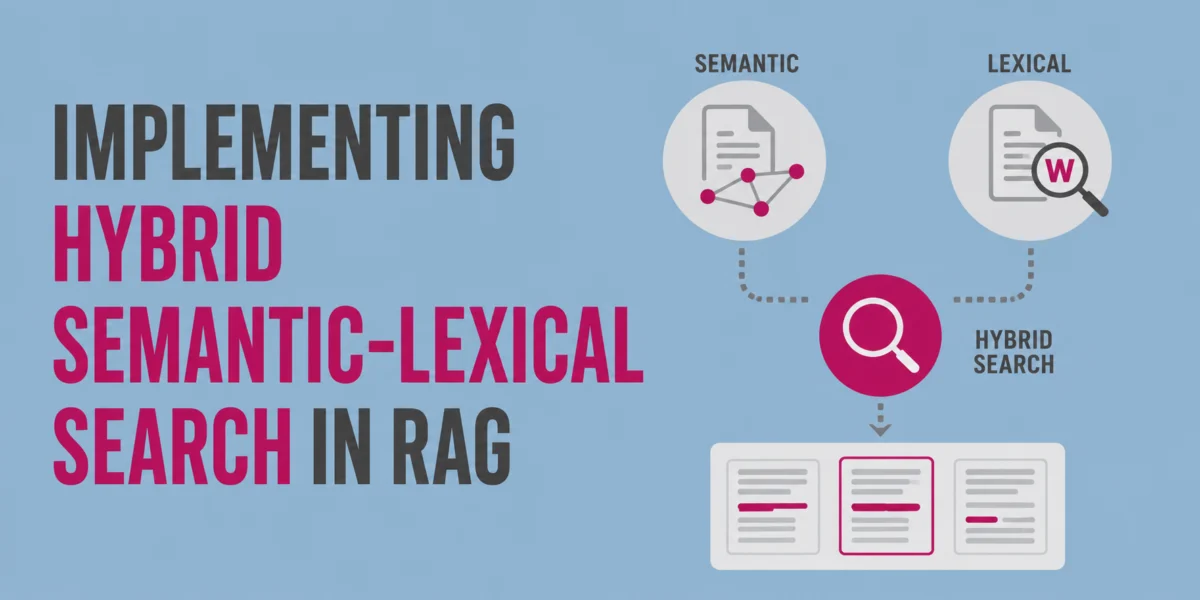

The transition of Retrieval-Augmented Generation (RAG) systems from experimental prototypes to robust, production-ready solutions hinges on the sophistication of their underlying retrieval mechanisms. A critical advancement in this journey is the adoption of hybrid search strategies, which meticulously combine the precision of lexical keyword matching with the contextual understanding of semantic search, unified through advanced ranking algorithms like Reciprocal Rank Fusion (RRF). This integrated approach is rapidly becoming the industry standard for enhancing the accuracy and relevance of information retrieved for Large Language Models (LLMs), effectively mitigating common challenges such as hallucination and providing more grounded, authoritative responses.
Understanding Retrieval-Augmented Generation (RAG)
RAG systems represent a paradigm shift in how LLMs interact with external knowledge. By augmenting LLMs with the ability to retrieve pertinent information from a vast, external knowledge base, RAG significantly enhances their capacity to generate accurate, relevant, and up-to-date responses. This architecture is particularly vital for enterprise applications where LLMs need to access proprietary data, provide factual answers, or cite sources. The core premise involves two main stages: retrieval, where relevant documents or passages are identified from a corpus, and generation, where the LLM synthesizes an answer based on the retrieved information and the user’s query. The efficacy of the entire system, therefore, is profoundly dependent on the quality and robustness of its retrieval component. Poor retrieval leads to "garbage in, garbage out," diminishing the LLM’s performance and trustworthiness.
The Dual Imperative: Lexical and Semantic Search
Traditionally, search systems have evolved along two distinct paths, each with inherent strengths and limitations:
-
Lexical Search (Keyword-Based): Methods like BM25 (Best Match 25), a probabilistic information retrieval algorithm, excel at identifying documents containing exact or highly similar keywords to the user’s query. It operates by analyzing term frequency, inverse document frequency, and document length, effectively weighting the importance of terms within a document and across the entire corpus.
- Strengths: Highly effective for queries requiring precise keyword matches, robust for domain-specific jargon, and capable of retrieving documents even if the semantic context is slightly off but keywords are present. It handles out-of-vocabulary terms well if they exist in the index.
- Limitations: Struggles with synonyms, polysemy (words with multiple meanings), and understanding the broader intent or context of a query. For instance, a query about "car" might not retrieve documents using "automobile" or "vehicle."
-
Semantic Search (Meaning-Based): Fueled by dense vector embeddings, semantic search transforms text into numerical representations that capture its underlying meaning and context. These embeddings are generated using sophisticated deep learning models, often transformer-based, which allow the system to understand relationships between words and phrases, even if they don’t share common keywords.
- Strengths: Exceptional at understanding synonyms, contextual nuances, and user intent. It can retrieve highly relevant documents even if the exact keywords are not present, provided the semantic meaning aligns with the query. This is crucial for natural language queries.
- Limitations: Can sometimes "miss" highly specific keyword matches if the embedding space doesn’t perfectly capture the precise lexical distinction. It might also suffer from "semantic drift" where very specific, uncommon terms might not be as accurately represented in a generalized embedding space. Furthermore, computational resources for generating and storing embeddings, especially for vast corpora, can be significant, often necessitating specialized vector databases.
The inherent "blind spots" of each method highlight why relying solely on one is insufficient for complex, real-world RAG applications. Industry analysis consistently points to the necessity of combining these approaches to achieve comprehensive and reliable retrieval performance, especially as RAG systems scale to handle diverse user queries and massive knowledge bases.
The Hybrid Search Imperative: Bridging the Gap
The recognition of these complementary strengths and weaknesses has driven the development and widespread adoption of hybrid search strategies. By combining lexical and semantic search, RAG systems can leverage the best of both worlds: the keyword precision of BM25 for direct matches and the contextual understanding of semantic embeddings for conceptual relevance. This fusion ensures higher recall (retrieving all relevant documents) and improved precision (retrieving only relevant documents), leading to a significantly more robust and accurate retrieval pipeline.
The journey from a rudimentary RAG prototype to a production-ready solution invariably involves this pivot to hybrid retrieval. Early prototypes often begin with semantic search due to its immediate appeal in handling natural language. However, as systems encounter varied user queries and diverse datasets, the limitations of a singular approach become apparent, necessitating the integration of lexical methods. This evolution reflects a broader trend in AI development, where multi-modal or hybrid approaches often yield superior results compared to monolithic systems.
Reciprocal Rank Fusion (RRF): The Gold Standard for Ranking
A pivotal component in a hybrid search strategy is the method used to combine the ranked lists generated by the individual lexical and semantic search engines. Simply adding raw scores from disparate systems is problematic due to their differing numeric scales and distributions. This is where Reciprocal Rank Fusion (RRF) emerges as the industry’s preferred solution.
RRF is an unsupervised rank aggregation method that combines multiple ranked lists into a single, unified ranking. Its elegance lies in its simplicity and robustness: for each document, it calculates a fusion score by summing the reciprocal of its rank across all contributing search results. The formula for RRF is typically:
$RRF_score = sum_r in Ranks frac1k + rank(d, r)$
Where:
- $rank(d, r)$ is the rank of document $d$ in the list $r$.
- $k$ is a constant (commonly set to 60, following academic convention) that ensures that low-ranked documents still contribute a small but meaningful score, preventing a single high rank from disproportionately dominating the fusion.
Why RRF is Superior:
- Scale Invariance: RRF operates on ranks, not raw scores, making it immune to the differing numerical scales of lexical (e.g., BM25 scores) and semantic (e.g., cosine similarity scores) search outputs.
- Robustness: It inherently rewards documents that appear consistently high across multiple search lists, indicating strong relevance across different retrieval modalities. Documents that appear very high in one list but low in others will still get a boost, but not as much as those consistently highly ranked.
- Simplicity: Despite its effectiveness, the underlying calculation is straightforward, making it computationally efficient and easy to implement.
- Industry Acceptance: RRF has been widely adopted in information retrieval research and production systems due to its proven efficacy in improving overall search quality.
Architectural Overview of Hybrid RAG Implementation
Implementing a hybrid search strategy involves a systematic, multi-stage process:
-
Data Ingestion and Preprocessing:
- The raw text documents forming the knowledge base are first loaded.
- For lexical search (BM25), documents are tokenized (split into words) and often lowercased.
- For semantic search, the same documents are encoded into dense vector embeddings using a pre-trained sentence transformer model (e.g.,
all-MiniLM-L6-v2). These embeddings are typically stored in a vector database for efficient similarity search.
-
Parallel Search Execution:
- When a user query is received, it undergoes similar preprocessing: tokenization for lexical search and embedding generation for semantic search.
- Both lexical (BM25) and semantic searches are executed in parallel against their respective indices (tokenized corpus for BM25, vector database for semantic).
- Each search returns a ranked list of documents, along with their individual scores (though only ranks are used for RRF). It’s common practice to retrieve a larger
top_kfrom each individual search than the final desiredtop_kto ensure a broader pool for fusion.
-
Reciprocal Rank Fusion:
- The ranked lists from the lexical and semantic searches are then fed into the RRF algorithm.
- An RRF score is calculated for each document in the combined set of retrieved documents, based on its rank in each individual list.
- Documents are then sorted by their final RRF scores to produce a single, unified, and optimized ranked list.
-
Retrieval and Generation:
- The top-
kdocuments from the RRF-fused list are selected. - These highly relevant documents are then passed to the LLM as context, enabling it to generate an informed and accurate response to the user’s query.
- The top-
This modular architecture allows for flexibility, enabling individual search components to be optimized independently or even swapped out for newer algorithms as they emerge.
Illustrative Scenario: The "Rice Fields" Query
Consider a user query: "Which nation is best known for rice fields and paddies?"
- A pure semantic search might prioritize documents about countries conceptually linked to agriculture or specific geographical regions known for rice cultivation, even if the exact terms "rice fields" or "paddies" are not frequently mentioned. For instance, it might rank "Vietnam.txt" or "Thailand.txt" highly due to their broader association with rice farming culture.
- A pure lexical search (BM25) would heavily favor documents that explicitly contain the keywords "rice," "fields," and "paddies." It might rank "Indonesia.txt" or "Japan.txt" higher if those specific terms appear more frequently in those documents, regardless of the overall semantic context.
- A hybrid search with RRF would combine these signals. If "Vietnam.txt" ranks highly in semantic search (due to conceptual relevance) and "Indonesia.txt" ranks highly in lexical search (due to keyword density), RRF would provide a balanced score. If "Thailand.txt" appears reasonably high in both lists, its RRF score would be significantly boosted, potentially placing it at the top, offering a more comprehensive and accurate result than either method alone. This balancing act ensures that both explicit keyword presence and implicit semantic understanding contribute to the final retrieval decision, leading to a more satisfying user experience.
The Broader Impact on Enterprise AI and User Experience
The implementation of hybrid search with RRF is not merely a technical optimization; it has profound implications for the utility and adoption of RAG systems in critical enterprise environments:
- Enhanced Reliability: By mitigating the weaknesses of individual search methods, hybrid RAG systems offer more reliable and consistent retrieval, reducing instances of irrelevant or incomplete information being fed to the LLM.
- Improved User Satisfaction: Users benefit from more accurate, contextually relevant, and comprehensive responses, fostering greater trust in the AI system. This is crucial for applications like customer service bots, internal knowledge bases, and research tools.
- Scalability and Robustness: As knowledge bases grow exponentially, hybrid strategies provide the necessary robustness to navigate vast amounts of information effectively, ensuring that the RAG system remains performant and accurate.
- Future-Proofing: The modular nature of hybrid search allows for easier integration of future advancements in both lexical and semantic retrieval technologies, ensuring that RAG systems can evolve without complete architectural overhauls.
- Competitive Advantage: Organizations deploying RAG systems with sophisticated hybrid search capabilities gain a competitive edge by delivering superior AI-powered applications that can handle a wider range of user queries with greater precision.
Challenges and Future Directions
While hybrid search offers significant advantages, it also presents its own set of considerations. The computational overhead of running two parallel search pipelines and the storage requirements for both tokenized text and vector embeddings can be higher than a single-modality approach. Optimizing model inference speed and efficiently managing large-scale vector databases are ongoing areas of development.
Future research and development in this domain are exploring more dynamic weighting mechanisms for lexical and semantic components, potentially adapting based on query characteristics. Furthermore, integrating advanced re-ranking models (often smaller, specialized LLMs) after the RRF stage can further refine the retrieved document list, providing an additional layer of relevance filtering. The interplay between these components will continue to shape the next generation of highly effective RAG systems.
In conclusion, moving beyond a singular search approach to embrace hybrid semantic-lexical retrieval, anchored by robust fusion techniques like Reciprocal Rank Fusion, is a non-negotiable step for organizations aiming to deploy production-grade RAG systems. This strategy not only enhances the accuracy and reliability of information retrieval but also solidifies the foundation for building intelligent, trustworthy, and highly performant AI applications capable of meeting the complex demands of real-world scenarios.
