

The landscape of artificial intelligence is undergoing a seismic shift, driven by the introduction of increasingly powerful, yet costly, large language models. Anthropic’s recent release of Claude Fable 5 has ignited a critical discussion around AI model selection, moving the focus from raw benchmark performance to strategic utilization and cost-effectiveness. This evolution necessitates a new skill set for AI practitioners: the ability to intelligently route tasks to the most appropriate model, a capability that is rapidly becoming the differentiator between efficient and exorbitant AI deployments. The recent US government directive to Anthropic, halting access to Fable 5 and Mythos 5 shortly after their launch, underscores the volatility and emergent complexities of this rapidly developing field, highlighting the precariousness of relying on any single model.
The core of this transformation lies in the understanding that the most advanced AI models, while offering unparalleled capabilities, are not intended for ubiquitous, default use. Instead, their true value is unlocked when employed for specific, high-complexity tasks, such as planning, orchestration, and intricate analysis. For the bulk of routine operations, less expensive and more accessible models can deliver comparable, if not identical, results at a fraction of the cost. This paradigm shift is not merely a temporary trend but a fundamental recalibration driven by the underlying economics of AI development and deployment, a trend amplified by the impending price wars among major AI providers.
The Strategic Deployment of Fable: Efficiency Through Orchestration
Early adopters and astute observers of AI have quickly recognized the strategic advantage of employing advanced models like Fable 5 judiciously. Instead of running every task through the most powerful model, the emerging best practice involves using it as an orchestrator or a high-level planner. This approach significantly reduces the operational costs associated with AI utilization without compromising on the quality of the final output.
Dan McAteer, through a shared workflow, illustrated how Fable can be integrated into a system to handle the most reasoning-intensive aspects of a task. By designating Fable as the orchestrator and leveraging its intelligence for complex phrases, users can avoid overwhelming its capacity and exceeding usage limits. McAteer’s succinct observation, "Fable is so overpowered that you don’t need its intelligence for every step," encapsulates this efficient model.
CJ Zafir further elaborated on this strategy, reporting a halving of his weekly Claude Code limit consumption. His workflow involved using Fable for the initial planning phase, then delegating the execution of the task to OpenAI’s Codex 5.5, and finally employing Fable again for a comprehensive review. This layered approach optimizes resource allocation, ensuring that Fable’s premium capabilities are reserved for where they are most impactful.
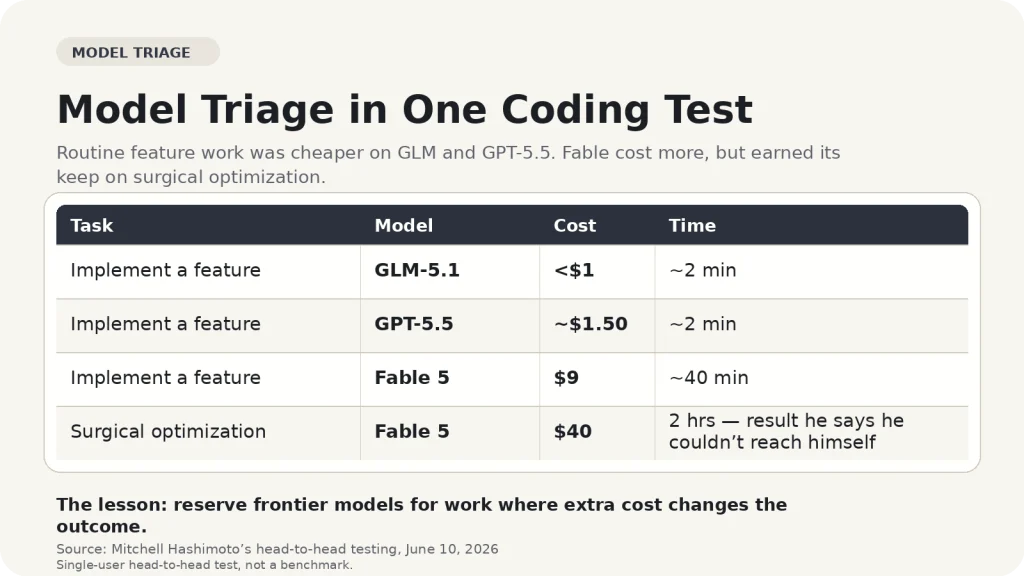
Mitchell Hashimoto provided quantitative evidence supporting this tactical approach. His extensive testing revealed that for standard "implement this feature" tasks, Fable, GPT-5.5, and Zhipu’s GLM-5.1 all produced equally acceptable outcomes. However, the cost and time differentials were stark. GLM-5.1, costing under a dollar, completed the task in minutes. GPT-5.5 incurred a cost of approximately $1.50. In contrast, Fable consumed 40 minutes and cost $9 for the same basic task.
The true differentiator for Fable emerged when presented with a complex problem: optimizing a SwiftUI-layout resolver written in Go. Fable tackled this challenge, taking two hours and costing $40, to achieve a level of performance that Hashimoto himself could not replicate. This outcome solidified his recommendation: Fable should be reserved for "targeted, surgical analysis and work," rather than being used for everyday operations. This concept of "model triage" – selecting the right tool for the right job – is becoming paramount.
Morgan Linton’s commentary on a benchmark, "Fable low is better than Opus and GPT high. Try it," further emphasizes this point. This is not a simple performance review but a directive for strategic routing, suggesting that even Fable’s less intensive modes can outperform other leading models on specific tasks.
The Economic Imperative for Model Triage
The pricing structure of advanced AI models like Fable 5 is a primary driver for this shift towards strategic deployment. Anthropic’s API pricing for Fable stands at $10 per million input tokens and $50 per million output tokens. This is precisely double the rate of Opus 4.8. Within subscription plans, Fable’s usage counts approximately twice that of Opus against allocated limits. This pricing, coupled with its limited availability within subscription plans until June 23, suggests a deliberate strategy to encourage judicious use. After this date, Fable will require separate usage credits billed at full API rates.

Anthropic has stated that this pricing reflects Fable’s advanced capabilities and that it intends to reintegrate it into subscriptions when feasible. However, the short subscription window can be interpreted as a temporary subsidy for a model that the company cannot yet afford to position as a default option. This economic reality forces organizations to re-evaluate their AI spending.
Citadel Securities’ "Tokenomics" report aligns with this perspective, arguing that expectations for agentic AI were built on an "unrealistic expectation of frictionless deployment costs." The report highlights an emerging divergence: frontier inference capabilities are consolidating among organizations that can justify the significant expenditure, while others are transitioning to more cost-effective models.
Evidence of this market shift can be observed in the decline of Silicon Data’s LLM Expenditure Index. This index can decrease due to falling model prices, the adoption of more efficient models, or a market move away from concentrated, high-cost deployments. A recent arXiv study further corroborates this at the task level, demonstrating that agentic coding can consume up to 1,000 times more tokens than ordinary code chat. Moreover, identical runs can exhibit variations of up to 30x, with no reliable correlation between increased token usage and improved accuracy. This data underscores the pervasive nature of model triage, operating at both micro and macro levels.
An interesting economic debate arises from the current token pricing. While Fable’s cost for complex optimization tasks might seem high, Hashimoto’s $40 optimization run could have cost multiples of that in engineering time and resources. This suggests that, in certain specialized applications, Fable might actually be underpriced relative to the human capital it can displace. The market’s current discourse, however, leans towards Fable being overpriced for general use. If frontier tokens are indeed mispriced – too expensive for routine tasks and too inexpensive for highly specialized, complex work – then the skill of model selection becomes even more critical, not less.
The Price Wars Intensify the Need for Routing Intelligence
The competitive landscape of AI is heating up, with major players like OpenAI reportedly considering significant price cuts to their token rates. This move, aimed at preempting a user war with Anthropic as both companies approach potential IPOs, will further complicate the AI ecosystem. Sam Altman of OpenAI has acknowledged that token costs have become a "huge issue," noting that companies often exhaust their annual AI budgets in the first quarter. Uber’s CTO confirmed this, stating that their company experienced precisely this scenario. The burgeoning "cleanup business" for AI cost observability, as detailed by Chris J. Preimesberger, is a direct consequence of this spending anxiety.
While cheaper tokens might seem like a relief, they do not eliminate the fundamental problem of model selection; in fact, they amplify it. Every price adjustment alters the calculus for answering the most critical question: "Which model should execute this task?" The sheer volume of these decisions is escalating due to the increasing prevalence of "loop engineering."
Janakiram MSV’s insightful article on "Loop engineering" highlights this paradigm shift. This practice involves designing automated agent workflows rather than direct prompting. Boris Cherny, head of Claude Code at Anthropic, exemplifies this trend, stating, "I don’t prompt Claude anymore. I write loops and the loops do the work." Within these engineered loops, numerous decisions revolve around model selection: which model will orchestrate, which will execute, and which will certify the output. McAteer’s and Zafir’s efficient workflows are prime examples of loop engineering with an embedded cost optimization function.
The need for transparency and supervision in these complex, multi-model workflows is also gaining traction. Matt Shumer proposed a "supervision layer" where a long-running Fable process appends timestamped updates to a persistent HTML page. This allows users to track the progress of intricate tasks, transforming the experience from mere prompting to active supervision of a team of AI agents, each with its own cost profile and assigned responsibilities. This shift fundamentally redefines the role of the AI practitioner, moving from prompt engineer to a manager of AI resources, tasked with optimizing performance and cost across a diverse and evolving set of models.
The recent development where the US government mandated Anthropic to disable access to Fable 5 and Mythos 5, just days after their release, serves as a stark reminder of the external factors that can impact AI model availability. The government cited a discovered method for "jailbreaking" the models, a technique Anthropic reportedly assessed as minor and present in other public models. Regardless of Anthropic’s assessment and their efforts to restore access, the incident underscores the inherent volatility in the AI landscape. A model that a user might be integrating into their workflow can, as demonstrated, be rendered inaccessible overnight. This unpredictability further amplifies the importance of a robust model selection strategy, making the ability to pivot to alternative solutions the paramount skill for navigating the future of AI-driven industries. The incident, occurring just before the publication of this analysis, inadvertently sharpened the central thesis: adaptability and informed model choice are not just advantageous, they are essential for survival and success in the dynamic world of artificial intelligence.
