
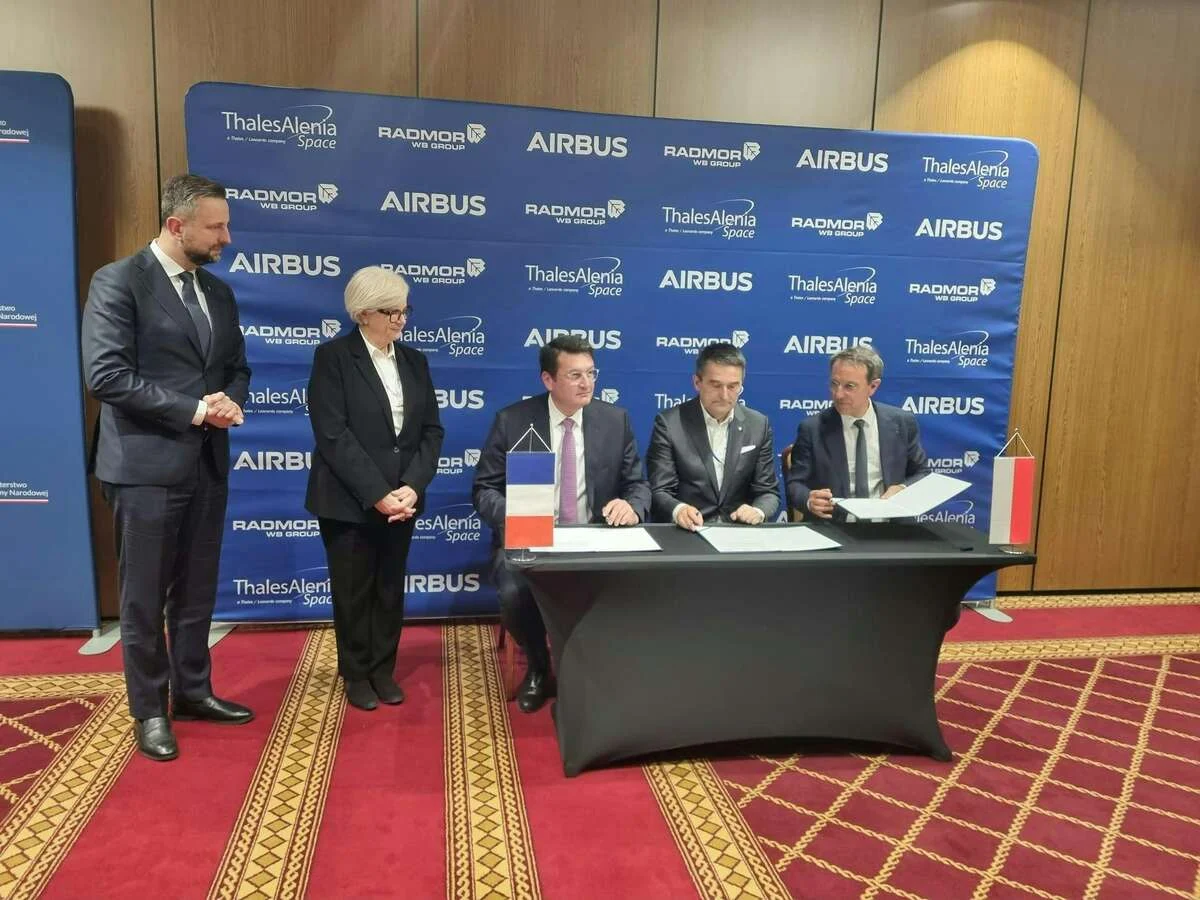

The Polish Ministry of Defence has officially entered into a landmark agreement with a consortium of European aerospace leaders to develop and deploy the nation’s first dedicated military Geostationary Orbit (GEO) telecommunications satellite, marking a significant leap in Warsaw’s independent command and control capabilities. The contract, signed during a high-level diplomatic summit between Polish and French defense officials on April 20, brings together the technical expertise of Thales Alenia Space, Airbus Defence and Space, and the prominent Polish electronics manufacturer Radmor. This tripartite industrial collaboration is designed to provide the Polish Armed Forces with a secure, resilient, and fully sovereign communication infrastructure, ensuring that Poland remains at the forefront of defense technology within the North Atlantic Treaty Organization (NATO) and the European Union.
The signing ceremony featured Polish Defence Minister Władysław Kosiniak-Kamysz and French Minister of the Armed Forces Catherine Vautrin, highlighting the deepening bilateral defense ties between Warsaw and Paris. As Poland continues to aggressively modernize its military in response to shifting security paradigms in Eastern Europe, the acquisition of a dedicated GEO satellite represents a shift from reliance on commercial or allied bandwidth toward a self-contained, national space segment. This project is not merely an equipment purchase but a comprehensive end-to-end system development that includes the satellite bus, specialized military payloads, mission control segments, and a robust ground infrastructure capable of withstanding sophisticated electronic warfare and cyber-attacks.
Technical Scope and Industrial Synergy
The development of the Polish GEO satellite will leverage the specific strengths of each partner involved in the consortium. Thales Alenia Space and Airbus Defence and Space, two of the world’s most experienced satellite manufacturers, will take the lead on the satellite platform and the complex telecommunications payload. Their involvement ensures that the satellite will be built on proven architectures, such as the Spacebus NEO or Eurostar platforms, which are known for their longevity and high-power capacities.
The payload is expected to include advanced X-band and Ka-band transponders, which are the standard for high-security military communications. These frequencies allow for high-throughput data transfer, essential for modern battlefield management systems, real-time drone surveillance feeds, and secure voice communications between high-level command structures and field units.
A critical component of this agreement is the involvement of Radmor, a subsidiary of the WB Group and a cornerstone of the Polish defense industry. Radmor’s role is pivotal for ensuring "national sovereignty," as the company will be responsible for integrating the satellite system with Poland’s existing tactical communication networks. By involving a domestic manufacturer, the Polish Ministry of Defence ensures that the encryption protocols and ground-based user terminals remain under national oversight, reducing the risk of third-party interference and fostering local industrial growth in the high-tech aerospace sector.
Strategic Context: The Evolution of Polish Defense Posture
The decision to invest in a dedicated military satellite comes at a time when Poland is significantly increasing its defense spending, which has reached approximately 4% of its Gross Domestic Product (GDP)—the highest percentage among all NATO members. This massive investment is driven by the necessity to modernize the Polish Armed Forces following the full-scale invasion of Ukraine by Russia in 2022.
Historically, Poland has relied on a mix of commercial satellite services and access to shared NATO assets for its long-range communications. However, the conflict in Ukraine has demonstrated that in a high-intensity environment, commercial systems can be vulnerable to jamming or restricted by the providers themselves. By owning and operating its own GEO satellite, Poland gains "freedom of action," allowing the military to prioritize its own data traffic during crises without having to compete for bandwidth on shared platforms.
The GEO orbit choice is also strategic. Unlike Low Earth Orbit (LEO) constellations, which require hundreds of satellites to provide continuous coverage, a single GEO satellite remains fixed over a specific point on the Earth’s surface. For Poland, this means a permanent, unblinking eye and a constant communication link over the European theater, providing a stable backbone for the "Eastern Shield"—Poland’s comprehensive border defense and surveillance program.
Timeline and Developmental Milestones
While the April 20 announcement did not provide a specific launch date, industry standards for the design, construction, and testing of a military-grade GEO satellite typically range from four to six years. The project is expected to follow a rigorous development timeline:
- Requirement Definition and Design Phase: In this initial stage, the Polish MoD and the consortium will finalize the technical specifications, focusing on the specific anti-jamming and cybersecurity features required for the Polish theater of operations.
- Manufacturing and Integration: The satellite bus will be constructed in the facilities of Airbus or Thales, while Radmor begins the development of the ground-based control stations and specialized user terminals.
- Ground Segment Deployment: Before the satellite is launched, a network of secure ground stations must be established within Polish territory. These stations will handle the telemetry, tracking, and control (TT&C) of the satellite.
- Launch and In-Orbit Testing (IOT): Once launched—likely via a European heavy-lift rocket such as the Ariane 6—the satellite will undergo months of testing to ensure all systems are functioning in the harsh environment of space.
- Full Operational Capability (FOC): Upon successful testing, the system will be handed over to the Polish Armed Forces for active duty.
This project follows Poland’s 2022 acquisition of two high-resolution Earth observation satellites from Airbus, which are scheduled for delivery and launch in the coming years. Together, the observation and telecommunications satellites will provide Poland with a dual-layered space capability: one for seeing the battlefield and one for communicating across it.
Resilience and Cybersecurity in a Contested Environment
One of the most emphasized aspects of the new contract is the focus on resilience. Modern space assets face a variety of threats, ranging from cyber-attacks on ground stations to electronic jamming of signals and even physical threats in orbit. Hervé Derrey, President and CEO of Thales Alenia Space, noted that the project would embody the "highest standards of resilience, cybersecurity, and anti-jamming technologies."
To achieve this, the satellite will likely employ "frequency hopping" and "nulling" technologies. Frequency hopping allows the signal to move rapidly across different frequencies to avoid being targeted by jammers, while nulling allows the satellite’s antennas to ignore signals coming from the direction of a known jammer. Furthermore, the end-to-end encryption will be designed to meet the most stringent NATO standards, ensuring that even if a signal is intercepted, it remains unreadable to adversaries.
The ground segment is equally critical. The agreement includes the creation of a secure "mission control" within Poland. This ensures that even if international networks are compromised, the Polish military maintains a direct, physical link to its satellite assets. This move is a direct response to the "hybrid warfare" tactics seen in recent years, where cyber-attacks are used to disable infrastructure before a shot is ever fired.
Official Responses and Diplomatic Implications
The partnership has been hailed as a triumph of European industrial cooperation. During the talks, Minister Władysław Kosiniak-Kamysz emphasized that "sovereignty in space is as important as sovereignty on the ground." He noted that this investment is a key pillar of the Polish Space Strategy, which aims to build a comprehensive ecosystem of satellite capabilities by 2030.
French Minister Catherine Vautrin echoed these sentiments, suggesting that the deal strengthens the "European pillar" of NATO. By collaborating with French-based entities like Thales and Airbus, Poland is reinforcing its role as a central player in European defense procurement, moving away from its traditional heavy reliance on American-made systems. This shift is seen by analysts as a strategic move to diversify Poland’s defense suppliers and foster a more integrated European defense industrial base.
Industry leaders have also expressed their commitment to the project. The involvement of Radmor is particularly significant for the Polish economy. As a local partner, Radmor will gain access to advanced satellite integration techniques, which can then be applied to other areas of the Polish tech sector, creating high-value jobs and fostering innovation.
Broader Impact and Future Outlook
The implications of this contract extend far beyond the immediate communication needs of the Polish Army. It represents a fundamental change in how middle-power nations approach space. In the past, dedicated military satellites were the exclusive domain of global superpowers. Today, through strategic partnerships and increased defense budgets, countries like Poland are proving that national space sovereignty is an attainable and necessary goal.
Furthermore, this satellite will enhance Poland’s contribution to NATO collective defense. In the event of a conflict on the alliance’s eastern flank, Poland’s ability to provide secure, high-capacity communication links could be vital for the coordination of multinational task forces. It also positions Poland as a potential provider of "space-as-a-service" for smaller regional allies who may not have the resources to launch their own satellites but require secure communications.
As the project moves forward, the focus will shift to the integration of this space asset with other high-tech acquisitions, such as the F-35 Lightning II aircraft, Patriot missile systems, and the newly ordered Abrams and K2 tanks. All of these platforms rely heavily on data and connectivity. By securing the "high ground" of geostationary orbit, Poland is ensuring that its multi-billion dollar investments in land and air power will have the communication backbone necessary to function in the complex, contested battlefields of the 21st century.
In conclusion, the agreement between the Polish Ministry of Defence, Thales Alenia Space, Airbus, and Radmor is a transformative step for Poland’s national security. It addresses the urgent need for secure communications in an era of renewed geopolitical tension while simultaneously building the domestic industrial capacity required for long-term technological independence. As the "Final Frontier" becomes an increasingly crowded and contested domain, Poland’s move to secure its own GEO satellite ensures that its voice will remain clear and its command structure remains unbroken, regardless of the challenges that may arise on the ground or in the stars.
