
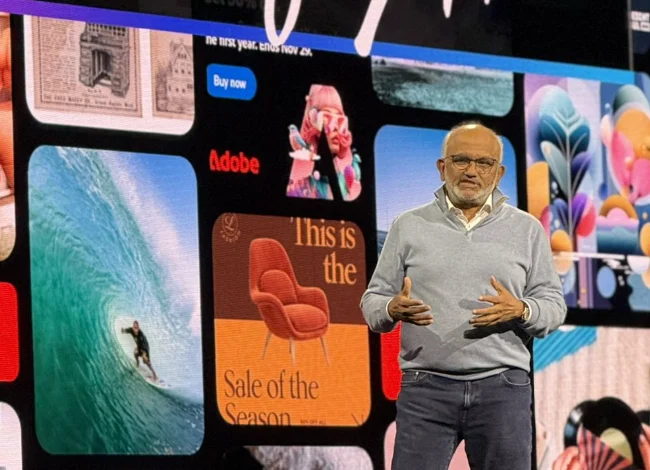

The Adobe Summit 2024 in Las Vegas served as a pivotal moment for Adobe Inc., marking what is widely expected to be the final keynote appearance for Shantanu Narayen in his current capacity as Chief Executive Officer. Following the announcement of his impending departure last month, the industry veteran took the stage to outline a strategic roadmap that places generative artificial intelligence at the center of the company’s future. Narayen’s address to analysts and attendees focused on the democratization of creativity, the convergence of productivity and design, and the transition of enterprise AI from theoretical transformation to practical execution.
Under Narayen’s 17-year leadership, Adobe has undergone significant structural shifts, most notably the 2012 transition from perpetual licensing to a cloud-based subscription model. As the search for his successor continues, Narayen emphasized that the company’s core mission remains unchanged: empowering every individual, from hobbyists to professional creators, to bring their visions to life. This mission is now being supercharged by the integration of AI-powered conversational interfaces and "quick-and-easy" applications designed to bridge the gap between technical skill and creative output.
The Strategic Convergence of Creativity and Productivity
A central theme of the summit was the blurring of lines between creative software and productivity tools. Narayen argued that the modern professional landscape no longer treats these as separate silos. Instead, productivity in the digital age requires a high degree of creative input, and creativity requires the efficiency afforded by modern productivity tools.
Narayen noted that Adobe’s innovation is "ruthlessly" focused on three key audiences: business professionals, consumers, and core creative professionals. By delivering AI-powered applications, Adobe aims to streamline workflows that previously required deep technical expertise. The company’s goal is to enable users to bring any media type to life across any "surface," a term Narayen used to describe the expanding ecosystem of digital environments where content is created and consumed.
The CEO pointed out a significant shift in the content lifecycle. Traditionally, creative content was the sole domain of specialized professionals. Today, that content is increasingly moving from those professionals into the hands of marketing teams and broader enterprise departments. This shift necessitates a new class of tools that allow non-specialists to adapt and deploy high-quality assets without compromising brand integrity.
Navigating the Multi-Surface AI Landscape
As generative AI models like Microsoft Copilot, OpenAI’s ChatGPT, and Anthropic’s Claude gain mainstream adoption, Adobe views these platforms not as competitors, but as additional surfaces for content creation and consumption. Narayen compared the current AI boom to previous technological shifts, such as the move from desktop to mobile and the rise of web browsers. Each new platform represents an opportunity for Adobe to embed its creative engines.
Adobe’s strategy involves ensuring that its core products—Photoshop, Illustrator, Premiere Pro, and the Firefly generative AI suite—support a variety of media generation models. Narayen acknowledged that new AI-first applications are emerging daily, each with different attributes. Adobe’s role, he suggested, is to act as the stabilizing platform that helps customers identify and utilize the right model for specific tasks.
Firefly, Adobe’s family of creative generative AI models, was highlighted as a cornerstone of this strategy. Since its launch, Firefly has been integrated across the Creative Cloud, allowing for "semantic editing," mood board generation, and rapid idea iteration. By positioning Firefly as a "production studio," Adobe is attempting to attract a new generation of users who prioritize speed and AI-assisted workflows over traditional manual editing.
Enterprise Evolution: From Transformation to Execution
For the corporate sector, the focus has shifted from the excitement of "AI transformation" to the necessity of "AI execution." Narayen shared insights from recent executive forums, noting that while the term "transformation" was dominant a year ago, business leaders are now measuring success through tangible execution.
The anxiety surrounding AI’s impact on the workforce appears to be diminishing as tools become more practical. Narayen observed that when enterprise clients see AI agents, "coworkers," and conversational interfaces in action, their response shifts from fear of replacement to an understanding of augmentation. The ability to "do more" with existing resources is the primary driver of enterprise adoption.
Adobe is also pushing the boundaries of "intellectually appropriate" enterprise models. These models are designed to leverage an organization’s proprietary data securely, allowing for personalized content creation that adheres to specific brand guidelines. This level of customization is facilitated by AI coding, which Narayen believes will not replace human developers but will instead lead to a proliferation of customized workflows and applications within the enterprise.
Financial Context and Market Position
The summit’s strategic declarations come at a time of robust financial performance for Adobe. In its most recent fiscal reports, Adobe showcased the scale of its reach, with over 850 million users across its product suite. The company has successfully rebranded its digital marketing efforts under the banners of Customer Experience Management (CXM) and Customer Experience Orchestration.
Supporting data highlights Adobe’s dominance in the creative software market, where it maintains a significant share despite rising competition from agile, web-based platforms like Canva. The integration of Firefly has been a major growth driver; according to company data, users have generated billions of images using Firefly since its beta release in early 2023. This rapid adoption underscores the market’s appetite for "safe-for-commercial-use" AI tools that respect intellectual property rights—a key differentiator for Adobe.
Furthermore, Adobe’s pivot toward "orchestration" addresses a critical pain point for large organizations. As companies deploy multiple AI models and apps, the need for a central platform to manage these disparate workflows becomes paramount. Narayen asserted that Adobe is now the world’s largest provider of marketing technology, uniquely positioned to handle the complexity of multi-channel engagement and commerce.
Timeline of the Narayen Era and AI Integration
The current trajectory of Adobe is the result of a decade-long evolution. A look at the company’s recent chronology illustrates the speed of its AI pivot:
- 2012: Adobe moves to the Creative Cloud subscription model, setting the stage for continuous software updates and cloud-based collaboration.
- 2016: Launch of Adobe Sensei, the company’s first major foray into embedding AI and machine learning across its suite.
- March 2023: Launch of Adobe Firefly, marking the company’s entry into generative AI with a focus on ethical training data.
- December 2023: Termination of the $20 billion Figma acquisition due to regulatory hurdles, leading Adobe to refocus on internal AI development and partnerships.
- March 2024: Announcement of Shantanu Narayen’s transition and the unveiling of new AI "agents" at the Adobe Summit.
The Human Element in an Artificial Intelligence World
Despite the heavy emphasis on automation, Adobe leadership maintains that human intelligence remains the indispensable component of the creative process. David Wadhwani, President of Adobe’s Creativity and Productivity business, provided a sobering counterpoint to the AI hype during the analyst briefing. He noted that generic Large Language Models (LLMs) still lack the "depth and precision" of a professional creator or a specialized marketing professional.
This perspective suggests that Adobe’s long-term strategy is not to replace the professional but to provide a more sophisticated "co-pilot" that understands the nuances of brand, tone, and technical accuracy. The company’s focus on "skills" and "agents" is intended to handle the repetitive, low-value tasks, leaving the high-level conceptual work to the human user.
Implications for the Future of Digital Content
As Adobe enters a period of leadership transition, the legacy Narayen leaves behind is one of a company that successfully navigated two major industry upheavals: the move to the cloud and the rise of generative AI. The broader implication of Adobe’s current strategy is a world where high-fidelity content creation is no longer a bottleneck for businesses.
The move toward "Customer Experience Orchestration" indicates that Adobe intends to be more than just a software provider; it aims to be the operating system for the digital economy. By providing the tools for creation, the models for personalization, and the orchestration for delivery, Adobe is cementing its role as a critical infrastructure provider for the global marketing and media industries.
The search for a new CEO will likely prioritize a leader who can maintain this momentum while navigating the increasingly complex regulatory and ethical landscape surrounding AI. For now, the "Narayen era" concludes with a clear message: the democratization of creativity is no longer just a goal, but an operational reality powered by the execution of artificial intelligence.
