

For years, system logs existed in a state of technical necessity but practical neglect. Mandated for compliance or ingrained as a development best practice, logs were generated, sent to storage – be it an S3 bucket, a SIEM, or a server’s file system – and then largely ignored. This wasn’t due to negligence, but rather the inherent nature of these logs: they were raw dumps of data, requiring significant forensic effort to decipher. The only time these forgotten records were revisited was in the aftermath of an incident, often revealing a critical gap: "We weren’t logging what we should have been." By then, the damage was done, the attacker’s path was obscured, and investigations were hampered by incomplete evidence. This era, where logging was a passive requirement, has definitively ended. The pertinent question has shifted from if logs are being generated to whether they can provide meaningful insights when it truly matters.
The pressure for this transformation has not emanated from a single source but from a confluence of escalating demands across multiple sectors. Regulatory frameworks have tightened, now requiring demonstrable evidence rather than mere assertions of security posture. The U.S. Securities and Exchange Commission’s (SEC) updated disclosure rules have reshaped how public companies communicate security incidents, while in Europe, the NIS2 Directive (EU 2022/2555) has elevated security standards for critical infrastructure. Auditors, once satisfied with a screenshot of a logging policy, now expect to see queryable, timestamped logs directly tied to specific events.
Concurrently, a profound maturation of security awareness within engineering and product development teams has occurred. Developers and product managers are now asking more incisive questions about the underlying technologies they utilize. When evaluating new vendors, security-conscious engineers look beyond certifications like SOC 2 to understand the actual substance of a product’s security logging. This scrutiny has permeated enterprise procurement processes, with security review questionnaires growing more extensive and legal and compliance teams actively requesting audit log samples during vendor evaluations. A product incapable of producing a clean, exportable activity log is now at a significant disadvantage, losing deals it might have secured just a few years prior.
The rise of AI-powered adversaries further compounds the urgency. Attackers are operating at unprecedented speeds, making real-time detection increasingly challenging. In this landscape, logs provide the next best capability: a detailed record of an adversary’s movements, the systems they accessed, and the pattern of their attack. This historical data becomes the bedrock for designing more robust defenses against future threats.
The implications of AI’s increasing integration into operational environments cannot be overstated. AI agents are already provisioning resources, executing purchases, altering account settings, and deleting data within production systems. Gartner’s projections highlight this trend: by 2028, an estimated 33% of enterprise software applications will incorporate agentic AI, a dramatic increase from less than 1% in 2024. Furthermore, by the same year, AI agents are predicted to autonomously make 15% of day-to-day work decisions. Each of these autonomous actions represents a potential audit log entry that was largely non-existent a year ago. The scope of logging is no longer confined to human actions; it now encompasses the activities of AI agents, the authorization mechanisms that govern them, and whether those actions remained within predefined boundaries.
Empirical data underscores the growing significance of robust logging. Verizon’s 2026 Data Breach Investigations Report, analyzing over 22,000 confirmed breaches, revealed that exploitation of vulnerabilities now accounts for 31% of all initial access vectors, surpassing credential abuse for the first time in the report’s 19-year history. Notably, third-party involvement in breaches surged by 60% year-over-year, reaching 48% of all reported incidents. When initial access occurs with such rapidity and across a complex web of external relationships, the logging infrastructure becomes paramount in reconstructing the sequence of events. With approximately one in three breaches initiated by a vulnerability exploited before most teams can patch it, and remediation taking an average of eight months for identified vulnerabilities, logging effectively differentiates between a thorough postmortem analysis and mere conjecture.
The Critical Distinction: A Log vs. A Record

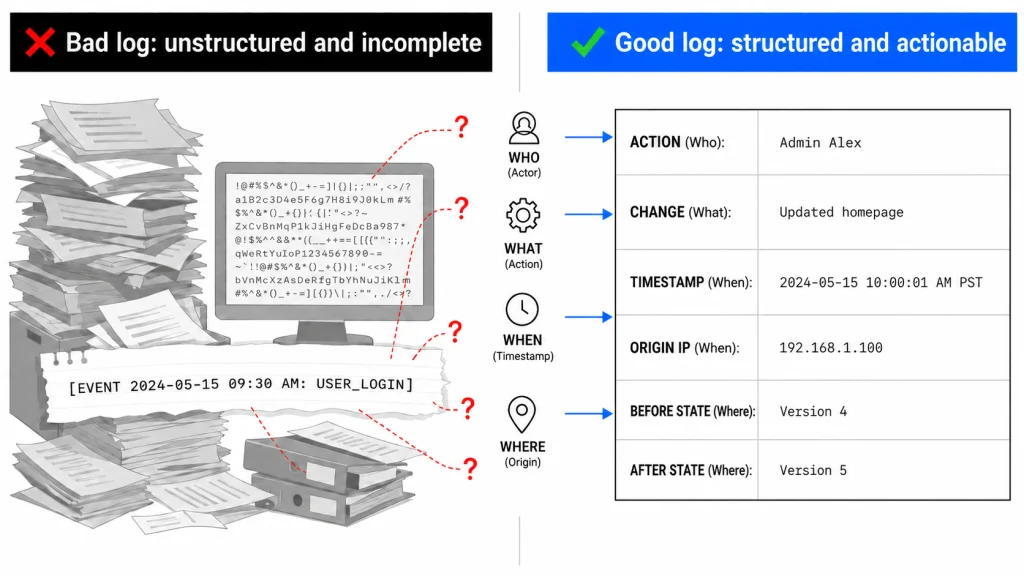
The effectiveness of logging systems varies dramatically, a distinction that often goes unrecognized until critical junctures like audits or active security incidents. Surface-level logging merely indicates that an event occurred. A true audit trail, however, captures the complete context surrounding that event: who initiated the action, the precise modifications made, the exact time of occurrence, the origin of the request, and the system’s state both before and after the change. This fundamental difference between an event notification and a comprehensive activity record dictates whether a log can merely confirm an occurrence or actively reconstruct an entire incident.
This requirement becomes even more pronounced when the actor is not human. In a purely human-driven environment, investigators can sometimes infer intent by examining surrounding behaviors. However, when an AI agent acts autonomously, this ambient context is absent. In such scenarios, the audit trail serves as the sole source of truth. A complete activity record in an agentic environment must capture not only the action itself but also the agent’s identity, the authorization chain that triggered the action, and the defined scope within which the agent was intended to operate.
SOC 2 compliance further emphasizes this need. Several of its Common Criteria, particularly Type II, mandate evidence of logged system access, tracked changes to data and configurations, and the retention of tamper-evident records. A log entry stating simply "user logged in" is insufficient. A more robust log capturing the user, timestamp, IP address, session ID, and the authentication method used (standard or elevated) moves closer to meeting these requirements. The practical test for any logging system is straightforward: if an incident occurred six months ago, could your logs clearly reconstruct the sequence of events to brief a board, respond to a regulator, or hand over to a forensic investigator? If the answer is anything less than a confident "yes," the logs are not yet operationally effective.
Actionable security logging necessitates several non-negotiable features. Logs must be immutable to serve as trusted evidence. They need to be structured for efficient querying, not just passive reading. Crucially, they must capture the correct events, encompassing user actions, system modifications, access grants and revocations, and configuration changes – not solely authentication events. Retention policies are also a critical consideration. While 30 days of hot storage might suffice for some tools, investigations may necessitate six months or more of contextual data. The ease with which historical logs can be retrieved directly impacts a tool’s credibility during incidents and investigations, and ultimately, the effectiveness of the security teams relying on it.
Your Logging Infrastructure: A New Revenue Asset
Historically, a well-instrumented audit trail was an internal asset, residing within a SIEM and primarily serving the security team and auditors. Today, its role has expanded significantly, becoming a factor in sales cycles. Enterprise buyers are increasingly scrutinizing audit trails during procurement, and legal teams are reviewing them before contracts are finalized. Trust centers that present clean, structured security data are now being indexed by AI-powered procurement tools, which can summarize vendor risk before human intervention.
This paradigm shift places security teams in a unique position. The diligent work of building reliable logging, maintaining tamper-evident records, and structuring events for queryability is now directly linked to revenue generation. Buyers who can access a clear audit trail can expedite the procurement process. Deals that might have stalled during security reviews can now close more smoothly due to the immediate availability of credible evidence.
The Storm-0558 incident in 2023 serves as a stark, high-stakes illustration of this principle. A China-linked threat actor exploited a stolen Microsoft signing key to forge tokens and access mailboxes belonging to officials within the U.S. State Department and Department of Commerce, resulting in the exfiltration of approximately 60,000 unclassified emails. The State Department was able to detect this intrusion due to its subscription to a higher tier of Microsoft Purview Audit logging, which included mailbox access events. Other affected agencies on lower tiers lacked this crucial visibility. Following pressure from CISA and the U.S. Cyber Safety Review Board, Microsoft subsequently made these audit logs accessible to all customers, regardless of license tier, within months. The industry-wide takeaway was unequivocal: logging is not a premium feature.

This represents a competitive differentiator that is often overlooked. Sales teams cannot manufacture trust during a security review; they can only leverage what has already been built. Security teams that excel at instrumenting audit trails provide sales with tangible proof of their organization’s commitment to security. The opportunity extends beyond accelerating deal closures; it involves presenting a distinct advantage in a market where many vendors still treat logging as a purely internal function. Enterprise buyers, increasingly leveraging AI-assisted workflows, are accountable to their boards and regulators when incidents occur. If a product within their technology stack cannot provide a clear record of an AI agent’s actions and its authorization, that product becomes a liability. Transparent, accessible audit trails signal maturity and a proactive approach to accountability in an era where actors are not always human. In the realm of enterprise sales, this signal carries significant weight.
Logging as a Product, Not Merely a Process
A distinction exists between audit logging that operates solely behind the scenes and logging that is integrated as a core component of a product. The gap between these two approaches is narrower than many anticipate, and the rewards for bridging it are substantial. The shift is from a posture of "we have logs, and we can provide them if needed" to "here are your logs, directly within the product, available whenever you require them." This evolution transforms an audit trail from a compliance artifact into a valuable product feature.
Practically, this involves surfacing user activity logs directly within the product dashboard. It means providing account administrators with a clear view of every action taken within their workspace, including who made a change, what was altered, and when. It also entails making these logs easily exportable in formats compatible with a customer’s own SIEM or for direct submission to auditors, eliminating the need for support ticket escalations. The support benefits are often underestimated; a significant portion of "what happened to my account" inquiries can be resolved by customers themselves when provided with self-service visibility into their activity history. This not only reduces friction and builds confidence but also proactively reduces the volume of support escalations.
Webflow exemplifies this integrated approach, employing a tiered logging strategy that treats visibility as both a user experience and a security imperative. At the Enterprise tier, site-level activity is presented directly within the Designer via the Site Activity log, empowering teams to troubleshoot in real time. Every class change, component edit, CMS update, custom code modification, and publish event is logged with author, timestamp, and branch information, and historical entries are never rewritten. This in-product visibility transforms the audit trail from a back-office compliance burden into a collaborative tool for site governance.
For stringent security and compliance requirements, a separate Workspace audit log API provides access to granular, security-relevant events crucial for incident response. This includes logins, access grants, permission and role changes, invitation flows, and Workspace setting modifications. Designed from its inception to integrate with enterprise logging platforms, it offers one-year retention and AES-256 encryption at rest. By bifurcating these capabilities, Webflow ensures that logging supports daily workflows while meeting the rigorous demands of security investigators. This model represents a fundamental shift: logging ceases to be an incidental byproduct of a product and becomes a distinct competitive advantage offered by that product.
This architectural approach directly addresses a challenge confronting all security teams: distinguishing human actions from AI-assisted actions within the same audit trail. As AI features become integrated into content workflows—generating copy, suggesting design modifications, or altering CMS entries—activity logs must answer a question they were not originally designed to address: was this action initiated by a person or by an AI? Webflow’s Site Activity Log now displays AI attribution alongside human edits, allowing users to ascertain whether a human or an AI agent initiated a change. This is not a minor enhancement to logging; it represents a fundamental restructuring of accountability in products where AI is a primary actor.
The authorization layer completes this picture. Understanding that an AI agent performed an action is only valuable when coupled with knowledge of the permissions that enabled that action and whether those permissions aligned with the agent’s intended scope. This is where access control and audit logging converge. The Workspace Audit Log captures role changes and permission grants, enabling reconstruction not only of what happened but also of what was enabled. For enterprise customers facing scrutiny from boards and regulators regarding AI governance, this complete chain of evidence distinguishes a valuable vendor from a potential liability. As the agentic layer continues to expand, this form of instrumented visibility—who acted, what they were permitted to do, and whether the actor was human or AI—is crucial for a product’s continued presence within an enterprise stack. This is no longer solely a compliance narrative; it is fundamentally a product narrative.
