

The promise of vendor neutrality within the OpenTelemetry (OTel) ecosystem is a topic that has sparked considerable discussion among industry professionals. While OpenTelemetry offers a standardized data format and transport mechanism for telemetry data, ensuring interoperability and flexibility, understanding the true extent of its vendor neutrality requires a deeper examination. This exploration delves into the nuances of this promise, examining how OpenTelemetry empowers organizations with choice and agility in their observability strategies.
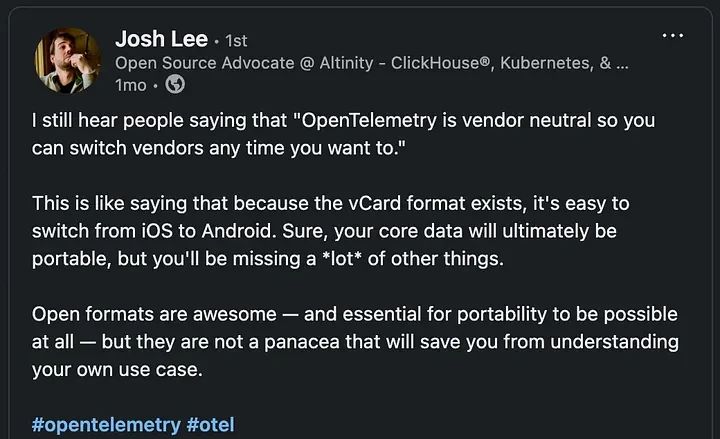
The genesis of this discussion often traces back to conversations within the community, amplified by platforms like LinkedIn. A notable post by Josh Lee succinctly captured a common sentiment: "I still hear people saying that ‘OpenTelemetry is vendor neutral so you can switch vendors any time you want to.’ … This is like saying that because the vCard format exists, it’s easy to switch from iOS to Android." This analogy highlights a critical distinction: while a standard format facilitates data exchange, it doesn’t eliminate the complexities inherent in migrating entire systems and workflows.
This observation has spurred further investigation into the practical implications of OpenTelemetry’s vendor neutrality, prompting a comprehensive analysis of its core components and the broader impact on the observability landscape.

The Imperative for Openness in Observability
The fundamental rationale behind adopting OpenTelemetry lies in the inherent need for openness in observability and monitoring. As organizations increasingly rely on a diverse array of systems, open protocols that act as translation layers become indispensable. This openness is particularly crucial in distributed environments where data originates from numerous sources and needs to be aggregated and analyzed centrally.
Historically, monitoring solutions primarily revolved around logs and metrics, with established, relatively open standards like Prometheus for metrics and syslog or the ELK stack’s JSON format for logs. These approaches facilitated straightforward data ingestion by any compatible tool. However, the advent of microservices fundamentally altered this paradigm, necessitating a more sophisticated approach to understanding system behavior.
The Rise of Distributed Tracing and the Need for Unification

The microservices architecture, characterized by its distributed nature, created a significant challenge for traditional monitoring. A single user request could traverse dozens or even hundreds of independent services, making it difficult to pinpoint performance bottlenecks or diagnose errors by piecing together disparate logs and metrics. Distributed tracing emerged as the solution, providing a unified view of a request’s journey across the entire system.
This shift demanded a significant expansion of instrumentation boundaries. Each service needed to not only emit its own telemetry but also carry and propagate contextual information from upstream services. This created a complex interdependency between different technology stacks within an organization. For instance, Java developers now had to consider the instrumentation practices of their Python counterparts, and vice versa.
The initial response to this complexity often involved proprietary agents and protocols developed by observability vendors. Each vendor invested heavily in creating SDKs for a multitude of languages and frameworks, leading to duplicated effort and a degree of vendor lock-in for customers who embedded these proprietary agents throughout their software. This situation mirrored the classic xkcd cartoon about standards, where the proliferation of competing standards leads to the creation of yet another standard to address the problem.
However, OpenTelemetry offered a different path. Instead of competing, vendors collaborated on a common standard. This collaboration enabled format compaction and shifted the competitive landscape to what vendors could do with the data, rather than how they collected it. The underlying agreement on fundamental truths about observability—that it should be open, collaborative, and focused on empowering users—fueled its widespread adoption.

Defining OpenTelemetry Vendor Neutrality
At its core, vendor neutrality in OpenTelemetry means that if an organization chooses to switch observability vendors, the existing instrumentation in their applications does not need to be updated. This is a monumental advantage, as re-instrumenting code across an entire organization is a time-consuming and costly endeavor. With OpenTelemetry, the switch primarily involves reconfiguring the destination for telemetry data, making it significantly easier to evaluate and adopt new solutions. This flexibility also allows for concurrent data transmission to multiple vendors during evaluation periods, facilitating "vendor bake-offs" to identify the best fit.
The components that underpin this vendor neutrality are:
- OpenTelemetry APIs and SDKs: The OpenTelemetry specification defines a standard for telemetry data and its instrumentation. The APIs provide the interface for instrumenting applications, while the SDKs implement these APIs, dictating how telemetry is generated and correlated. The separation of API and SDK is crucial, allowing users to plug in any compatible SDK, whether it’s the official OpenTelemetry SDK, a vendor-specific one, or even a custom implementation. This empowers library vendors to offer out-of-the-box instrumentation, enhancing the developer experience without introducing proprietary dependencies.
- OpenTelemetry Protocol (OTLP): OTLP is a vendor- and tool-agnostic protocol for encoding, transmitting, and delivering OpenTelemetry data. It serves as the universal language for telemetry, ensuring that data generated by SDKs can be understood by any observability backend that supports OTLP. This has led to a proliferation of interoperable tools, all leveraging the shared protocol, format, and semantic conventions.
- OpenTelemetry Collector: The OpenTelemetry Collector is a highly versatile, vendor-neutral binary designed to ingest, transform, and export telemetry data to one or more observability solutions. It acts as an agnostic agent, deployed within an environment to manage data flow. Key advantages of the Collector include its ability to receive data from various sources, process and enrich it, and export it to multiple destinations simultaneously.
The Power of Interoperability and Flexible Data Pipelines

The interoperability facilitated by OpenTelemetry unlocks a wide range of use cases, moving beyond simple vendor switching. The Collector’s capability to multicast telemetry data to multiple backends simultaneously allows for sophisticated data routing strategies.
For instance, an organization might choose to send different telemetry signals (traces, metrics, logs) to distinct destinations, optimizing for specific analytical needs or cost efficiencies. This could involve sending traces to a specialized tracing backend, metrics to a time-series database, and logs to a log management system.
In scenarios where an all-in-one observability platform is preferred, all signals can be directed to a single, compatible backend. During vendor evaluations, telemetry data can be sent to multiple platforms concurrently, enabling side-by-side comparisons and informed decision-making.
Furthermore, for organizations with stringent compliance requirements, telemetry data can be sent to a primary observability vendor while simultaneously being archived in an on-premises datastore for long-term retention. This hybrid approach ensures both immediate analytical insights and historical data preservation.

The flexibility extends to filling gaps in existing solutions. If a preferred vendor lacks support for a critical feature, such as profiling, OpenTelemetry allows organizations to integrate specialized open-source or vendor-specific tools to address those needs without disrupting their existing data flow.
Specific Pipelines for Diverse Teams and Mergers
The OpenTelemetry ecosystem also facilitates tailored observability pipelines for different teams within an organization. Development teams, for example, might utilize local, open-source tools like otel-tui, OTel Front, or OTel Viewer for real-time troubleshooting of their code, independent of the production environment’s backend.
In the event of mergers and acquisitions, where two companies may have disparate observability backends (e.g., Company A using Backend X and Company B using Backend Y), OpenTelemetry provides a unifying layer. Until full integration, the merged entity can leverage OpenTelemetry to send data to both backends, ensuring continuity and facilitating a phased migration. This "have your cake and eat it too" scenario, while potentially incurring additional storage costs, offers unparalleled flexibility during complex organizational transitions.

The Nuances of the Vendor Switch
While OpenTelemetry excels at data ingestion and transport, it’s crucial to acknowledge that true vendor neutrality extends beyond just getting data into a system. Several aspects of an observability solution can introduce friction during a vendor switch:
- Look and Feel and Workflow: Users become accustomed to specific user interfaces and workflows. Migrating to a new vendor necessitates learning a new interface and adapting to its unique features and nuances, which can impact productivity.
- Storage and Historical Data: The economics of observability often tie costs to ingested and retained data. Most vendors do not offer seamless export of historical telemetry data. This means that switching vendors without a parallel long-term storage solution (enabled by OTLP) can result in the loss of valuable historical insights.
- Queries and Dashboards: Each observability vendor typically has its own querying language (e.g., PromQL, DQL, SPL) and dashboarding tools. Migrating existing dashboards and queries requires manual translation and rebuilding, which is a significant time investment. While some AI-driven tools are emerging to automate this process, it remains a notable consideration.
- Alerts and SLOs: Custom alerts and Service Level Objectives (SLOs), often configured within an observability platform, must be recreated when switching vendors. This assumes the new vendor offers comparable alerting and SLO capabilities.
- Infrastructure as Code (IaC): Many observability vendors provide Terraform providers or similar IaC tools to automate configuration. Switching vendors necessitates adapting to new providers and potentially reconfiguring infrastructure as code, as not all providers offer equivalent functionality. However, the increasing adoption of AI tools is beginning to streamline these migration tasks.
A Future Vision for Vendor Neutrality
The future of vendor neutrality in observability hinges on the continued evolution of open standards and the development of interoperable backend components. While OpenTelemetry focuses on the data generation, collection, and export layers, the industry is moving towards more open backend solutions for storage, querying, and visualization.

A compelling vision for the future involves observability platforms making their data stores accessible via universally available APIs. This would allow for a single source of truth for observability data, accessible by multiple analysis tools simultaneously. Such an approach would enable organizations to integrate specialized analysis tools, train in-house AI models, and generate customized reports, all from a unified data repository.
The OpenTelemetry community has demonstrated remarkable progress in fostering this open ecosystem. Projects like Jaeger have evolved to natively support OTLP, and Prometheus is co-evolving with OpenTelemetry, ensuring that the benefits of shared standards permeate across the observability landscape.
Conclusion: Embracing Choice and Composability
The OpenTelemetry ecosystem has emerged as a robust and increasingly dominant force in observability, driven by its commitment to open standards and collaboration. Its vendor neutrality, particularly in data ingestion and transport, provides organizations with unprecedented choice and agility. While the promise of complete vendor neutrality is nuanced, extending beyond data collection to encompass UI, querying, and historical data management, OpenTelemetry lays a strong foundation.

The true power of OpenTelemetry lies not just in the ability to switch vendors, but in the composability it enables. By providing portable data and interoperable tools, it empowers organizations to build the observability solutions they need today, adapting to evolving requirements and integrating best-of-breed components. Ultimately, the success of any observability strategy, regardless of vendor, is measured by its ability to answer meaningful questions, provide actionable insights, and ensure the reliability of applications and systems.
