
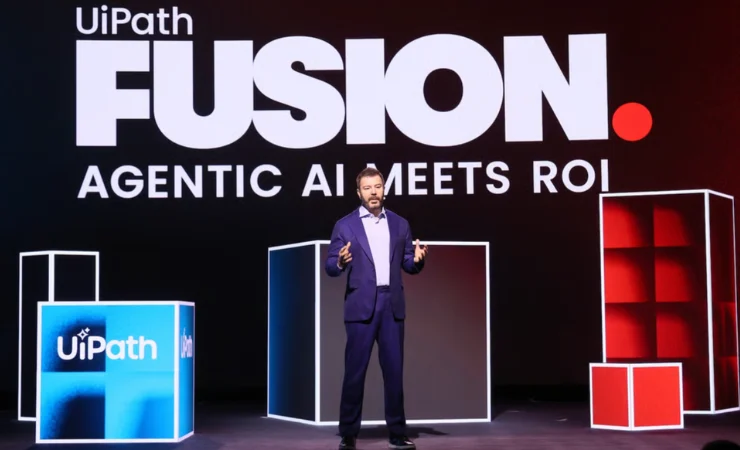

Following the release of its first-quarter fiscal results, UiPath has provided a comprehensive look into its strategic roadmap, specifically focusing on the integration of autonomous coding agents into its enterprise orchestration platform. Daniel Dines, the founder and CEO of UiPath, recently detailed how the company intends to navigate the shift from traditional robotic process automation (RPA) to a landscape dominated by generative artificial intelligence. The strategy centers on a fundamental paradox: while AI is probabilistic and often unpredictable, the enterprise environment demands deterministic reliability. By positioning itself as the "orchestration layer" for AI-generated code, UiPath aims to capitalize on the anticipated surge in software production driven by agents like Anthropic’s Claude Code and OpenAI’s Codex.
The Strategic Pivot to Coding Agents and Orchestration
The integration of coding agents, announced formally last month, represents a significant evolution in UiPath’s product suite. These agents are designed to reside within the company’s existing orchestration layer, allowing enterprises to generate and execute custom scripts—primarily in Python—without the manual overhead traditionally associated with software development. Dines argues that the primary impact of AI will not be the consumption or replacement of existing software, but rather a massive acceleration in the creation of new, specialized automation.
In the enterprise context, "deterministic" refers to a system where a specific input always yields the same output, following a strict set of rules or logic. In contrast, generative AI is "probabilistic," meaning its outputs are based on statistical likelihoods and can vary even when given the same prompt. Dines posits that while AI can suggest and build automations, the execution of those automations must remain deterministic to ensure business continuity and accuracy. This distinction forms the basis of UiPath’s value proposition: providing the stable substrate upon which volatile AI-generated logic can safely operate.
A Chronology of Enterprise Automation and UiPath’s Growth
To understand the current trajectory of UiPath, it is necessary to examine the broader timeline of enterprise workflow evolution. The industry has moved through distinct phases, each defined by its core focus:
- First Generation (The Document Era): Represented by platforms like IBM Lombardi, these systems were primarily document-centric, focusing on the digitization of paper-based workflows.
- Second Generation (The UX and Database Era): Systems such as ServiceNow shifted the focus toward user experience and database management, allowing for better tracking of internal tickets and assets.
- Third Generation (The Code-Centric Era): This current phase, led by technologies like Temporal, focuses on durable execution where the workflow is defined and managed as code.
UiPath’s rise began during the second generation, where it dominated the RPA market by mimicking human interactions with user interfaces. However, as the limitations of UI-based automation became apparent—such as fragility when software interfaces change—the company began a transition toward "API-first" and "code-first" automation. The recent announcement of "UiPath for Coding Agents" is the latest milestone in this journey, signaling a shift toward a future where "software is a subspecies of automation."
The Technical Infrastructure: Temporal and Durable Execution
A critical component of UiPath’s ability to manage AI-generated code is its underlying infrastructure. The company’s orchestrator, known as Maestro, is built upon Temporal, an open-source durable-execution engine. Originally developed at Uber as the Cadence project to handle massive-scale request fulfillment, Temporal ensures that a workflow’s progress is preserved regardless of infrastructure failures.
Dines explained that UiPath hosts its own version of Temporal, building a translation layer on top of it. This layer utilizes Business Process Model and Notation (BPMN), a standardized flowchart language, to interpret complex business processes. These processes are then compiled into "Temporal primitives"—the basic building blocks of the engine.
The technical innovation lies in "event-sourcing." Unlike traditional engines that save a "snapshot" of the entire system state (which is resource-intensive), Temporal maintains a log of every input and output. If a process crashes, the engine "replays" the log. It resumes from the beginning, re-reading the recorded results of completed steps rather than re-executing them. This replay mechanism requires absolute determinism; if the logic produces a different result during the replay than it did during the initial run, the system fails. This technical requirement reinforces Dines’s argument that for AI to be useful in the enterprise, it must produce deterministic code.
Market Data and the Productivity Hypothesis
The push toward coding agents is driven by the need to solve the "implementation bottleneck." Historically, the cost of hiring developers to write custom automation scripts often outweighed the benefits of the automation itself. UiPath’s internal hypothesis is that coding agents will provide a "10x increase in productivity" for automation developers.
Relevant industry data supports the potential for this shift:
- Developer Shortage: According to IDC, the global shortage of full-time developers is expected to reach 4 million by 2025.
- AI Adoption: A recent Gartner report indicates that 70% of enterprises will identify AI-augmented software engineering as a top priority by 2027.
- RPA Market Growth: The RPA market is projected to reach over $13 billion by 2030, but growth is increasingly tied to "intelligent automation" rather than simple task-bot deployment.
UiPath intends to prove over the next two quarters that these productivity gains are repeatable and scalable across its customer base. Success is defined as reducing implementation times from weeks or months down to a single day.
The Quality Paradox and the Role of Automated Testing
One of the more candid admissions from the UiPath leadership is the acknowledgement that AI-generated software is often of "lesser quality" than code written by experienced human developers. This creates a secondary market for UiPath’s Test Cloud. As the volume of code increases, the necessity for rigorous, automated testing becomes paramount.
In a live production environment, a faulty automation handling sensitive data—such as insurance claims or medical records—can lead to catastrophic legal and financial consequences. However, in a testing environment, failure is viewed as "valuable information." UiPath is positioning its testing suite as an essential safeguard, arguing that autonomous agents are perfectly suited for testing because the stakes of an error are inverted: an error in testing leads to improvement, while an error in production leads to disaster.
Governance, Compliance, and the Model-Agnostic Approach
Governance remains a primary concern for regulated industries such as healthcare and finance. When an AI agent is "loose" within a system, reasoning and iterating in real-time, it poses significant risks to data privacy and security. Dines noted that UiPath’s platform allows for granular governance, such as restricting which websites an agent can visit or which email providers it can use.
However, a gap remains in the "pre-platform" stage—the period during which the agent is actively reasoning and building. Currently, the responsibility for overseeing this stage falls largely on the customer. To mitigate some of these concerns, UiPath has adopted a "bring-your-own-model" (BYOM) strategy. By remaining model-agnostic, UiPath allows customers to use models they already trust or have specialized licensing agreements with, whether they are frontier models from OpenAI and Anthropic or internally fine-tuned versions.
Broader Implications for the Enterprise Software Industry
The strategy outlined by UiPath reflects a broader trend in the tech industry: the commoditization of code. As the cost of writing software drops toward zero, the value shifts from the act of creation to the act of management, auditing, and maintenance.
By focusing on the "durability layer," UiPath is attempting to build a moat that is difficult for competitors to replicate. While many vendors can offer AI-powered code generation, providing a platform that can durably execute that code, audit its actions, and ensure its reliability through server crashes and network interruptions is a much higher technical bar.
The transition is not without risk. UiPath faces stiff competition from "big tech" players like Microsoft, with its Power Automate suite, and Salesforce, which is heavily investing in its "Agentforce" platform. These competitors have the advantage of being "baked into" the operating systems and CRM platforms that enterprises already use. UiPath’s success will likely depend on whether its specialized focus on deterministic orchestration and durable execution provides enough of a performance edge to justify its role as a standalone platform in an increasingly integrated ecosystem.
In conclusion, UiPath’s current trajectory is a bet on the persistence of software over the volatility of pure AI. By embracing coding agents as tools for mass-producing deterministic software, the company is positioning itself as the essential infrastructure for an era where the volume of code is expected to grow exponentially, even as the human effort required to produce it diminishes.
